Clinical Trials
The path from understanding a disease to treating it with medicines is long, difficult and expensive. Clinical trials are a critical part of this complex biopharmaceutical research and development process, ensuring that prescription medicines are safe and effective for the patients who use them. These carefully designed studies help researchers assess the benefits and risks of potential medical treatments or interventions, producing data that the U.S. Food and Drug Administration (FDA) closely reviews when deciding whether to grant approval.
The Biopharmaceutical Research & Development Process
From drug discovery through FDA approval, developing a new medicine takes at least 10 years on average and costs an average of $2.6 billion.* Less than 12% of the candidate medicines that make it into Phase 1 clinical trials will be approved by the FDA.
Biopharmaceutical Research
The Biopharmaceutical Research & Development Process
How Clinical Trials Work
When researchers have completed the rigorous screening and preclinical testing process for a potential new medicine, the company files an Investigational New Drug (IND) application with the FDA. This application allows the investigational medicine to be tested in human volunteers in clinical trials. A clinical trial is a carefully designed study which tests the benefits and risks of a specific medical treatment or intervention, such as a new drug or a behavior change (e.g., diet).
Many drug candidates undergo a multi-phase clinical trials process. Usually, the number of human volunteers in the trial increases as the treatment moves through these phases, which is why innovative medicines cannot be developed without the help of volunteers who participate in clinical trials.
Scientists at the FDA carefully review all the data from the studies on the drug under investigation and, after weighing the benefits and risks of the potential medicine, decide whether to grant approval.
Improving and Modernizing Clinical Trials
Strengthening U.S. Innovation and Leadership
The United States has long been at the forefront of medical innovation, helping bring groundbreaking medicines to patients around the world. Maintaining that leadership requires a clinical research environment that supports scientific innovation while upholding rigorous standards for patient safety and drug effectiveness.
As competition for biopharmaceutical research grows globally, there is increasing focus on making clinical trials more efficient and reducing unnecessary delays that can slow the development of potential new treatments. Strengthening the clinical trial process can help ensure patients continue to benefit from new medical advances while reinforcing America's legacy in biomedical research.
Clinical Trial Participation
Ensuring that clinical trial participants represent the Americans that will ultimately use the drug is a critical step to improving access to medicine development and the biopharmaceutical industry has taken action to enhance participation in clinical trials. The demographics of a clinical trial should, to the extent possible, reflect the intended treatment population. Despite progress and the steps taken by the FDA and the biopharmaceutical industry, clinical trials do not always reflect these demographics.
Stakeholders must continue to come together to address barriers to participation if we are going to make further progress. One way to do so is by promoting community-based clinical trials and trials which are embedded in routine clinical care, allowing sponsors to expand testing beyond major cities, greatly improving access, especially in rural areas. This approach allows trial activities to take place under the care of local providers with oversight of the investigator, removing barriers to participation.
Clinical Trial Diversity
Clinical Trial Data Transparency
Transparency in clinical trial data improves access to research and results to inform medical decision-making, advance scientific discovery and accelerate the development of new treatments to benefit patients. The biopharmaceutical industry has long-established commitments to facilitate appropriate transparency throughout the lifecycle of a clinical trial including initiation, results reporting and data sharing, and the biopharmaceutical industry is at the forefront of initiatives to improve access to clinical trial data in order to advance medical research.
Data Transparency
Impact of Research in Your Backyard
Biopharmaceutical companies are conducting clinical trials across the country, connecting patients with potential treatments and working toward new medicines and cures. PhRMA has created reports showcasing clinical trials in a number of states, highlighting their importance to patient health as well as the contribution to the local economy. The reports focus on clinical trials targeting six of the nation’s most debilitating diseases: asthma, cancer, diabetes, heart disease, mental illness, and stroke.
Download the full clinical trials report and view the reports by state below.
View the Research in Your Backyard report in
Alabama
AL
Alaska
AK
Arizona
AZ
Arkansas
AR
California
CA
Colorado
CO
Connecticut
CT
Delaware
DE
District of Columbia
DC
Florida
FL
Georgia
GA
Hawaii
HI
Illinois
IL
Indiana
IN
Iowa
IA
Kansas
KS
Kentucky
KY
Louisiana
LA
Maine
ME
Maryland
MD
Massachusetts
MA
Michigan
MI
Minnesota
MN
Mississippi
MS
Missouri
MO
Montana
MT
Nebraska
NE
Nevada
NV
New Hampshire
NH
New Jersey
NJ
New Mexico
NM
New York
NY
North Carolina
NC
North Dakota
ND
Ohio
OH
Oklahoma
OK
Oregon
OR
Pennsylvania
PA
Puerto Rico
PR
Rhode Island
RI
South Carolina
SC
South Dakota
SD
Tennessee
TN
Texas
TX
Utah
UT
Vermont
VT
Virginia
VA
Washington
WA
West Virginia
WV
Wisconsin
WI
Wyoming
WY
Research in Your Backyard
View the Research in Your Backyard report in
https://cdn.aglty.io/phrma/fact-sheets/research-in-your-backyard/Alabama_RIYB4.pdf
https://cdn.aglty.io/phrma/fact-sheets/research-in-your-backyard/RIYB-Colorado_022724_Final.pdf
https://cdn.aglty.io/phrma/fact-sheets/research-in-your-backyard/Connecticut_RIYB3.pdf
https://cdn.aglty.io/phrma/fact-sheets/research-in-your-backyard/Florida_RIYB3.pdf
https://cdn.aglty.io/phrma/fact-sheets/research-in-your-backyard/RIYB_Georgia_2019.pdf
https://cdn.aglty.io/phrma/fact-sheets/research-in-your-backyard/Illinois_RIYB3.pdf
https://cdn.aglty.io/phrma/fact-sheets/research-in-your-backyard/Indiana_RIYB3.pdf
https://cdn.aglty.io/phrma/fact-sheets/research-in-your-backyard/RIYB_Iowa10-2023.pdf
https://cdn.aglty.io/phrma/fact-sheets/research-in-your-backyard/Maine_RIYB3.pdf
https://cdn.aglty.io/phrma/fact-sheets/research-in-your-backyard/Maryland_RIYB3.pdf
https://cdn.aglty.io/phrma/fact-sheets/research-in-your-backyard/Michigan_RIYB3.pdf
https://cdn.aglty.io/phrma/fact-sheets/research-in-your-backyard/Massachusetts_RIYB3.pdf
https://cdn.aglty.io/phrma/fact-sheets/research-in-your-backyard/Minnesota_RIYB3.pdf
https://cdn.aglty.io/phrma/fact-sheets/research-in-your-backyard/RIYB_Nebraska-2023.pdf
https://cdn.aglty.io/phrma/fact-sheets/research-in-your-backyard/RIYB_Nevada_2024_072624.pdf
https://cdn.aglty.io/phrma/fact-sheets/research-in-your-backyard/RIYB_New-Jersey_2017.pdf
https://cdn.aglty.io/phrma/fact-sheets/research-in-your-backyard/NewYork_RIYB3.pdf
https://cdn.aglty.io/phrma/fact-sheets/research-in-your-backyard/RIYB_New Mexico_2024_070824.pdf
https://cdn.aglty.io/phrma/fact-sheets/research-in-your-backyard/Ohio_RIYB3.pdf
https://cdn.aglty.io/phrma/fact-sheets/research-in-your-backyard/RIYB_Oregon_080224_FINAL.pdf
https://cdn.aglty.io/phrma/fact-sheets/research-in-your-backyard/RIYB_Pennsylvania_2017.pdf
https://cdn.aglty.io/phrma/fact-sheets/research-in-your-backyard/2018_South-Carolina_RIYB-.pdf
https://cdn.aglty.io/phrma/fact-sheets/research-in-your-backyard/Texas_RIYB3.pdf
https://cdn.aglty.io/phrma/fact-sheets/research-in-your-backyard/Vermont_RIYB3.pdf
https://cdn.aglty.io/phrma/fact-sheets/research-in-your-backyard/Virginia_RIYB3.pdf
Research in Your Background - Washington
https://cdn.aglty.io/phrma/fact-sheets/research-in-your-backyard/WestVirginia_RIYB3.pdf
Research in your backyard: Wisconsin
Clinical Trials
View the fact sheet on Clinical Trials in
Related Resources
New research: Industry sponsored clinical trials contribute billions to state economies
It’s well understood that without clinical trials there wouldn’t be all the groundbreaking innovative, life-saving drugs that patients rely on, but less understood is their significant economic impact across the United States. New research by TEConomy Partners, in concert with PhRMA, quantifies the impact of clinical trials across all 50 states, Puerto Rico and the District of Columbia.
The biopharmaceutical industry drives innovation and economic growth in the U.S. and globally. It creates jobs for skilled workers and sustains the economy. Robust pro-innovation policies, including strong intellectual property protections, a well-functioning regulatory system, and support for research and development, are essential for this growth.
In 2023 alone, the biopharmaceutical industry sponsored nearly 5,300 clinical trials of medicines in the U.S., involving over 900,000 participants.
Here are some key findings:
- The biopharmaceutical industry spent more than $30 billion directly in clinical trial sites across the U.S. in 2023. These amounts are in addition to the significant resources invested in clinical trial-related activities occurring outside the individual trial sites.
- In total, biopharmaceutical company investments in U.S. clinical trial sites generated more than $62 billion in economic activity in communities throughout the U.S. This includes the ripple effect of expenditures by clinical trial vendors and contractors, such as clinical research organizations, and direct spending by industry and vendor employees.
The 2025 clinical trials study also examines the economic impact of industry-sponsored clinical trials by phase and disease area. Notably, the report captures the economic impact of post-approval research, which may include pursuing new uses or indications for an approved medicine, new formulations or dosage forms, or even new patient populations. These numbers provide additional heft to the importance of follow-on research, particularly given prior research showing that more than half of all approved uses for medicines were based on trials conducted after a medicine’s initial approval.
Zoom in on the states:
- States with the highest economic impact from industry-funded clinical trials in 2023 include:
- Florida: $8.3 billion (2,198 active trials)
- Texas: $7.7 billion (2,508 active trials)
- California: $7.1 billion (2,695 active trials)
- New York: $3.1 billion (1,932 active trials)
- Ohio: $2.3 billion (1,475 active trials)
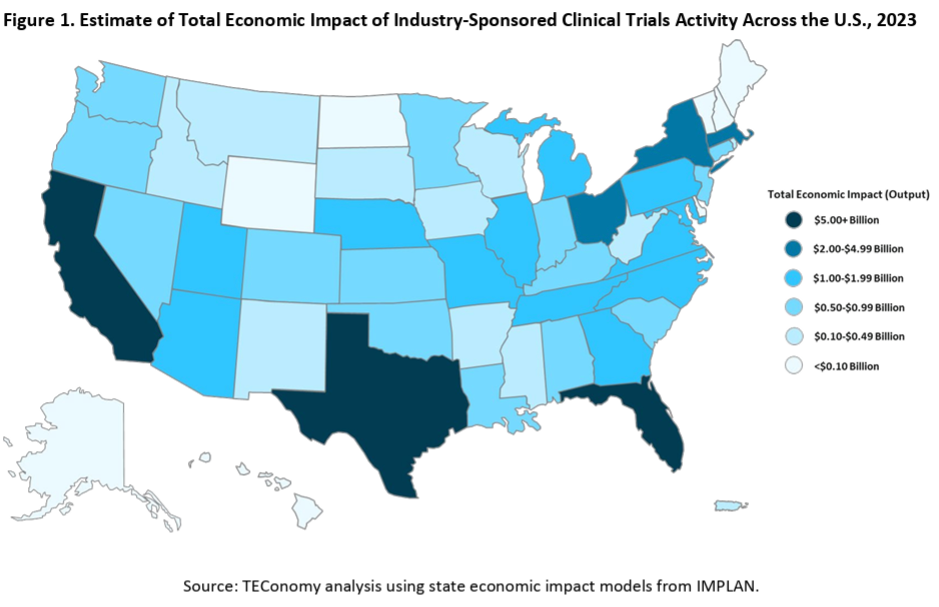
This report focuses solely on investments made at clinical trial sites and does not capture all trial-wide work that occurs across sites, including trial design, coordination and data analysis, nor does it capture the substantial investments companies make every year in basic and preclinical research before projects even get to the clinical testing phase. These activities only add to the positive economic impact of clinical trials.
While clinical trials are essential for advancing numerous life-saving medications that benefit patients, we can’t ignore their substantial contributions to the U.S. economy.
The new report underscores findings from another recent analysis from TEConomy Partners that focused on biopharmaceutical companies and their U.S. supply chains, showing that the industry is a key contributor in supporting jobs and local economies across the country. The analysis found that biopharmaceutical manufacturers:
- Contributed over $1.65 trillion directly and through supplier activities to the U.S. economy in 2022. Exceeds $800 billion in direct output in 2022.
- Supported nearly 5 million American jobs.
To learn more about the importance of clinical trials, click here.
Reid Porter
Image of beakers and flasks on lab bench
New report: Post-approval innovation delivers substantial patient benefits
Post-approval R&D is the continued investigation by biopharmaceutical companies, often through lengthy clinical trials, to find new uses and improvements for U.S. Food and Drug Administration (FDA)-approved medicines to better meet patient needs. Recently, there has been growing discussion among IP critics aimed at undermining the importance of post-approval R&D. Yet, despite critic’s dismissive claims, post-approval R&D is critical to advancing life-saving treatments and improving patients’ lives for the better.
In fact, a new report illustrates how post-approval R&D is essential to not only delivering substantial health benefits to patients but economic benefits to society at large, through:
- Expanding uses of existing medicines and improving existing formulations and dosage forms. Post-approval R&D increases treatment options for patients by demonstrating, for example, that an existing medicine can treat a different disease or stage of disease, a new dosage form is safe and effective or new formulations are safe and effective for children.
- Reducing health and economic burdens by advancing treatment options that are convenient and aligned with patients’ needs. For example, new dosage forms or formulations often provide greater convenience to patients by reducing treatment complexity, easing administration or reducing side-effects. These benefits in turn improve treatment adherence and disease management while reducing costly disease complications, hospitalizations and boosting productivity in the workplace.
- Increasing therapeutic options and driving competition. Payers leverage choice in the marketplace to negotiate rebates and discounts off the prices of medicines which can lower costs by as much as half. Post-approval R&D to develop competitive alternatives to meet a wide range of patient needs contributes to optionality and enhancing brand-to-brand competition and savings to the health care system.
And as we dig deeper, the case for post-approval R&D gets stronger—particularly when you consider the many therapeutic areas that rely on it to advance new treatments.
For instance, a study that reviewed 155 oncology medicines first approved between 2000 and 2021, found that 9 out of 10 FDA-approved cancer medicines underwent further trials after approval, with over half of all uses approved by the FDA post-approval. Additionally, 51% of these new uses were approved in new disease areas than the initial approval, often involving unique types or subtypes of cancer.
Similarly, another study found nearly half of cardiovascular drug new uses are identified more than seven years after initial FDA approval. What’s more, 82% of pediatric trials on existing medicines started about six years after the medicines first received approval, highlighting the importance of post-approval R&D, particularly in the later stages of a product’s lifecycle.
The evidence is clear: Post-approval innovations extend far beyond minor adjustments; they often represent significant breakthroughs for patients while providing widespread health and economic benefits to society. Intellectual property protections, including patents, are what incentivize manufacturers to continue to make investments to improve their medicines and explore how they may help a broader range of patients.
Organizations like I-MAK that downplay post-approval R&D—particularly when it leads to patent protections for new uses—fail to recognize the essential role of these innovations. This ongoing R&D, often involving additional costly and lengthy clinical trials, highlights the necessity of strong patent protections to safeguard scientific progress and ensure real-world benefits reach patients. Strong IP protections create the foundation for ongoing scientific discovery – encouraging companies to invest in new medicines that can reach more patients. Undermining this system poses a real threat, potentially freezing the progress of vital research and leaving groundbreaking treatments and cures undiscovered.
Post-approval innovation isn’t a loophole. It’s a lifeline. And it deserves the same protection and recognition as the first breakthrough.
Andrew Powaleny
Recognizing the importance of vaccination for American health and security
Vaccines play a vital role in protecting our health, especially as preventable disease outbreaks rise.
Here’s five things to know about vaccines:
- Vaccines are powerful tools that protect us from serious infectious diseases that can cause severe illness or in some cases even death. Before vaccines, diseases we can now prevent—like measles, polio and whooping cough—caused significant illness and claimed thousands of lives each year. In the early 20th century, nearly one in five children died before they turned five, many from infectious disease that are now preventable. Today, vaccines remain one of the most effective tools to keep children and families healthy. It’s critical we maintain high vaccination rates because infectious diseases that were previously eliminated or controlled through vaccines can resurge when vaccination rates decline below a certain threshold.
- There are several types of vaccines – and while different by design, every vaccine is developed with the same goal: to protect you and your loved ones from serious diseases. Some prevent individuals from contracting or transmitting a specific disease, while others reduce the severity of illness if you do get sick. But all vaccines work by training your immune system to recognize and respond to harmful pathogens—helping your body build protection before exposure to the illness itself.
- Vaccines are given to prevent rather than treat disease, which is why they undergo a rigorous development and review processes. Vaccines undergo clinical trials prior to approval and scientists, both from the federal government and at the biopharmaceutical company, continue to monitor vaccine safety after FDA review and approval. Most vaccines have been proven safe and effective through decades of clinical studies and real-world use. Their safety is monitored by government agencies, vaccine makers, universities and health systems around the world.
- Vaccines play a key role in our nation’s security and position as a global leader in innovation. Powered by American innovation, vaccines ensure our nation is protected from disease outbreaks while safeguarding national security, economic stability and American leadership.
- It is critical that vaccines are available, accessible and covered by insurance, so that every American can protect themselves and their families. Broad access to and coverage of vaccines ensures people can take informed, proactive steps to stay protected.
The bottom line: Vaccines play an important role in keeping American families healthy – and the need for a strong policy environment that supports access to vaccines and empowers innovation that protects our country’s health and global security.
Mike Ybarra