Price Setting
Government Price Setting has Harmful Consequences for Patients
Government price-setting policies come in a variety of forms, but they all lead to the government inserting itself between patients and providers, threatening access to treatments and chilling research and development of new medicines. They also don’t necessarily make drugs more affordable or accessible for patients – in fact, when other countries have adopted government price setting, patients have access to fewer new medicines and wait longer to get breakthrough treatments and cures. Instead of pursuing proposals that could hurt patients and cripple innovation, U.S. patients deserve policies that protect access to treatments and make medicines more affordable.
Most Favored Nation Price Controls
Most Favored Nation (MFN) is a government price control that ties U.S. prices to prices set by foreign governments. These policies outsource U.S. pricing to countries that use discriminatory metrics like Quality-Adjusted Life Years, to systematically undervalue medicines. Even more, MFN policies do nothing to rein in middlemen like insurers, PBMs and hospitals that distort the system by profiting off treatments.
MFN is a bad deal for American patients and workers.
- MFN takes away billions of dollars that could otherwise be used to expand manufacturing in America and invest in future treatments and cures.
- Imposing MFN in Medicare and Medicaid would dramatically reduce R&D funding and could result in up to 500 fewer treatments over the next decade, according to a University of Chicago analysis.
- Another estimate shows under a broader MFN policy, investments from small and emerging biopharmaceutical companies could fall by up to 90%.
- MFN risks ceding our global leadership to China.
- Imposing price setting weakens U.S. leadership at a time when China has the fasting growing biopharmaceutical pipeline in the world.
- China-headquartered companies conduct a third of all clinical trials worldwide for innovative drugs, up from 5% a decade ago.
- MFN does nothing to rein in PBMs and insurers who decide what medicines patients can access and what they pay.
- The U.S. is the only country in the world that lets insurers, PBMs, hospitals and others take 50% of every dollar spent on medicines while driving up out-of-pocket costs and creating barriers for patients.
To lower prices for Americans, policymakers should focus on solutions that put American patients first, including reining in middlemen and ensuring foreign countries pay their fair share, without harming America’s innovation ecosystem or threatening its leadership in biopharmaceutical research, development and manufacturing.
MFN drug pricing risks reviving a harmful metric the U.S. rejected
U.S. policymakers have long rejected using rigid formulas to decide who gets medicines in this country. But proposals like Most Favored Nation (MFN) pricing wouldn’t just import foreign prices, but also the flawed values of countries they reference. Many foreign governments rely on Quality Adjusted Life Year (QALY) metrics that assign numerical values to patients’ lives based on health status to determine who gets treatment and who doesn’t.
QALYs systematically disadvantage seniors, people with disabilities and those with chronic illnesses by assigning their lives a lower value than a healthy individual, making them less likely to receive the latest medicines and best care. These blunt tools would embed discrimination into government price setting based on one-size-fits-all assumptions that distort treatment value and access. Congress banned the use of QALYs and similar cost-effectiveness metrics to determine issues like coverage or reimbursement in Medicare.
What this looks like in practice:
Under a QALY‑based system like Sweden’s, a patient with multiple sclerosis (MS) is assigned a health value of about 0.37, meaning each year of life counts as just over one‑third of a healthy year in cost-effectiveness calculations. As a result, MS treatments that slow disease progression can be labeled “too expensive” on paper, allowing the government to deny access even if the treatment would meaningfully improve the patient’s quality of life.
Examples of QALY measurements by country:
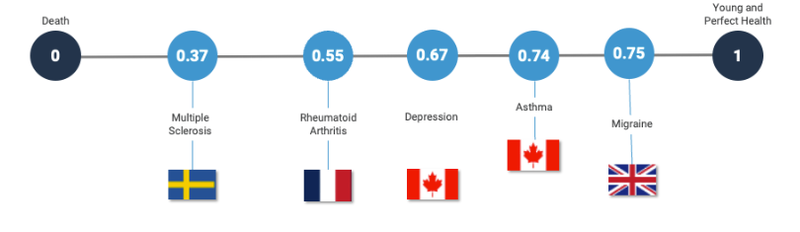
The bottom line:
MFN would tether U.S. drug prices to foreign systems that rely on QALYs, importing not just prices, but value judgments the United States has deliberately rejected. Any American affordability policy must protect—not restrict—access to the medicines patients need.
Brianna Allen
MFN undermines U.S. biopharmaceutical innovation
Government-imposed Most Favored Nation (MFN) drug pricing would weaken the U.S. biopharmaceutical ecosystem—putting future treatments and cures for American patients at risk.
Why it matters: Biopharmaceutical innovation depends on long-term, high-risk investments. But MFN policies that tie U.S. prices to those set by foreign governments fundamentally reshape investment decisions and discourage the development of new medicines.
By the numbers:
- A University of Chicago analysis estimates that MFN pricing in Medicare and Medicaid would slash R&D funds by nearly 50%.
- That significant drop in R&D could result in up to 500 fewer new treatments over 10 years.
- A separate estimate shows under a broad MFN policy, investments from small and emerging biopharmaceutical companies could fall by up to 90%.
Background: Drug development often takes more than a decade and billions of dollars before patients see a new treatment. MFN imposes price ceilings by importing foreign government price controls, which can reduce the predictability of future revenues and results in fewer companies being able to attract the capital required to fund early-stage research. This can narrow the pipeline of new medicines before they ever reach patients.
What works: For more than 40 years, the U.S. has led the world in drug development—giving American patients the earliest access to new medicines while America’s IP system balances innovation and affordability. That balance delivers more choices than anywhere in the world and real savings as competition from brand competitors and generics leads to lower costs:
- Close to 900 new medicines have been launched in the U.S. since 2000.
- Competition leads to manufacturer rebates which can lower the costs of brand medicines by 50% or more.
- Nine in 10 U.S. prescriptions are filled with low-cost generics.
- These generics come with an average copay of about $7––far cheaper than in other countries.
- Due to generic utilization, prescriptions filled in Medicare and Medicaid cost 18% less on average than in other countries.
Smart policy choices matter: Europe embraced government price controls decades ago—and lost its biopharmaceutical leadership. MFN would push the U.S. down the same path, increasing reliance on other countries for new medicines.
We’re already seeing the impact of price setting on U.S. innovation. The Inflation Reduction Act’s “pill penalty” has contributed to a 70% drop in investment in small molecule drug development since the law was introduced. This comes at a time when China is actively seeking to overtake the U.S. in global drug development. Doubling down on MFN-style price setting would accelerate that shift.
Bottom line: MFN may look appealing on paper, but it ignores the real drivers of high costs. Today, about 50 cents of every dollar spent on brand name medicines goes to middlemen and others who play no role in developing treatments. Real solutions should:
- Protect innovation.
- Target true cost drivers: PBMs and insurers who drive up patient costs, hospital markups under 340B and foreign governments not paying their fair share for innovative medicines.
Learn more about why MFN is a bad deal for Americans at PhRMA.org/PriceSetting.
Matthew Norawong
CMS puts patients and innovation at risk with MFN
CMS recently proposed two mandatory Most Favored Nation (MFN) drug pricing policies in Medicare Parts B and D, pitching them as efforts to lower costs for American patients. Instead, the proposals have serious flaws, exceeding CMS’ authority, failing to deliver patient savings and risking long‑term harm to innovation and access.
Here are three key things to know from PhRMA’s submission to CMS on the policies:
1. These aren’t “tests”— they’re price controls
CMS calls its MFN policies payment “tests.” They’re not. The proposals lock in rebates tied to foreign prices, with CMS already knowing the outcome: that extracting a mandatory rebate reduces net government costs. CMS even proposes that it can unilaterally punish manufacturers (through civil money penalties) if they don’t participate. That isn’t experimentation—it’s government-imposed price controls by another name.
Why it matters: CMS’ authority is meant to test new ways of paying for and delivering care—not to rewrite laws, which only Congress can do.
2. Seniors won’t see meaningful savings
CMS justifies the MFN proposals as affordability reforms, but evidence doesn’t support that claim. Most Medicare beneficiaries already have supplemental Part B coverage, and CMS has acknowledged that under Part D, the rebates won’t be visible at the pharmacy counter. For most Medicare beneficiaries, these policies would not directly reduce out of pocket costs. In fact, the government’s own projections suggest patients could actually see higher costs.
Why it matters: The mandatory rebates CMS is proposing would transfer money from biopharma manufacturers to the government—not save patients money.
3. MFN risks long-term harm to innovation
Mandatory MFN pricing would significantly weaken America’s pipeline of future treatments by sharply reducing investment across the biopharmaceutical ecosystem. Estimates show broad MFN policies could cut the number of medicines developed by small firms by up to 90%, and extending MFN pricing across Medicare and Medicaid could result in 500 fewer treatments over the next decade.
Why it matters: At a time when America’s biopharmaceutical leadership is being challenged and China is rapidly accelerating in medical innovation, weakening the U.S. innovation ecosystem would be a strategic mistake.
The takeaway: MFN drug pricing policy is the wrong approach for American patients that will have harmful, long-term consequences for access and innovation.
To deliver lower costs for U.S. patients, policymakers must address the reason drug prices are higher here: PBMs and insurers driving up costs, 340B hospitals marking up medicines and foreign governments not paying their fair share for innovative treatments.
Read our full comments here.
Brianna Allen
Medicare “Negotiation”
Signed into law in 2022, the Inflation Reduction Act put in place policies that mandate government-set prices for medicines covered by Medicare. These polices are expected to have a negative impact on access to medicines covered by Medicare Part B and Part D, in addition to discouraging continued drug development. The law introduced a ‘pill penalty’ in which the price setting process starts seven years after small molecule medicines (e.g., tablets, capsules and pills) are initially approved by the U.S. Food and Drug Administration (FDA) compared to 11 years after initial FDA approval for large molecule medicines (e.g., biologics that are injected or infused). This system ignores the nature of the research and development (R&D) process, discouraging continued R&D after a medicine is FDA approved and deeming some types of medicines as not worth the real-life impact they can have on patients. This process also ignores how therapeutic value increases over time as medicines are approved for new uses, such as in new patient populations, new diseases or new formulations.
Medicare "Negotiation"
pharmacist talking with patient about medication
New list of selected drugs highlights growing consequences of government price setting
CMS just dropped the next 15 drugs that will face government set prices in 2028 under the Inflation Reduction Act.
The list includes additional treatments for cancer, autoimmune diseases and other serious conditions—highlighting how expanding government price setting will continue to hinder patient access and future medical breakthroughs.
Here are the key takeaways:
The pill penalty’s impact intensifies. The IRA penalizes small molecule medicines by subjecting them to price setting years earlier than biologics—a “pill penalty” that is already discouraging development. Under the IRA, small molecule investment has dropped nearly 70%, and monthly, post approval cancer trials for small molecules are down more than 45%, signaling a sharp pullback in research tied directly to this policy.
CMS’s IPAY 2028 price setting list includes six small molecule medicines, including treatments for cancer and HIV, that would not have been selected if not for the pill penalty—clear evidence of its impact. Left in place, the policy will further constrain investment in the very therapies that could deliver the next generation of breakthrough cures.
Part B drugs face price setting for the first time, deepening access concerns. Medicare Part B drugs, or medicines administered in a hospital or clinical setting, are eligible for negotiation for the first time in 2028, widening the scope of the price setting program and its implications for patients. The list includes six drugs paid under both Medicare Part D and Medicare Part B. Expanding the price setting program into Part B could cause significant operational and access challenges given how these drugs are reimbursed, since doctors will be getting smaller reimbursements based on the new, lower maximum fair prices. One analysis by Avalere Health found that 92% of providers would be somewhat or very likely to stop stocking Part B drugs that are subject to negotiation.
Autoimmune and cancer treatments again take the brunt. The list will significantly affect patients with autoimmune diseases and cancers, echoing trends seen over the past two years. These high need, high complexity conditions increasingly rely on therapies that are now being pulled into government price setting. Patients with chronic and life threatening illnesses may face narrower formularies, more utilization management hurdles, and growing uncertainty about access to current and future treatments.
A growing emphasis on specialty drugs—and continued cost sharing risks. The list of selected drugs for 2028 shows a continued shift toward specialty medicines, which carry higher clinical value and often higher acquisition cost. As more specialty drugs are subject to price setting, many Part D beneficiaries who rely on these therapies may see little to no reduction in out-of-pocket costs due to benefit design and reaching the annual out-of-pocket maximum. Meanwhile, the IRA’s changes are putting upward pressure on Part D premiums and reducing plan choice. Insurance companies are also adopting tighter coverage restrictions, raising real concerns about how the IRA will reshape care for patients who rely on complex therapies.
The bottom line: The IRA continues to show why government price setting in any form is bad policy for the United States. Policymakers should focus on stronger oversight of insurers and PBMs, reject further expansion of price controls, eliminate the pill penalty and restore policies that support innovation—because patients’ access to future cures depends on it.
Learn more at PhRMA.org/IRA.
Brianna Allen
Price Setting is the Wrong Approach for Americans: Lessons Learned from the IRA
Rather than doubling down on the IRA’s failed price‑setting framework through Most Favored Nation, Congress should heed the clear evidence that price controls harm patients and undermine American leadership.
Government Price Setting
Resource
Price setting policies put cancer gains in jeopardy
New data marks a major milestone in the nation’s fight against cancer: the five‑year relative survival rate for all cancers has reached 70% for people diagnosed between 2015–2021, according to the American Cancer Society.
Since the mid-1990s, especially dramatic survival gains for historically fatal cancers include:
- Myeloma: 32% → 62%
- Liver cancer: 7% → 22%
- Lung cancer: 15% → 28%
Why it matters: This progress didn’t happen by accident. It reflects decades of investment in new therapies, early detection and sustained clinical research, much of it reliant on a strong innovation ecosystem. A vibrant research and development pipeline is what ultimately delivers new medicines that can extend survival, improve quality of life and give patients more time—more moments at home, more milestones reached and more years with the people they love.
The catch: Early evidence shows the Inflation Reduction Act’s (IRA) drug price‑setting provisions are weakening America’s innovation ecosystem—particularly for small‑molecule medicines, which underpin many of the cancer advances driving survival rates higher.
Under the IRA’s “pill penalty,” the government can impose price controls on pills and other small‑molecule treatments years earlier than for biologics. This shortened timeline slashes the window for earning returns used to fund future R&D, and as a result, discourages development of small molecule medicines.
The consequences are significant:
- Early-stage investment in small molecule medicines has fallen 70% since the IRA was introduced, according to an analysis by Vital Transformation. This steep decline means fewer pills will progress through the pipeline.
- After the IRA’s passage, monthly small molecule post-approval trial starts for cancer dropped by 45.3% on average, according to Zheng et al. These are the trials that generate new uses, reach patients with earlier‑stage disease and improve outcomes—precisely the work that turns scientific discovery into better survival for patients.
This trend sends a clear warning: price‑setting policies threaten the scientific progress that drove a 34% decline in cancer mortality since 1991 and saved 4.8 million lives, according to the American Cancer Society.
The bottom line: America is achieving unprecedented progress against cancer—but sustaining that momentum depends on policies that protect the innovation driving it. As survival rates reach record highs, now is the moment to strengthen biopharmaceutical research, not weaken it.
Policymakers should reject further expansion of government price controls, including Most Favored Nation drug pricing, and instead fix harmful IRA provisions like the pill penalty that are already discouraging investment and slowing post‑approval research. Addressing these flaws and rejecting additional price controls is essential to ensure the next generation of cancer treatments and cures reach the patients who need them.
Learn more at PhRMA.org/Cancer.
Brianna Allen
Myth vs. Fact: How government price setting impacts innovation
As the debate over how to lower drug prices continues, the Inflation Reduction Act (IRA) drug price-setting provisions should serve as a cautionary tale. Three years into implementation and the evidence is clear: government price-setting is chilling medical innovation, halting clinical trials and undermining patient access to innovative treatments. It’s time to set the record straight and dig into the harmful realities of government price setting.
Myth #1: Allowing the government to set the price of medicines will lower drug costs without affecting research and development.
Fact: The IRA’s price-setting mechanisms are already discouraging investment in new treatments.
Since the IRA was introduced, investments in early stage small-molecule medicines have dropped nearly 70%, according to an analysis by Vital Transformation. That’s because the IRA allows the government to prematurely set the price for certain medicines long before their therapeutic value can be fully realized.
Myth #2: Price setting won't impact ongoing innovation for medicines already on the market.
Fact: Price-setting policies discourage post-approval R&D.
Post-approval R&D often leads to new uses for existing drugs, including delivery enhancements that can help patients better manage their condition or treat different patient populations. In fact, since August 2022 when the IRA became law, the monthly average number of post-approval clinical trials for cancer have fallen 40% with a marked 45.3% reduction in trials of small molecules. Policies, like the IRA, that discourage post-approval R&D could severely limit progress in the fight against cancer and other diseases.
Myth #3: Price setting only affects older drugs.
Fact: Some drugs could face price setting immediately after approval due to the government’s flawed interpretation of what counts as a new medicine.
CMS took an overly broad approach, inconsistent with statute, by treating all products with the same active moiety or ingredient as a single drug – even if the FDA approved the products under different applications. This means that a new and improved formulation of a drug, even one for a completely different patient population or disease, could have its price set immediately at launch. This misguided approach harms patients by discouraging innovators from exploring, researching and developing new uses of approved medicines or different ways to administer them.
The bottom line: The IRA’s price-setting policies are actively reshaping drug development decisions in ways that harm patients. Policymakers must fix the IRA’s flaws and reject any expansion of government price controls. Reforms must protect access and preserve the incentives that have made the U.S. the world leader in medical innovation.
Learn more at PhRMA.org/PriceSetting.
Brianna Allen
The IRA’s price setting doesn’t guarantee lower costs or better access
As policymakers continue debating how to lower drug costs for Americans, one thing is becoming increasingly clear: government price setting is the wrong approach. Three years into the Inflation Reduction Act (IRA), seniors are facing higher costs, fewer choices and more barriers to care.
Why? Because insurers and PBMs control how much patients pay out of pocket, which medicines they can get and what hoops they have to jump through. And in response to the IRA, these middlemen are adjusting their policies, shifting patients from copays to coinsurance, pushing drugs to higher tiers on formularies and increasing coverage denials. But instead of reining in abusive practices from insurers and PBMs, the IRA has made it harder for seniors to access their medicines.
Here’s how the IRA is reshaping affordability and access:
- Higher costs despite price setting. As plans adjust to the IRA changes, patients are facing higher costs and fewer options––despite the IRA’s price-setting provisions. Premiums for non-low-income beneficiaries in standalone Part D plans are set to jump 32% next year. The number of available standalone Part D plans has also decreased by more than half since 2023, limiting choices for seniors and people with certain disabilities.
- Access to medicines is getting worse. More than 70% of patients with newly diagnosed chronic conditions face immediate coverage denials as PBMs and insurers increasingly block prescribed treatments and impose unnecessary barriers. At the same time, 86% of independent pharmacies are either considering not stocking or will not stock at least one price-set drug due to cashflow concerns.
- Future treatments are at risk. Instead of lowering out-of-pocket costs, price setting siphons billions of dollars away that could otherwise be used to research and develop new, innovative medicines. That means fewer treatments to fight against our nation’s toughest health care challenges like cancer, mental health and other chronic conditions. All while China is seeking to overtake the U.S. as the global leader in drug development––much like how they surpassed Europe just a few years ago.
There’s a better way: If policymakers are serious about lowering drug costs for seniors, then the evidence paints a clear picture that price setting is not the solution. Instead, they should address flaws in our health care system that allow 50 cents of every dollar spent on medicines to go to entities that play no role in their development.
Learn more about solutions at PhRMA.org/PriceSetting.
Matthew Norawong
Prescription Drug Boards
Prescription drug boards give bureaucrats the power to arbitrarily set medicine prices in a given state. As a result, decisions about medicines would be a part of a political process that changes with elections and the whims of politicians.
Under this policy, the state would evaluate whether certain medicines and treatments are “worth” paying for, meaning the state’s bureaucracy could come between patients and the treatments their doctors prescribe. This spells disaster for patients as they could face barriers to obtaining lifesaving medications.
Instead of pushing for government price-setting policies like prescription drug boards that assign bureaucrats the power to arbitrarily set medication prices, state leaders can choose to fix a broken health care insurance system without risking patient access, innovation and jobs.
Patients need help affording their medicines at the pharmacy counter, which is why we have consistently supported numerous policies that will directly address this need. Unfortunately, there’s no evidence the prescription board will solve these problems.
Prescription Drug Boards
viles of medicines
Government Price-Setting Policies Do Not Address Systemic Health Equity Issues
From state Prescription Drug Affordability Board (PDAB) action to the implementation of the Inflation Reduction Act (IRA), state and federal price-setting policies do little to solve barriers to care for historically underserved communities that are disproportionately impacted by chronic conditions.Instead, they put access to medicines at risk while letting insurers and pharmacy benefit managers (PBMs) off the hook by allowing them to pocket tens of billions in drug manufacturer rebates and discounts that should be going to patients at the pharmacy counter.
Government Price-Setting Policies Do Not Address Systemic Health Equity Issues image
Cost and Value
Fact Sheet
4 Truths About State Government Price Setting
Prescription drug affordability boards (PDABs) wedge government-appointed bureaucrats between doctors and their patients while shortsightedly focusing on only one component of health care — all too curiously avoiding any review of or actions on abusive health insurance practices. This is not good news for patients.
4 Truths About State Government Price Setting image
Access to Medicines
Fact Sheet
Government price setting threatens families’ access to the medicine they need
Threaten's Access
Ensuring A Better Future For Her Child: Emily H
Caring for a child with a serious illness isn’t easy. "It took us a long time to get answers for him—9 years. And it took going across the country to a specialty clinic." Now Emily is raising her voice to ensure that her son and kids across the country have access to the medicines and new innovation they need.
photo of Emily
Patients Like Olga Worry Congress Might Compromise Access to Medicines by Meddling with Medicare
Olga is a senior who feels blessed to have gotten the Covid-19 vaccine. But she is worried now that Congress might meddle with her Medicare and make changes that threaten her access to medicines.
photo of Olga
Patients Like Sue Worry Congress is Compromising Access to Medicines by Meddling with Medicare
Sue is a patient with Type 1 diabetes who depends on Medicare to get her medicines. It’s not always easy. Now some in Congress want to make it harder for patients like Sue to access her medicines. There’s a better way to fix health care for patients.
photo of Sue
Related Resources
Part D premiums are going up, while choices are going down
The Centers for Medicare and Medicaid Services (CMS) recently released their Medicare Advantage and Part D landscape files. These files serve as a comprehensive dataset that lets seniors compare plan options ahead of open enrollment but also show how the Inflation Reduction Act (IRA) continues to disrupt the Part D market.
A closer look at the data reveals a disturbing trend: For millions of beneficiaries, premiums are going up, and choices are going down.
- Premiums for non-low-income subsidy beneficiaries in standalone Part D plans are expected to rise by 32% among plans offered in both 2025 and 2026, according to a new analysis from Avalere, which weights for enrollment.
- Additionally, the number of standalone Part D plans is set to decrease by 22% in 2026, dropping from 464 plans in 2025 to just 360. This follows a 35% reduction in PDP offerings from 2024 to 2025, reflecting a significant contraction in the market.
While CMS’s announcement claims that average premiums and plan choices are expected to “remain stable,” this assessment doesn’t show the full picture of what most beneficiaries will experience.
Dive deeper: The premiums listed in the landscape files represent the standard monthly cost for each Medicare Part D plan. However, the actual premium paid by beneficiaries often differs due to factors such as low-income subsidies and income-related surcharges. For example, most beneficiaries who receive the low-income subsidy enroll in plans where they don’t pay any premiums.
Additionally, not all plans have the same number of enrollees –– some plans with very low premiums may have smaller enrollment, while plans with higher premiums might cover a much larger share of beneficiaries. By adjusting for this, we get a much clearer sense of what beneficiaries truly experience.
While CMS doesn’t provide a methodology for their claim, it may assume that beneficiaries in higher premium plans switch to more affordable options. But both historical data and a newly released poll find that relatively few beneficiaries switch plans annually.
So what’s driving this concerning trend in the Part D market? The IRA introduced significant changes to the Medicare prescription drug benefit as well as the inclusion of price-set medicines starting in 2026. As plans adapt to these changes, it’s creating a lot of disruption for patients, many of whom are facing higher premiums, higher out-of-pocket costs and restricted options.
Taken together, these trends show that the IRA’s intended benefits are not reaching most beneficiaries. Instead, PBMs and insurers continue to drive higher costs and limit choices, underscoring the urgent need for policymakers to address these persistent abuses.
A better way: Government price setting is putting Medicare under significant strain. Imposing further price controls would make it even worse. If the U.S. is serious about lowering drug costs, policymakers need to address PBMs and insurers driving up costs and creating more barriers for patients. CMS must also use its authority to ensure patient access is not disrupted.
Learn more at PhRMA.org/PriceSetting.
Matthew Norawong
Medicare patients face higher drug costs, despite IRA promises
Lawmakers promised that the Inflation Reduction Act (IRA) would make prescription drugs more affordable. But a new analysis from the USC Schaeffer Center shows that most Medicare beneficiaries could see higher out-of-pocket costs under the law.
What’s happening: Insurers and PBMs are shifting costs to patients through higher deductibles and coinsurance in response to the IRA. And while the IRA caps annual out-of-pocket costs at $2,000, most beneficiaries won’t hit that cap and may see their costs increase through higher deductibles and coinsurance.
The study: Researchers examined trends in Part D benefit design between 2020 and 2024 and compared them to changes between 2024 and 2025 to see how insurers are adjusting their policies amid increased financial responsibility under the new law.
Key findings:
- Average deductibles in Medicare Advantage drug plans jumped from $62 in 2024 to $224 in 2025.
- The share of enrollees in Medicare Advantage prescription drug plans with coinsurance for the tier typically used for preferred brand drugs rose from 0.7% in 2023 before the IRA took effect, to 27.5% in 2025 under the new rules. Similarly, the share of enrollees in standalone Part D plans with coinsurance for this tier rose from 40.7% to 84.1% over that same period.
- Plans are replacing co-pays with coinsurance, tying beneficiary costs to the undiscounted list price of the drug, rather than the price after rebates and discounts made to plans and PBMs are applied.
Why it matters: Patients are paying more given the increase in plans with coinsurance—and many will never even benefit from the IRA’s $2,000 out-of-pocket cap.
The bottom line: The IRA doesn’t guarantee savings at the pharmacy. Insurers and PBMs are finding new ways to pass costs to patients. Policymakers must hold insurers and PBMs accountable if they’re serious about lowering drug costs.
Learn more at PhRMA.org/IRA.
Elizabeth Carpenter
Foreign first pricing schemes don’t address why Americans pay more
Government price setting policies like Most Favored Nation-pricing are bad for American patients, especially over the long term. These “foreign first pricing” schemes don’t guarantee lower costs. Instead, they take away dollars that could be invested in American manufacturing and undermine biopharma R&D. Most importantly, foreign reference pricing fails to address the real reasons Americans pay more for medicines than other countries: pharmacy benefit managers (PBMs), 340B hospital markups and foreign governments not paying their fair share for innovative medicines.
To lower drug costs in America, policymakers must:
- Hold PBMs accountable
In 2023, PBMs took $140 billion in rebates and fees, driving up American medicine costs. These PBM profits may exceed the total cost of drugs overseas. Just three PBMs control nearly 80% of the U.S. market and they dictate what medicines patients can get, what they pay and what hoops they must jump through. - Fix the 340B Hospital Markup Program
The little-known federal 340B program is a $66 billion program that lets big, tax-exempt hospitals and clinics buy medicines for as little as a penny and then markup the price by thousands of dollars. Hospitals abuse the program to boost their profits at the expense of patients, taxpayers and employers. This program is leading to higher medicine prices in the U.S. - Make foreign countries pay their fair share
European countries routinely adopt pricing and reimbursement policies that undervalue medicines, making U.S. patients foot a disproportionate share of the bill for incentivizing the R&D investment for medicines used around the world. These tactics include biased pricing formulas, mandatory discounts, clawbacks and referencing prices paid by lower income countries. Policymakers can use trade negotiations to force countries to pay a minimum percentage of their GDP per capita on new innovative medicines to ensure everyone is paying their fair share.
Taken together, these policies can support American patients in accessing and affording the medicines they need, while ensuring the United States remains the global leader in biopharmaceutical innovation.
Brianna Allen