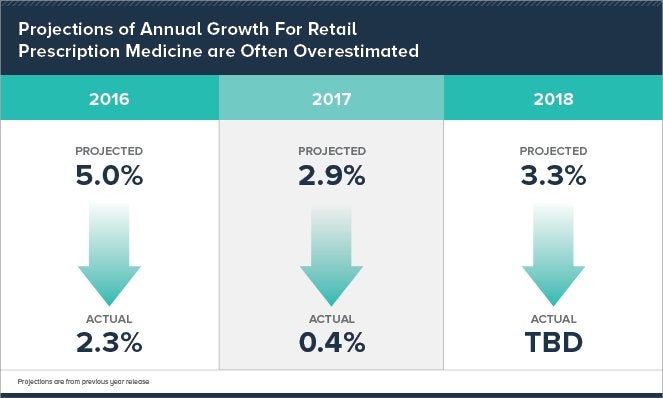
This week, National Health Expenditure (NHE) data released by the Centers for Medicare & Medicaid Services (CMS) projected retail medicine spending grew 3.3 percent in 2018. Each year, CMS projects spending on health care services, but in a February 2018 review of the accuracy of their projections, CMS found that the NHE estimates of medicine spending have often been significantly overestimated when compared to actual spending.
As part of new data released on February 20, 2019, CMS actuaries estimate that between 2018 and 2027, less than 10 percent of total growth in health care spending will be attributable to retail prescription medicine. As in past years, hospital care will contribute one-third of the growth. What may be more surprising to many is that the added costs of administering health insurance – such as billing and prior authorization reviews – is expected to contribute almost as much growth in spending over the 10-year-period as retail prescription drugs.
Not only are medicine costs a small, stable part of health care spending, but they also help reduce spending on other health care services, especially for patients with chronic conditions. According to the Health Affairs article covering the release of the NHE data, “the use of prescription drugs will increase over the next several years as a result of increasingly robust efforts by employers and insurers to reduce any barriers regarding the use of maintenance drugs needed to keep their enrollees with chronic conditions healthy.”
A large body of research has found better use of medicine and improved adherence to treatment results in significant savings on other health care costs. For example, for patients with diabetes:
- Improved diabetes medication adherence could result in over 1 million avoided emergency department visits and hospitalizations annually, for potential annual savings of $8.3 billion.
- Among Medicare Part D enrollees with diabetes, consistently high adherers had lower medical costs than non-adherent beneficiaries, saving up to $840 per patient per month.
Learn more at www.letstalkaboutcost.org.
Holly Campbell
Holly Campbell is former deputy vice president of public affairs at PhRMA focusing on the cost and value of medicines.
Holly Campbell
New data from insurers show detriments of copay accumulator adjustment programs
Nearly 40% of commercially insured patients face half their annual out-of-pocket expenses from just one health care encounter
Insurers shift medicine costs to patients with severe chronic illnesses
The new Administration should reconsider a recent HHS rule that could negatively impact patient access and affordability
New insulin report highlights how incentives benefit middlemen, harm patients
New data show retail medicine prices fell in 2019
Fact Check: How hospitals continue to drive health care spending
Accumulator adjustment programs lead to surprise out-of-pocket costs and nonadherence, analysis finds
Study finds biopharmaceutical innovation is responsible for 35% of the increase in life expectancy from 1990 to 2015
Survey found insurance premiums grew faster than inflation in 2020
Study finds middlemen excluded nearly 850 medicines from formularies this year
Manufacturer cost-sharing assistance programs can save chronically ill patients hundreds to thousands of dollars annually
Commercial health plans have increased patients’ out-of-pocket costs by over 50% in some therapeutic areas
Commercial health plans transition from copays to coinsurance and deductibles has increased patient out-of-pocket costs
Four things to know about the IQVIA “Medicine Spending and Affordability in the U.S.” report
New data show commercially insured patients face increasingly high cost sharing for brand medicines
Payers subject 80% of new RA and MS patients to utilization management restrictions
Study finds the pharmaceutical industry retains a smaller share of revenue than research-intensive industries
ICYMI: Pharmacy benefit managers increasingly exclude medicines from formularies, restricting patient access
New rule makes it harder for patients to lower their out-of-pocket costs
ICYMI: Patients saved nearly $800,000 out of pocket through innovative contracting arrangements
Retail medicine spending to remain stable share of overall health care spending through next decade
PhRMA comments on HHS proposed rule on manufacturer cost-sharing assistance and accumulator adjustment programs
Addressing barriers that inhibit value-based contracts
Fact Check: HCCI analysis overstates medicine spending and prices
Cancer medicines cost twice as much at hospitals, study finds
Nearly 50% of brand medicine spending goes to the supply chain and others
New NHE data: Medicine prices declined, and hospitals were biggest driver of health care spending in 2018
More evidence that medicine prices are growing at slowest rate in decades
The truth about the marketing and promotion of medicines
Survey shows out-of-pocket costs top health care concern for voters
Hospitals make 9 times more than physicians’ offices on provider-administered medicines
Three things to know about the Part D GAO report
Four states adopt first-in-the-nation laws to protect patients from surprise insurer practices
New Let’s Talk About Cost TV ad asks: Why aren’t patients sharing in savings at the pharmacy counter?
Study finds hospitals continue to mark up medicines up to 500% of their cost
Three reasons why the latest Rx Savings Solutions analysis is misleading
How the rebate rule would help reduce patients’ out-of-pocket costs
New study finds hospitals continue to push patients to costlier outpatient settings
4 Things to know about the IQVIA “Medicine Use and Spending” report
Six policy solutions to help patients afford their insulin
PhRMA comments on OIG proposed rule to reform the rebate system
340B continues to drive shift in site of care for physician-administered medicines to more expensive hospital settings
Five key facts about the market for insulins
OIG proposed rule could help strengthen the Part D market
Rebate rule would help ensure seniors with diabetes don’t pay more for their medicine than their insurer
The PBM story you haven’t heard: Hidden fees quadrupled in two years
OptumRX: Sharing rebates with patients is “worth it”
New data show how sharing negotiated discounts could save certain patients hundreds of dollars at the pharmacy counter
New study shows why insurers should share rebates with Medicare Part D beneficiaries on a mandatory basis
New IQVIA data show medicine prices grew just 1.5 percent in 2018
Health Affairs study misses the mark on medicine costs
New government data show medicine price growth continues to decline
10 things you should know about medicine spending and costs
Six key facts about the market for insulins
Americans want to know more than just the list price of a medicine—and we’re answering their call
What they are saying: PhRMA member executives on industry’s new approach to DTC television advertising
Coupons allow patients to remain on medicines in spite of high cost sharing and deductibles
New study finds some hospitals mark up medicine prices at least 700 percent
69 percent of patients abandon medicines when cost sharing is more than $250
New analysis in Health Affairs reinforces one-third of medicine list price rebated back to supply chain
PhRMA submission to HHS on blueprint to lower drug prices and reduce out-of-pocket costs
New data show patients’ out-of-pocket costs are rising faster than their insurers’ costs
Pass-through rebates do not violate non-interference clause but they do increase savings for seniors
Patients with a deductible have seen their out-of-pocket costs for brand medicines increase 50 percent since 2014
ICYMI: Analysis finds higher outpatient drug spending at 340B hospitals
Sharing negotiated discounts at the pharmacy counter could save seniors with diabetes more than $350 annually
Video: PhRMA CEO discusses biopharmaceutical supply chain at POLITICO event
Event tomorrow: Making the biopharmaceutical supply chain work for patients
Spending on medicines grew less than one percent in 2017
Patients pay the price when hospitals mark up cancer medicines
New Let’s Talk About Cost ads highlight how copay accumulator programs could leave patients financially exposed
Video: How does the supply chain shape brand-name medicine prices?
4 Things to know about the IQVIA 2018 and Beyond: Outlook and Turning Points report
ICYMI: Two PBM reports show dramatic slowdown in medicine spending growth
Copay coupons can help ease patients’ out-of-pocket costs
PhRMA launches new consumer-facing Let’s Talk About Cost website
NHE Data: Medicine spending grew just 1.3 percent in 2016
4 things to know about the QuintilesIMS drivers of medicine spending in the U.S. report
Video: PhRMA CEO discusses medicine costs with CNBC's Squawk Box
New analysis: More than half of patients’ out-of-pocket spending for brand medicines is based on full list price
What you need to know about the new NHE health spending projections
Lets Talk About Cost
What you need to know about the new NHE health spending projections
What you need to know about the new NHE health spending projections