not used title
not used title
May is World Trade Month, when we celebrate the many American companies exporting products around the world, and growing opportunities here in the U.S.
Every day, thousands of biopharmaceutical researchers in the United States work to develop innovative treatments and cures that have the potential to transform the way we treat some of the most complex diseases facing patients worldwide. Our companies lead the world in medical research, creating over half of the new molecules produced over the last decade.
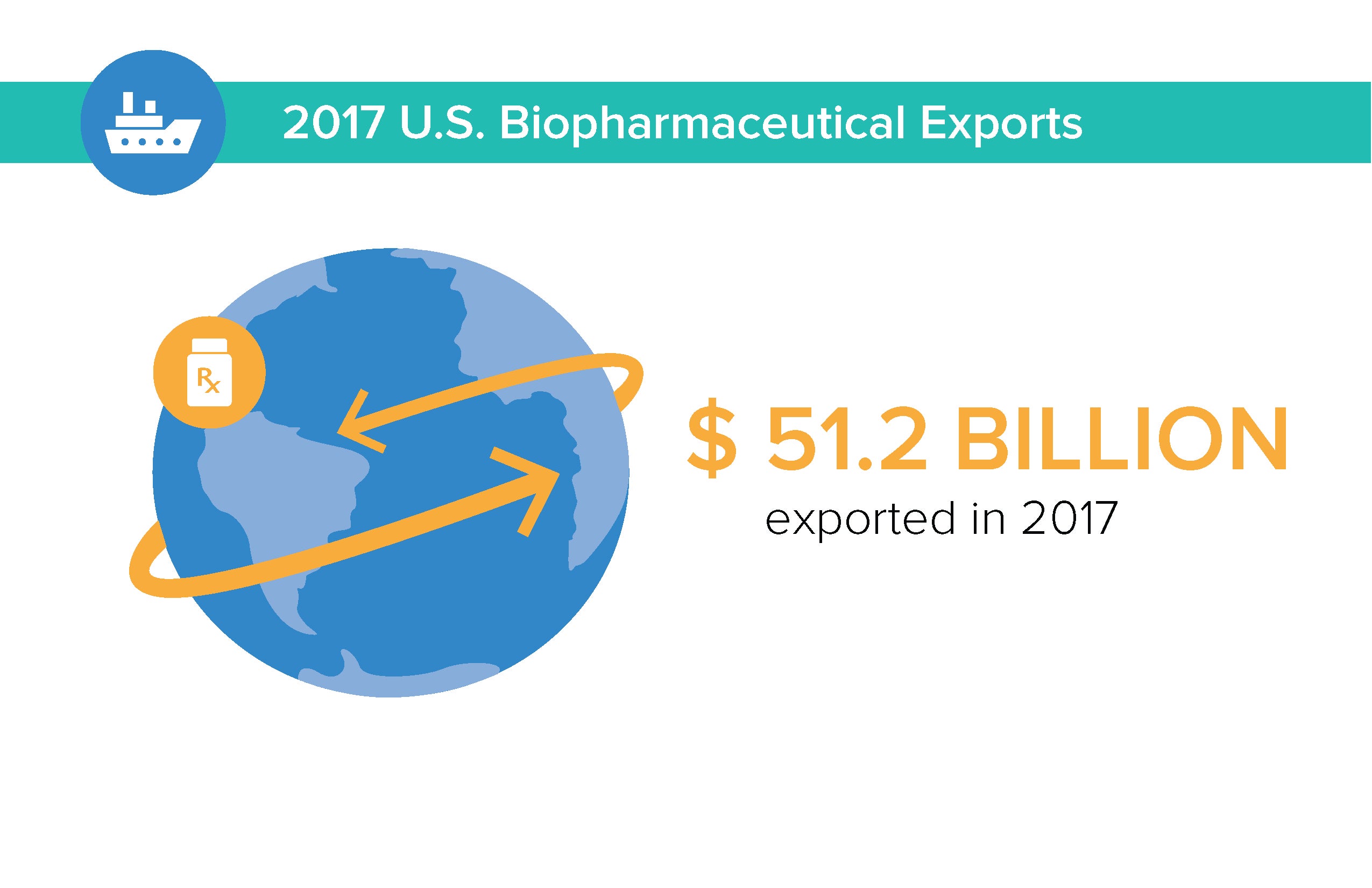 This leadership in global medical innovation has long been recognized, but industry’s impact goes even further. The U.S. biopharmaceutical sector is not only responsible for bringing groundbreaking new medicines to people around the world, but also plays a powerful role in driving and supporting the American economy. In fact, in 2017 alone, U.S. biopharmaceutical exports totaled $51.2 billion – only behind the software industry as a leading exporter among R&D intensive industries.
The vitally important scientific and economic contributions made by America’s biopharmaceutical industry haven’t just happened by chance. American innovation and economic output has long depended on strong regulatory systems, robust intellectual property protections and enforcement, and fair and transparent access to overseas markets.
Trade agreements with other nations extend this mutually beneficial arrangement into new frontiers, helping the industry reach patients and consumers with the latest medicines, while also protecting the American economy, the nearly 4.8 million jobs that the sector creates and the innovators who work tirelessly on tomorrow’s treatments and cures. Unfortunately, not all trade agreements are strong or well-enforced, undercutting one of America’s most crucial engines of economic growth.
Take South Korea, for example. Despite the clear commitments it made in the 2012 trade agreement known as KORUS, South Korea has refused to appropriately recognize the value of innovative U.S. pharmaceutical products, and instead implemented price controls that impede access to medicines and take advantage of billions of dollars in U.S. investments. Americans should not subsidize the medicine costs in other wealthy countries. Fortunately, in March the Trump Administration secured a long-needed commitment under KORUS that South Korea will rein in some of its unfair pricing policies.
But the United States government can’t stop at South Korea. To ensure U.S. innovation and economic growth are protected, and U.S. exports increase, it’s critical that the United States government continue to take action through trade negotiations that put America first, and through policies that encourage and support our innovation ecosystem.
The U.S. Trade Representative signaled through its 2018 Special 301 Report that it is concerned about the IP protection and enforcement and market access issues facing biopharmaceutical manufacturers, writing in a fact sheet, “In order to promote affordable healthcare for Americans and the innovation to preserve access to the cutting-edge cures and therapies, USTR has been engaging with trading partners to ensure that U.S. owners of IP have a full and fair opportunity to use and profit from their IP.”
As the administration negotiates a modernized North American Free Trade Agreement (NAFTA), it’s imperative it works to reduce trade barriers and hold our international partners accountable. The health of the American economy and global patient access hang in the balance.
Jay Taylor
Jay Taylor is Executive Vice President of International Advocacy at PhRMA. Prior to Joining PhRMA, Jay was a partner at the international law firm, McDermott, Will & Emery, where he specialized in international trade policy, export controls and Foreign Corrupt Practices Act (FCPA) matters. Previously, Jay served as Associate General Counsel at the Office of the United States Trade Representative (USTR), where he managed and litigated numerous international trade disputes, and drafted and negotiated several free trade agreements. Mr. Taylor received his undergraduate degree from Princeton University, and a law degree from Tulane University.
Jay Taylor
Author Twitter
Recognizing the transformative impact of intellectual property
October 13, 2026
PhRMA Foundation makes unprecedented investment in America’s future scientific workforce
October 5, 2026
ICYMI: Pennsylvania shows what biopharmaceutical innovation can deliver
September 21, 2026
Bayh-Dole: The fuel for America’s innovation engine
September 2, 2026
Setting the record straight: 3 facts about drug patents
July 13, 2026
New PBM principles don't change the fundamental challenge: Access to lower-cost medicines
July 10, 2026
Staffing up: Building the future biopharma workforce to keep America in the lead
June 29, 2026
MFN could disrupt the affordable medicines patients depend on
June 18, 2026
Intellectual Property and Hatch-Waxman: A blueprint for American leadership and patient savings
June 2, 2026
MFN price controls threaten American jobs and the U.S. economy
May 28, 2026
Argentina sets course to enable innovation by rejecting failed patent rules
March 26, 2026
16 years later: How BPCIA continues to expand competition and lower costs
March 23, 2026
Key context is often missing from the debate over the Patent Trial and Appeal Board
March 20, 2026
MFN undermines U.S. biopharmaceutical innovation
February 25, 2026
America Cures: Championing U.S. leadership in medical innovation
February 18, 2026
Updated Analysis Underscores the Need for Brazil to Address Patent Backlogs
February 2, 2026
How post-approval innovation keeps delivering for patients
December 9, 2025
Middlemen mark up drug prices and keep discounts meant for you
November 10, 2025
Celebrating STEM Day: Investing in America’s innovators
November 8, 2025
PhRMA calls on USTR to ensure foreign nations pay their fair share
November 4, 2025
Three things to know about Bayh-Dole: Innovation that pays off for taxpayers
October 9, 2025
Manufacturing U.S. jobs and breakthroughs
October 6, 2025
Historic biopharmaceutical investments: A prescription for America’s future
September 29, 2025
Delivering breakthroughs and lower costs for patients
September 8, 2025
PBMs, not patents, are blocking access to lower-cost medicines
July 23, 2025
New report: How intellectual property drives U.S. innovation and biopharma's impact
June 30, 2025
New report: Post-approval innovation delivers substantial patient benefits
June 2, 2025
Tariffs on medicines would harm American competitiveness, industry and patients
May 7, 2025
The biopharmaceutical industry is one of the highest contributors to America’s economy among all manufacturers
April 30, 2025
USTR 2025 Special 301 Report corrects course
April 29, 2025
From sound to science: How IP powers innovation in music and hearing
April 25, 2025
How the IRA is impacting the generic drug market
April 8, 2025
3 myths critics get wrong about intellectual property
March 28, 2025
ICYMI: PhRMA submits comments to White House on artificial intelligence
March 17, 2025
Strong Trade Policies Protect American Workers and Biopharmaceutical Innovation
March 12, 2025
New research: Industry sponsored clinical trials contribute billions to state economies
March 6, 2025
Biopharmaceutical innovation for a healthier America: PhRMA releases new innovation report
February 21, 2025
New policy agenda charts solutions for a healthier America
February 20, 2025
A successful PhRMA Forum highlights our commitment to a healthier America
February 20, 2025
Reimagining patient access through meaningful policy reform
November 5, 2024
USTR remembers—three years later—that it announced a trade initiative with Europe
November 1, 2024
PhRMA submission calls for USTR to correct course on trade policy, enforcement
October 18, 2024
40 Years of Hatch-Waxman: How Can We Secure its Legacy?
September 24, 2024
40 Years of Hatch-Waxman: How does the Hatch-Waxman Act help patients?
September 23, 2024
40 Years of Hatch-Waxman: What is the Hatch-Waxman Act?
September 19, 2024
New research: American biopharmaceutical investment in R&D drives transformational innovation
September 16, 2024
Biden Administration report debunks myths around patent “evergreening” and “thickets”
September 3, 2024
What to know about the latest effort to break patents using a legally dubious avenue
August 21, 2024
WTAS: Proposed Unsubstantiated USPTO Rule Change is a Threat to American Innovation
August 12, 2024
Industry-backed STEM programs have supported 111 million students and nearly 183,000 teachers
August 1, 2024
No Region Left Behind: USTR expands its unambitious trade agenda to the western hemisphere
July 29, 2024
WTAS: Voters voice concerns about PBM abuses, call on policymakers to act
July 19, 2024
PhRMA launches education campaign on the benefits of America's IP system
June 26, 2024
ICYMI: Innovation transforms lives but misguided federal policies threaten patient outcomes
May 30, 2024
Experts discuss the value of IP at Senate Judiciary Committee hearing
May 28, 2024
World Trade Week 2024: Time for a more ambitious U.S. trade agenda
May 23, 2024
Biopharmaceutical industry supports jobs and drives economic growth across the United States
May 16, 2024
World IP Day 2024: Supporting an innovative and sustainable future
April 26, 2024
Why won’t USTR strengthen medical supply chains with America’s allies?
April 25, 2024
ICYMI: Voter priorities this election season
April 18, 2024
International meetings hold big implications for Americans and our innovation ecosystem
February 26, 2024
Four years later, Maryland board still hasn’t delivered for patients
February 12, 2024
Setting the Record Straight: Comparing U.S. drug prices to those in foreign countries hurts patients
February 7, 2024
Proposed march-in framework would chill American innovation
February 7, 2024
PhRMA 2024 Special 301 submission: USTR needs to support American innovation, global access to medicines
January 31, 2024
Powering the next generation of therapies: A conversation with Astellas US President Mark Reisenauer
January 30, 2024
New poll: Americans agree that expanding the TRIPS waiver will harm U.S. global manufacturing and innovation leadership
January 29, 2024
What they are saying: Experts agree that proposed march-in framework would jeopardize innovation
January 25, 2024
When it comes to the future of innovation, the ball is in policymakers’ court
January 22, 2024
The Biopharmaceutical Industry Still Needs Clarity from the FDA on Orange Book Listings
December 19, 2023
The White House continues to attack American innovation
December 15, 2023
Biden Administration’s Indo Pacific trade dialogue is a missed opportunity to bolster American exports, innovation
November 29, 2023
Misuse of march-in could stifle innovation
November 27, 2023
WHO Pandemic Agreement offers opportunities and risks for American innovators
November 20, 2023
The IRA’s pill penalty threatens the future of oncology R&D
November 16, 2023
ICYMI: WSJ — Same Drug, Two Prices: Why the Higher Price Prevails
November 15, 2023
Word of the Month: The Bayh-Dole Act
November 8, 2023
ICYMI: Scott LaGanga and Matt Salo deliver a State of the Industry Report
October 25, 2023
PhRMA submission: USTR needs more ambition to combat unfair trade barriers
October 24, 2023
Word of the Month: AMR
September 27, 2023
New analysis shows PBMs use fees as a profit center
September 18, 2023
It’s PBMs, not patents, blocking competition
September 14, 2023
What you need to know: COVID-19 public health emergency is over, but ideological attacks on IP remain
September 12, 2023
The Biden Administration has failed to advance an inclusive, worker-centered trade agenda
September 5, 2023
New PhRMA ad exposes yet another way PBMs get between patients and their medicines
September 5, 2023
WTAS on reasonable pricing and public-private partnerships
August 8, 2023
Key considerations as Congress works towards PAHPA reauthorization
July 12, 2023
More than 60 researchers ask Congress to support innovation
June 26, 2023
Reject efforts to undermine America’s R&D ecosystem
June 15, 2023
Four ways that America’s biopharmaceutical industry supports jobs and fuels economic growth
May 18, 2023
Setting the record straight on the Bayh-Dole Act and March-in
May 10, 2023
4 key facts on medicine prices and spending
May 9, 2023
Americans want state policymakers to lower out-of-pocket costs
May 1, 2023
Policies need to address the growing threat of antimicrobial resistance
April 28, 2023
World IP Day 2023: Celebrating women leaders in innovation
April 26, 2023
Three facts about health care spending
April 25, 2023
AHIP’s latest misinformation campaign & what it’s trying to hide
April 24, 2023
What they are saying: Experts reinforce that TRIPS waiver expansion is harmful and unnecessary
April 13, 2023
New global analysis shows patient access challenges around the world
April 12, 2023
States can support access to medicine as COVID-19 Public Health Emergency ends
April 5, 2023
Arkansas puts patients first with new share the savings law
April 4, 2023
PhRMA provides comments and testimony to USITC investigation on COVID-19 medicines and the TRIPS Agreement
March 30, 2023
U.S. biopharmaceutical exports support jobs, innovation
March 20, 2023
Will the administration capitalize on the Indo-Pacific Economic Framework to drive medical innovation?
March 13, 2023
Holding pharmacy benefit managers accountable
February 23, 2023
PhRMA submits comments to USPTO highlighting important role of patent system in medicine development
February 23, 2023
Stopping pharmacy benefit managers from “gaming the system”
February 22, 2023
U.S. must address IP and market access barriers abroad to protect American innovation
January 31, 2023
ICYMI: PhRMA kicks off the year at the 2023 J.P. Morgan Health Care Conference
January 19, 2023
Biden administration should prioritize innovation in U.S.-Taiwan Initiative on 21st-Century Trade
January 17, 2023
ICYMI: PhRMA COO Lori Reilly speaks about the health care agenda for the next Congress
December 9, 2022
Expanding TRIPS waiver would jeopardize biopharmaceutical research and development
November 17, 2022
Six ways I-MAK is lying about biopharma patents
November 16, 2022
TRIPS waiver expansion risks public health
November 14, 2022
Expanding the WTO intellectual property waiver will hurt American jobs
November 9, 2022
PhRMA submission to USTR calls for urgent defense of American innovation abroad
November 1, 2022
The law driving technology transfer and fostering innovation
October 24, 2022
Don’t take anti-innovation, activist funded academics at their word
October 18, 2022
New report ignores benefits of patent system to innovation and patients
September 30, 2022
A key fact the White House is reluctant to admit
September 27, 2022
A key fact the White House is reluctant to admit
September 27, 2022
Partnerships are driving global COVID-19 treatment access
September 22, 2022
The dangers of expanding the TRIPS waiver
September 19, 2022
ICYMI: New research builds upon growing body of evidence on value of COVID-19 treatments and vaccines
August 16, 2022
New survey: Voters seriously concerned about fine print in reconciliation bill
August 12, 2022
Myth vs. Fact: The Senate’s latest price setting proposal
August 5, 2022
The Senate’s latest price setting proposal will undermine U.S. economic growth
August 3, 2022
Celebrating Medicare’s 57th anniversary
August 2, 2022
New analysis finds deeper impact of drug pricing bill on biopharmaceutical researchers
August 1, 2022
ICYMI: A patient, physician, biotech investor and industry leaders warn about the dangers of government price setting bill
July 29, 2022
The Senate’s latest price setting proposal will undermine: Our health care system
July 28, 2022
The Senate’s latest price setting proposal will undermine: American medical innovation
July 27, 2022
The Senate’s latest price setting proposal will undermine: Patient access to medicines
July 26, 2022
Patent policy changes proposed by USPTO and FDA would leave patients behind
July 22, 2022
The Patient Perspective: Government price-setting harms patients
July 22, 2022
PhRMA member companies’ R&D investments reach record high of $102.3 billion in 2021
July 18, 2022
ICYMI: PhRMA’s Ubl pens op-ed on IP waiver for COVID-19 technologies
July 15, 2022
Putting patients first at the state level — A conversation with Mark Reisenauer, President of Astellas Pharma US
July 14, 2022
Polling continues to show voters reject so-called Medicare “negotiation” once they learn about consequences for patients
July 12, 2022
By the Numbers: Patients lose when the government sets prices
July 8, 2022
Patients win as West Virginia implements first-in-nation share the savings policy
July 8, 2022
COVID-19 vaccines and treatments helped save millions of lives and billions in health care costs
July 7, 2022
Intellectual Property waiver on COVID-19 innovation is unnecessary and harmful
May 23, 2022
Biden Administration details inadequate protection of American intellectual property and foreign barriers to innovation abroad
April 29, 2022
Three charts show how the Medicare Part D program could be improved to work better for seniors and people with disabilities
April 27, 2022
Analysis: States can help patients save nearly $1,000 annually on their medicines
April 21, 2022
PhRMA encourages Biden administration to pursue ambitious Indo-Pacific Economic Framework
April 13, 2022
Biopharmaceutical industry drives economic growth in all 50 states
March 14, 2022
Veterans Affairs 101: Three charts show how the VA system differs from Medicare
March 11, 2022
Government price setting leaves behind families counting on new medicines
February 23, 2022
PhRMA submits comments urging CMS to withdraw coverage proposal
February 11, 2022
Medicaid 101: Three charts on access and spending
February 3, 2022
Government price setting won’t stop insurers from shifting costs to patients
February 2, 2022
Research and development continues long after a medicine is initially approved
February 1, 2022
Protecting U.S. innovation abroad to support economic and pandemic recovery
February 1, 2022
New comments outline ways to counteract cost-shifting insurance trends
January 28, 2022
Legislation threatens patent protections and future innovation
January 12, 2022
New study finds more than half of brand medicine spending goes to the supply chain and others
January 7, 2022
Making medicines more affordable: Preserving safety-net programs like 340B
December 17, 2021
Post-approval research save lives. Why is Congress trying disincentivize it?
December 17, 2021
A price control by any other name would still put patients at risk and threaten innovation
December 9, 2021
Making medicines more affordable: Making insurance work like insurance
December 8, 2021
Navigating the patient experience in the time of COVID-19
December 6, 2021
Global COVID-19 vaccination matters now and for the future
November 29, 2021
New report highlights importance of IP-intensive manufacturing industries to the U.S. economy
November 1, 2021
PhRMA submission to 2022 National Trade Estimate Report underscores need for pro-innovation U.S. trade policy to combat COVID-19
October 29, 2021
Strengthening the WTOs global trade and health agenda
October 18, 2021
New poll shows Americans reject Medicare negotiation once they learn more about the policy
October 15, 2021
New report shows 3 in 10 Americans that have insurance still face a financial barrier to care
October 7, 2021
PhRMA releases 2021 industry profile
September 20, 2021
Patients and innovators lose if the government pursues ‘march-in’
September 7, 2021
Supporting country readiness to boost global vaccine access
August 12, 2021
Ensuring global vaccine equity requires eliminating trade and regulatory barriers
August 5, 2021
Increasing global access to vaccines by optimizing production
July 29, 2021
PhRMA member companies’ R&D investments reach record high of $91.1 billion in 2020
July 22, 2021
Dose sharing as a part of the COVID-19 global vaccine equity strategy
July 20, 2021
Promoting global vaccine equity while protecting innovation
July 15, 2021
Data shows COVID-19 vaccines are creating a pathway to a strong U.S. recovery
July 2, 2021
New polling shows Americans are sounding the alarm on the TRIPS IP waiver
May 14, 2021
The Biden Administration allows politics to upend a pragmatic pandemic response
May 14, 2021
Four solutions Americans support to make health care more affordable
May 13, 2021
New report demonstrates development of new medicines relies on private sector expertise and investment
May 10, 2021
H.R. 3 threatens access to medicines, future innovation and American jobs
May 4, 2021
American leadership on innovation policy is essential to global health progress
May 4, 2021
Key excerpts: PhRMA submits comments to NIST in effort to safeguard intellectual property protections
April 9, 2021
Intellectual property is the key to vaccine development, manufacturing and technology sharing
March 5, 2021
The latest: What they are saying: Intellectual property protections vital to COVID-19 research, development and manufacturing
February 12, 2021
Beyond output and employment: The impact of America’s biopharmaceutical industry
February 11, 2021
Preserving U.S. innovation worldwide is more important than ever
January 29, 2021
American biopharmaceutical manufacturing: Fueling economic growth now and for years to come
December 21, 2020
New video: See how strong IP protections lead to stronger treatments for patients
November 9, 2020
U.S. trade policy must prioritize American biopharmaceutical innovation and patient access
November 2, 2020
Manufacturing Day 2020: A closer look at the biopharmaceutical industry’s contributions
October 2, 2020
Why the U.S. biopharmaceutical industry is leading the charge against COVID-19
September 30, 2020
New Graphic: Public-Private collaboration fuels the U.S. biopharmaceutical ecosystem
September 16, 2020
The latest: What they are saying: intellectual property protections critical as we work to defeat COVID-19
July 22, 2020
R&D Focus: 5 things to know about the biopharmaceutical research ecosystem
July 13, 2020