As we near the end of Medicaid Awareness Month, we wanted to acknowledge that Medicaid is one of the nation’s most important safety-net programs. This federal-state partnership provides health care coverage to more than 80 million individuals. What many don’t know is that biopharmaceutical manufacturers play a critical role in helping state Medicaid programs provide affordable access to medicines under the Medicaid Drug Rebate program (MDRP).
While the federal government provides general guidelines, each state designs their own Medicaid program and decides whether to provide prescription drug coverage. To help states provide robust access to medicines, manufacturers enter into a national rebate agreement with the Secretary of HHS (on behalf of states). Under the agreement, states agree to provide access to all of a manufacturer’s medicines and in exchange, manufacturers provide significant rebates based on Medicaid drug utilization. The goal of the MDRP was to ensure Medicaid received a price at least as low as the price given to a manufacturer’s “most favored customer,” thus helping keep costs down for state governments and patients. Today the system is still working.
All states offer prescription drug coverage today, and Medicaid spending on medicines remains low. In 2022, retail prescription drugs made up just 5.6% of all Medicaid spending. This is largely due to the $48.5 billion in rebates manufacturers provided — a 39% increase from 2017.
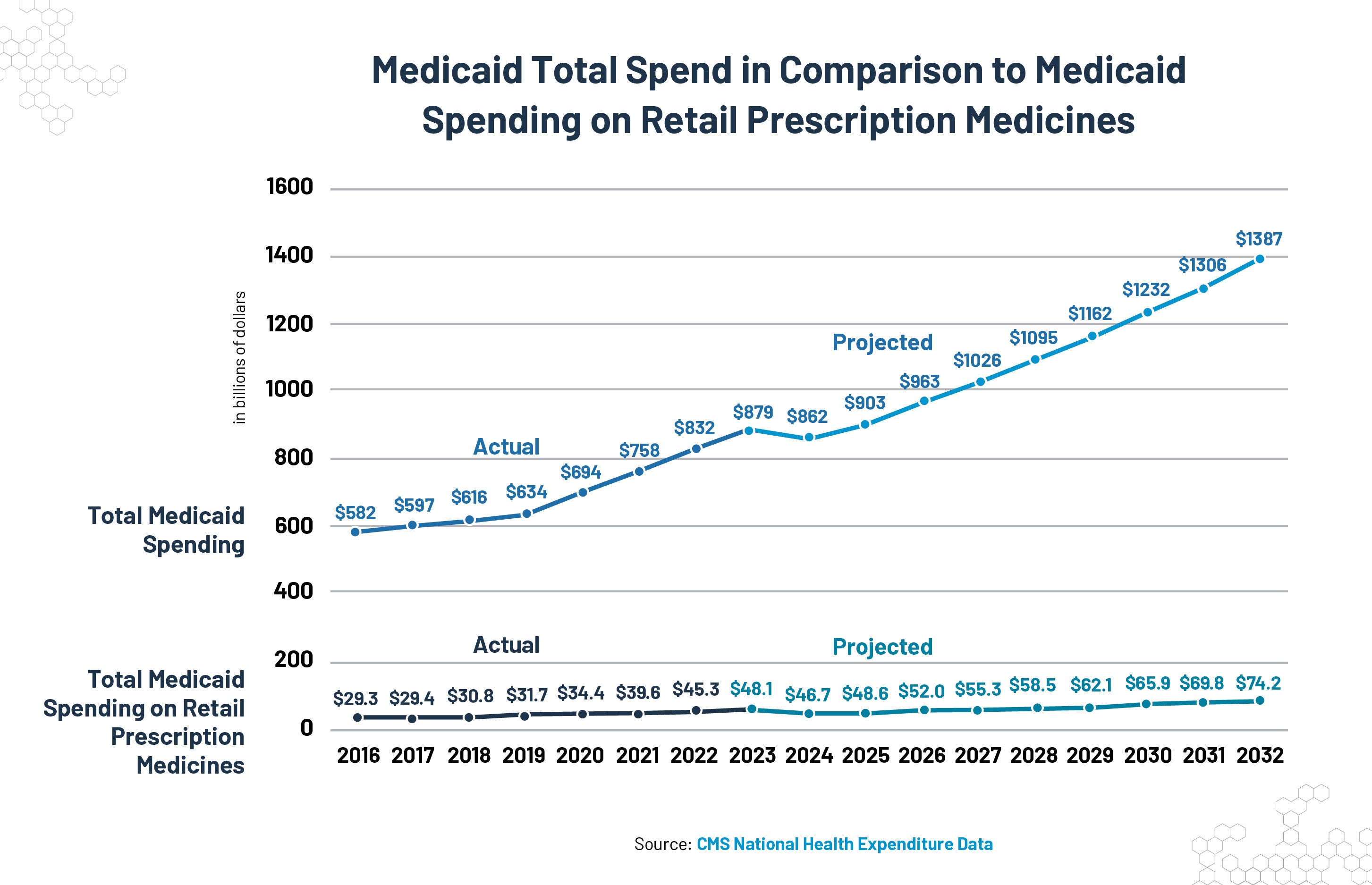
Due in part to the rebates provided by biopharmaceutical companies, Medicaid enrollees access medicines that they might not otherwise be able to, meaning that patients are less likely to avoid getting the care they need. And because Medicaid primarily focuses on individuals with low incomes, there are low or no copays. Without the program, many enrollees could not afford their lifechanging medicines.
The industry is committed to delivering new, innovative medicines and working with policymakers to ensure they are accessible and affordable for patients through programs like Medicaid.
Nicole Longo
Nicole Longo is Deputy Vice President of public affairs at PhRMA focusing on Medicare, 340B, importation and more. She previously worked for a D.C.-based public affairs firm where she assisted a wide range of clients with communications efforts on everything from trade policy to agriculture policy to health care policy. Outside the office, Nicole can be found trying new restaurants (usually Italian), taking an occasional barre class and cheering on the Cincinnati Bengals.
Nicole Longo
Delivering breakthroughs and lower costs for patients
The hidden cost of 340B: A multi-billion-dollar burden on taxpayers and Medicaid
Ensuring access to affordable medicines for patients through Medicaid
CMS, don’t fall behind the rest of the medical community on obesity
The real cost of denying access to medicines in Medicaid
Medicaid by the numbers
Increased use of prior authorization in Medicaid is blocking access for patients
Manufacturers provided $42 billion in Medicaid discounts in 2021 alone
CMS should rethink proposed changes to the Medicaid Drug Rebate Program | PhRMA
New calculator demonstrates how improved adherence to anti-diabetic medicines can benefit people in Medicaid
States can support access to medicine as COVID-19 Public Health Emergency ends
Study finds hepatitis C cure saved Medicaid $15 billion
Busting 3 Myths About Copay Coupons
Medicaid 101: Three charts on access and spending
Insurers shift medicine costs to patients with severe chronic illnesses
Tennessee’s Medicaid demonstration fails patients
Proposed change to Medicaid line extension definition ignores importance of critical improvements in treatments
Recent administration actions undermine patient assistance programs
Manufacturer cost-sharing assistance programs can save chronically ill patients hundreds to thousands of dollars annually
PhRMA submits comments to CMS on Medicaid proposed rule
ICYMI: Patients saved nearly $800,000 out of pocket through innovative contracting arrangements
Addressing barriers that inhibit value-based contracts
New data show how ICER’s value framework could prevent or delay access to treatments for Medicaid patients across the country
New analysis shows 820,000 prescriptions would be in jeopardy if ICER’s value framework is used in Medicaid
ICYMI: Two PBM reports show dramatic slowdown in medicine spending growth
New report shows better diabetes management saves money and improves patient outcomes
Providing affordable access to medicines in Medicaid
Medicaid
Providing affordable access to medicines in Medicaid
Providing affordable access to medicines in Medicaid