not used title
not used title
Biopharmaceutical companies are at the forefront of medical innovation. Every treatment the industry develops, and every therapy brought forward, is the result of many years of research, risk and investment. While some critics continue to question the necessity of intellectual property (IP) and patents in this process, the data tells a compelling story.
According to a study from NDP Analytics, IP is foundational to a productive modern economy and a crucial factor in sustaining American competitiveness. America’s great competitive advantage is innovation, and IP protections, especially patents, are vital investments in high-risk projects leading to new innovations.
The new report compares the economic performance of U.S. industries according to R&D investment and the patented inventions resulting from that investment. The report shows that industries which patent more and invest more in R&D to develop patent-protected technologies have greater contributions to the U.S. economy, through higher wages, exports, output and GDP. Delving into the report’s details reveals the outsized contributions biopharmaceuticals especially make to the U.S. economy.
Here are four key charts from the new data:
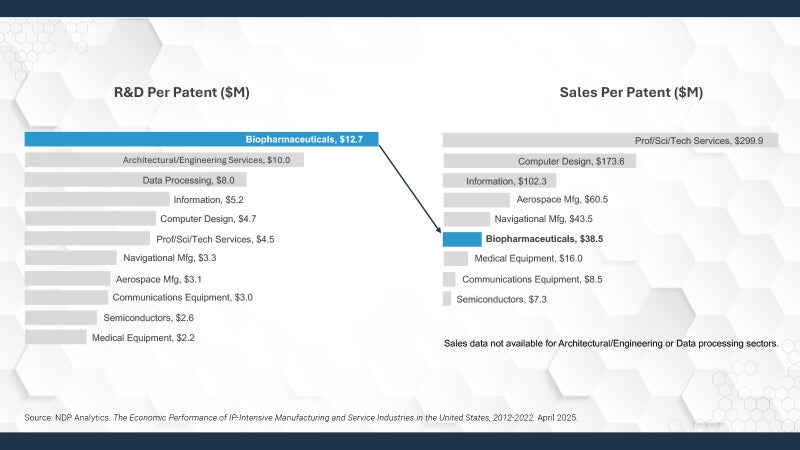
The biopharmaceutical industry invests more in R&D per patent than any other industry, but sales per biopharmaceutical patent are about average.
Biopharmaceutical companies invest more than $12 million for every patent issued by the USPTO—more than any other sector. Yet when it comes to sales generated per patent, the industry is squarely in the middle. This sales context is important because it demonstrates the biopharmaceutical industry’s significant risk in drug development where even vital investments won’t always be successful and be able to generate sales.
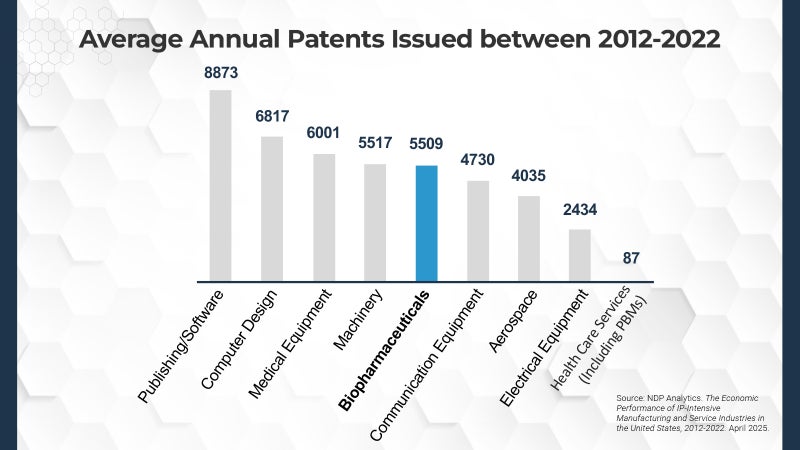
Despite investing the most, biopharmaceutical companies also rank in the middle in patent volume.
Even as biopharmaceutical companies commit massive resources to R&D, the industry ranks in the middle of the pack for annual issued patents as compared to other high-IP industries. This context is often overlooked by critics who focus on volume, not value.
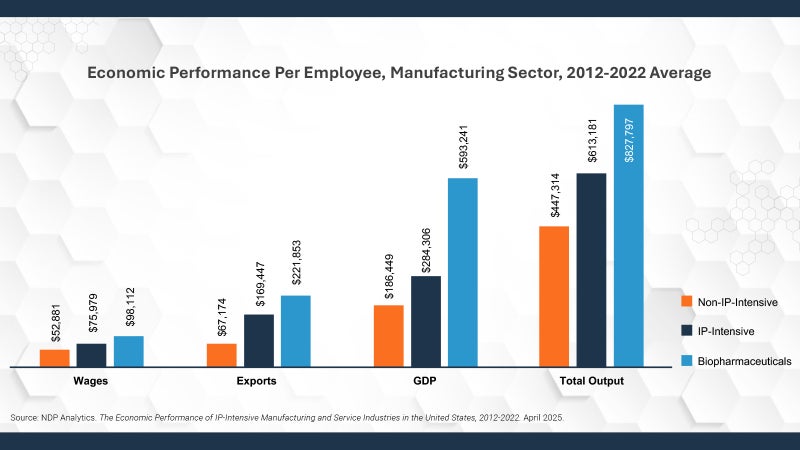
The biopharmaceutical industry plays a critical role in powering the U.S. economy.
The more intensively industry invests in R&D to develop IP-protected inventions, the greater the economic return. Biopharmaceuticals, as the most R&D/IP-intensive industry, outperforms almost every other industry across key economic metrics. Generally, the more IP held, and the higher R&D investment by an industry, the higher the productivity, output and wages will be in that industry.
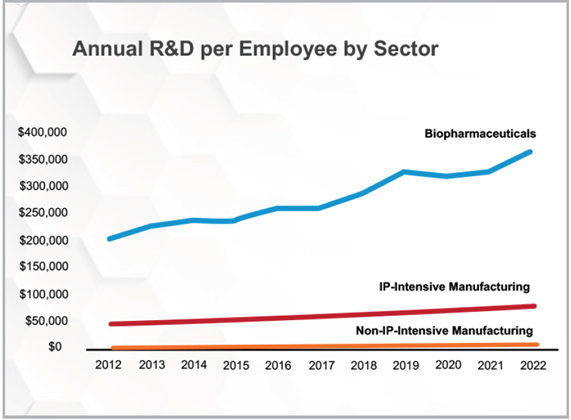
IP-intensive industries, including biopharmaceuticals, outperform because biopharmaceuticals and other IP-intensive manufacturers invest more in R&D and generate more patent-protected inventions than non-IP-intensive manufacturers.
The data is clear, and the facts matter. The biopharmaceutical industry is investing, innovating and driving progress that is benefitting both patients and the American economy.
Despite false narratives pushed by critics, patents are not just a legal tool, they’re the foundation of America’s innovation economy and support every medical breakthrough to date and every cure the biopharmaceutical industry is still chasing.
As the data shows, weakening that system will only risk the next generation of cures for patients and the well-being of the American economy.
Learn more at PhRMA.org/IP.
Andrew Powaleny
Andrew Powaleny is the Deputy Vice President of Public Affairs at PhRMA, where he leads communications on scientific, regulatory and intellectual property issues, highlighting the biopharmaceutical industry’s efforts in developing innovative medicines and vaccines while promoting an environment that encourages necessary risk-taking. For five years starting in 2019, he launched and led PhRMA’s grassroots initiative, Voters for Cures, bringing patients and caregivers together to advocate for access to medicine and biopharmaceutical innovation. He also co-founded and co-chaired PRIDE Umbrella, a resource group for LGBTQ+ individuals. Prior to joining PhRMA in 2015, Andrew worked as a communications consultant in Washington, D.C., and as Deputy Press Secretary for the U.S. House Committee on Energy and Commerce under Chairman Fred Upton. He holds a degree in public policy and government from Eastern Connecticut State University, with a minor in music. Outside of work, Andrew enjoys exercise, musical theater and mentoring college students through The Fund for American Studies alumni association.
Andrew Powaleny
Author Twitter
Author LinkedIn
Bayh-Dole: The fuel for America’s innovation engine
September 2, 2026
Setting the record straight: 3 facts about drug patents
July 13, 2026
New PBM principles don't change the fundamental challenge: Access to lower-cost medicines
July 10, 2026
MFN could disrupt the affordable medicines patients depend on
June 18, 2026
Intellectual Property and Hatch-Waxman: A blueprint for American leadership and patient savings
June 2, 2026
Argentina sets course to enable innovation by rejecting failed patent rules
March 26, 2026
16 years later: How BPCIA continues to expand competition and lower costs
March 23, 2026
Key context is often missing from the debate over the Patent Trial and Appeal Board
March 20, 2026
MFN undermines U.S. biopharmaceutical innovation
February 25, 2026
Updated Analysis Underscores the Need for Brazil to Address Patent Backlogs
February 2, 2026
How post-approval innovation keeps delivering for patients
December 9, 2025
PhRMA calls on USTR to ensure foreign nations pay their fair share
November 4, 2025
Three things to know about Bayh-Dole: Innovation that pays off for taxpayers
October 9, 2025
Delivering breakthroughs and lower costs for patients
September 8, 2025
PBMs, not patents, are blocking access to lower-cost medicines
July 23, 2025
New report: Post-approval innovation delivers substantial patient benefits
June 2, 2025
The biopharmaceutical industry is one of the highest contributors to America’s economy among all manufacturers
April 30, 2025
USTR 2025 Special 301 Report corrects course
April 29, 2025
From sound to science: How IP powers innovation in music and hearing
April 25, 2025
How the IRA is impacting the generic drug market
April 8, 2025
3 myths critics get wrong about intellectual property
March 28, 2025
ICYMI: PhRMA submits comments to White House on artificial intelligence
March 17, 2025
PhRMA submission calls for USTR to correct course on trade policy, enforcement
October 18, 2024
40 Years of Hatch-Waxman: How Can We Secure its Legacy?
September 24, 2024
40 Years of Hatch-Waxman: How does the Hatch-Waxman Act help patients?
September 23, 2024
40 Years of Hatch-Waxman: What is the Hatch-Waxman Act?
September 19, 2024
New research: American biopharmaceutical investment in R&D drives transformational innovation
September 16, 2024
Biden Administration report debunks myths around patent “evergreening” and “thickets”
September 3, 2024
What to know about the latest effort to break patents using a legally dubious avenue
August 21, 2024
WTAS: Proposed Unsubstantiated USPTO Rule Change is a Threat to American Innovation
August 12, 2024
PhRMA launches education campaign on the benefits of America's IP system
June 26, 2024
ICYMI: Innovation transforms lives but misguided federal policies threaten patient outcomes
May 30, 2024
Experts discuss the value of IP at Senate Judiciary Committee hearing
May 28, 2024
World Trade Week 2024: Time for a more ambitious U.S. trade agenda
May 23, 2024
World IP Day 2024: Supporting an innovative and sustainable future
April 26, 2024
International meetings hold big implications for Americans and our innovation ecosystem
February 26, 2024
Proposed march-in framework would chill American innovation
February 7, 2024
PhRMA 2024 Special 301 submission: USTR needs to support American innovation, global access to medicines
January 31, 2024
Powering the next generation of therapies: A conversation with Astellas US President Mark Reisenauer
January 30, 2024
New poll: Americans agree that expanding the TRIPS waiver will harm U.S. global manufacturing and innovation leadership
January 29, 2024
What they are saying: Experts agree that proposed march-in framework would jeopardize innovation
January 25, 2024
The Biopharmaceutical Industry Still Needs Clarity from the FDA on Orange Book Listings
December 19, 2023
The White House continues to attack American innovation
December 15, 2023
Biden Administration’s Indo Pacific trade dialogue is a missed opportunity to bolster American exports, innovation
November 29, 2023
Misuse of march-in could stifle innovation
November 27, 2023
WHO Pandemic Agreement offers opportunities and risks for American innovators
November 20, 2023
Word of the Month: The Bayh-Dole Act
November 8, 2023
PhRMA submission: USTR needs more ambition to combat unfair trade barriers
October 24, 2023
It’s PBMs, not patents, blocking competition
September 14, 2023
What you need to know: COVID-19 public health emergency is over, but ideological attacks on IP remain
September 12, 2023
WTAS on reasonable pricing and public-private partnerships
August 8, 2023
Key considerations as Congress works towards PAHPA reauthorization
July 12, 2023
Reject efforts to undermine America’s R&D ecosystem
June 15, 2023
Four ways that America’s biopharmaceutical industry supports jobs and fuels economic growth
May 18, 2023
Setting the record straight on the Bayh-Dole Act and March-in
May 10, 2023
World IP Day 2023: Celebrating women leaders in innovation
April 26, 2023
What they are saying: Experts reinforce that TRIPS waiver expansion is harmful and unnecessary
April 13, 2023
New global analysis shows patient access challenges around the world
April 12, 2023
PhRMA provides comments and testimony to USITC investigation on COVID-19 medicines and the TRIPS Agreement
March 30, 2023
U.S. biopharmaceutical exports support jobs, innovation
March 20, 2023
Will the administration capitalize on the Indo-Pacific Economic Framework to drive medical innovation?
March 13, 2023
PhRMA submits comments to USPTO highlighting important role of patent system in medicine development
February 23, 2023
U.S. must address IP and market access barriers abroad to protect American innovation
January 31, 2023
Biden administration should prioritize innovation in U.S.-Taiwan Initiative on 21st-Century Trade
January 17, 2023
Expanding TRIPS waiver would jeopardize biopharmaceutical research and development
November 17, 2022
Six ways I-MAK is lying about biopharma patents
November 16, 2022
TRIPS waiver expansion risks public health
November 14, 2022
Expanding the WTO intellectual property waiver will hurt American jobs
November 9, 2022
PhRMA submission to USTR calls for urgent defense of American innovation abroad
November 1, 2022
The law driving technology transfer and fostering innovation
October 24, 2022
Don’t take anti-innovation, activist funded academics at their word
October 18, 2022
New report ignores benefits of patent system to innovation and patients
September 30, 2022
Partnerships are driving global COVID-19 treatment access
September 22, 2022
ICYMI: New research builds upon growing body of evidence on value of COVID-19 treatments and vaccines
August 16, 2022
Patent policy changes proposed by USPTO and FDA would leave patients behind
July 22, 2022
ICYMI: PhRMA’s Ubl pens op-ed on IP waiver for COVID-19 technologies
July 15, 2022
Intellectual Property waiver on COVID-19 innovation is unnecessary and harmful
May 23, 2022
Biden Administration details inadequate protection of American intellectual property and foreign barriers to innovation abroad
April 29, 2022
PhRMA encourages Biden administration to pursue ambitious Indo-Pacific Economic Framework
April 13, 2022
Research and development continues long after a medicine is initially approved
February 1, 2022
Protecting U.S. innovation abroad to support economic and pandemic recovery
February 1, 2022
Legislation threatens patent protections and future innovation
January 12, 2022
Global COVID-19 vaccination matters now and for the future
November 29, 2021
New report highlights importance of IP-intensive manufacturing industries to the U.S. economy
November 1, 2021
PhRMA submission to 2022 National Trade Estimate Report underscores need for pro-innovation U.S. trade policy to combat COVID-19
October 29, 2021
Patients and innovators lose if the government pursues ‘march-in’
September 7, 2021
Supporting country readiness to boost global vaccine access
August 12, 2021
Ensuring global vaccine equity requires eliminating trade and regulatory barriers
August 5, 2021
Increasing global access to vaccines by optimizing production
July 29, 2021
Dose sharing as a part of the COVID-19 global vaccine equity strategy
July 20, 2021
Promoting global vaccine equity while protecting innovation
July 15, 2021
New polling shows Americans are sounding the alarm on the TRIPS IP waiver
May 14, 2021
The Biden Administration allows politics to upend a pragmatic pandemic response
May 14, 2021
New report demonstrates development of new medicines relies on private sector expertise and investment
May 10, 2021
American leadership on innovation policy is essential to global health progress
May 4, 2021
Key excerpts: PhRMA submits comments to NIST in effort to safeguard intellectual property protections
April 9, 2021
Intellectual property is the key to vaccine development, manufacturing and technology sharing
March 5, 2021
The latest: What they are saying: Intellectual property protections vital to COVID-19 research, development and manufacturing
February 12, 2021
Preserving U.S. innovation worldwide is more important than ever
January 29, 2021
New video: See how strong IP protections lead to stronger treatments for patients
November 9, 2020
Why the U.S. biopharmaceutical industry is leading the charge against COVID-19
September 30, 2020
New Graphic: Public-Private collaboration fuels the U.S. biopharmaceutical ecosystem
September 16, 2020
The latest: What they are saying: intellectual property protections critical as we work to defeat COVID-19
July 22, 2020
R&D Focus: 5 things to know about the biopharmaceutical research ecosystem
July 13, 2020
The latest: What they are saying: Importance of intellectual property protections to combat COVID-19
July 2, 2020
The latest: What they are saying: Intellectual property protections critical as we work to defeat COVID-19
June 5, 2020
IP Explained: Intellectual property system working to combat COVID-19
May 28, 2020
What they are saying: Intellectual property protections are critical as we work to defeat COVID-19
May 4, 2020
The continued imperative to protect U.S. innovation worldwide
April 29, 2020
IP Explained: Four key takeaways from new Bayh-Dole white paper
February 19, 2020
Trump administration must defend and protect U.S. innovation
February 6, 2020
IP Explained: By the Numbers: How reliable IP protections promote a strong U.S. economy
November 4, 2019
IP Explained: FACT CHECK: March-In Authority and the Bayh-Dole Act
October 9, 2019
IP Explained: Four things to know about the Bayh-Dole Act
September 13, 2019
IP Explained: Understanding biopharmaceutical innovation
July 30, 2019
IP Explained: Why IP protections are important for biologic medicines
July 18, 2019
IP Explained: What is Section 101 and why reforms are needed
June 26, 2019
IP Explained: How Hatch-Waxman successfully balances affordability and innovation
May 22, 2019
World Trade Month: How we can expand world-class pro-innovation standards
May 22, 2019
IP Explained: Myth vs. fact about strong patent protections in the biopharmaceutical industry
May 2, 2019
IP Explained: What they are saying on the importance of strong intellectual property protections
April 24, 2019
IP Explained: Why patents are so critical to biopharmaceutical innovation
April 16, 2019
New report: Using march-in authority would jeopardize U.S. innovation
March 19, 2019
Special 301 submission calls for a level playing field for American innovators
March 13, 2019
Fact Check: Biologics, regulatory data protection and the United States-Mexico-Canada Agreement
February 27, 2019
PhRMA submission to the 2019 National Trade Estimate Report urges action to protect U.S. biopharmaceutical innovation
November 2, 2018
Five myths about global efforts to combat tuberculosis
September 20, 2018
Here’s how America’s biopharmaceutical companies lead the way in development of innovative new medicines
July 25, 2018
Celebrating U.S. innovation as USPTO issues the 10 millionth patent
June 19, 2018
To continue to drive the innovation economy and exports, American biopharmaceutical sector depends on fair trade agreements
May 10, 2018
What is inter partes review and why does it matter?
March 16, 2018
Supporting opportunities for enhanced competition in the marketplace
November 22, 2017
Biopharma leads sustained economic growth driven by IP-intensive industries
September 26, 2017
Opportunities to build upon enhanced competition for medicines in the marketplace
July 27, 2017
Foreign government price setting by any name harms innovation and access to medicines
June 6, 2017
Compulsory licensing: A misused and abused international trade law
May 16, 2017
ICYMI: Ubl weighs in on how fair trade protects US biopharmaceutical innovation
May 5, 2017
Illegal trade barriers discriminate against U.S. innovators
May 2, 2017
Trading fair means upholding the law: A focus on patents
April 18, 2017
Enforcing unmet trade obligations protects U.S. innovation
April 11, 2017
NAFTA tribunal fails to rule on Canada’s patent utility doctrine
April 4, 2017
PhRMA urges USTR to protect American innovators abroad
February 10, 2017
Intellectual Property
New report: How intellectual property drives U.S. innovation and biopharma's impact
June 30, 2025