
Discussions about costs are important. We recognize that many are struggling to access the medicine they need and have important questions about their medicine costs. And we want to help find the answers.
That is why we are convening a conversation called Let’s Talk About Cost that takes a broad look at this complex issue, exploring the slowdown in medicine cost growth, the rising cost of chronic disease, insurance coverage of medicine, the role of middlemen and what our industry can do to make medicine more affordable for patients.
Questions you may be asking include:
If medicine costs are growing more slowly, why doesn’t it feel that way?
Multiple sources including Express Scripts, the largest pharmacy benefit manager (PBM) in the nation, confirm medicine spending growth was between just 3 and 5 percent in 2016, the slowest rate in years. Unfortunately, it doesn’t feel that way for patients. That is because insurers are increasingly using high deductibles, which result in patients paying the full list price of a medicine, even if their insurer receives a significant discount.
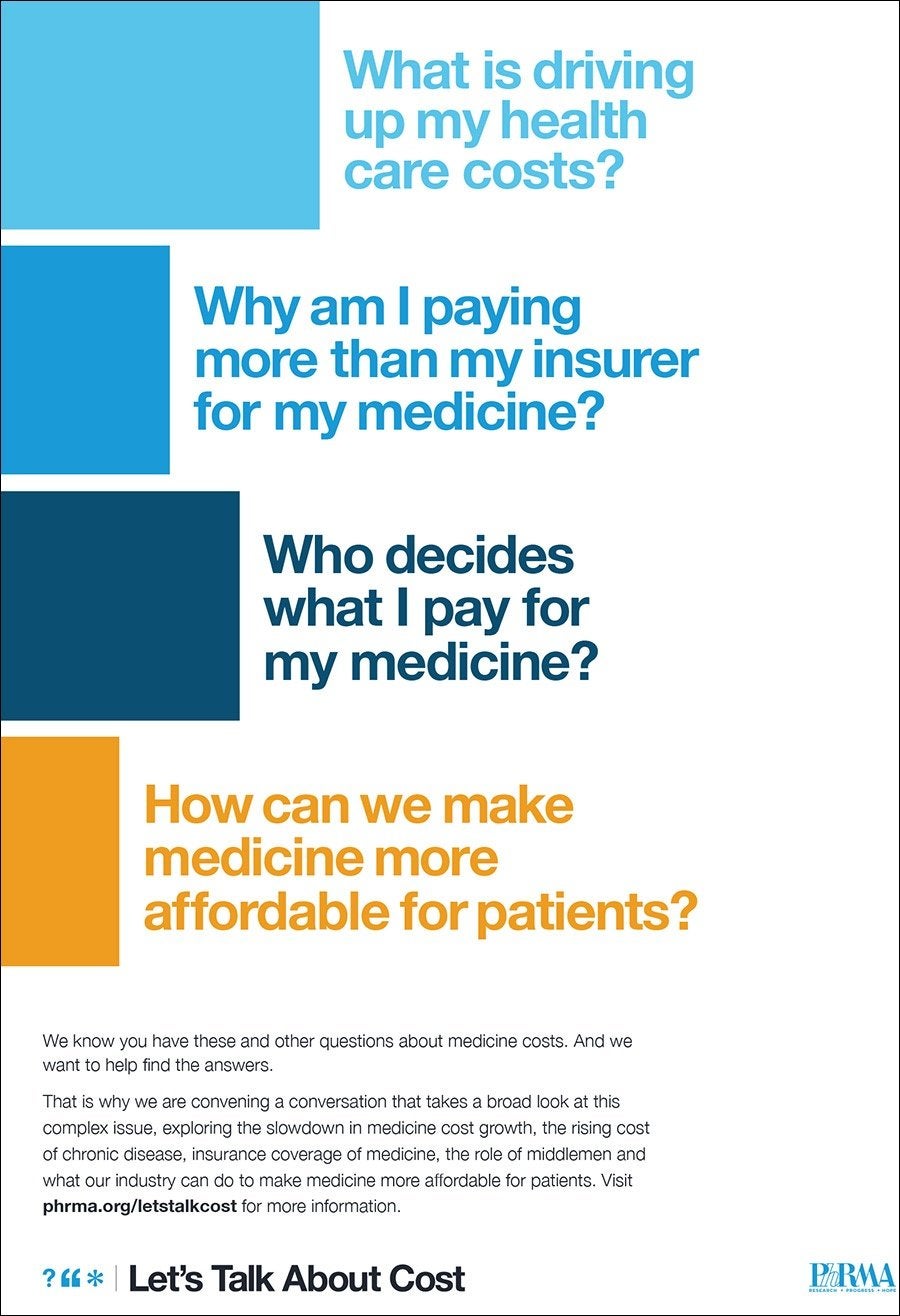
What is driving up my health care costs?
The biggest cost driver in our health care system is chronic disease. Patients with chronic diseases, such as cancer, diabetes and heart disease, account for approximately 90 percent of all health care spending and are the leading causes of death and disability in the United States.
Why am I paying more than my insurer for my medicine?
Private payers are reportedly receiving rebates of between 30 percent and 55 percent for medicines to treat a number of conditions, including diabetes, asthma and high cholesterol. Yet, these negotiated discounts are not shared with patients who pay a deductible or coinsurance for their medicine. No patient should pay more for their medicine than their insurer.
Who decides what I pay for my medicine?
While biopharmaceutical companies set the list price for a brand medicine, more than a third is rebated back to payers and other middlemen in the supply chain. Ultimately, your health insurer determines what you pay for your medicine out of pocket.
How can we make medicine more affordable for patients?
Biopharmaceutical companies offer patient assistance programs that have helped millions of patients access needed medicines for free or nearly free. They are also working with private health insurers to find new ways to pay for medicine that reward outcomes and lower costs for patients.
These and other questions will be featured in print, radio, digital and social channels throughout the year. Advertisements and promotion will run on a variety of platforms nationally.
To learn more about Let’s Talk About Cost and view the advertisements, visit PhRMA.org/LetsTalkCost.
Robert Zirkelbach
Robert Zirkelbach is an accomplished public affairs executive with more than 20 years of experience shaping the debate and influencing policy on behalf of highly regulated industries and corporations. As Chief Public Affairs Officer & Head of Strategic Initiatives at the Pharmaceutical Research and Manufacturers of America (PhRMA), Zirkelbach leads public affairs, strategic initiatives and membership on behalf of America’s biopharmaceutical industry.
He oversees integrated public affairs campaigns that advance patient-first solutions, strengthen our health care system and preserve the role of the U.S. as the world leader in biopharmaceutical innovation. Since returning to PhRMA in 2023, he has elevated the industry’s voice in Washington, expanded PhRMA’s membership and spearheaded the organization’s five-year strategic plan.
Previously, Zirkelbach served as Global Head of Issues and Advocacy at ExxonMobil, where he led high-impact advocacy campaigns on issues central to the company’s mission, including climate change and plastic waste. During his tenure, he also oversaw a strategic risk function responsible for identifying and mitigating potential policy, geopolitical and reputation risks facing the company. Zirkelbach served as spokesman for America’s Health Insurance Plans (AHIP) during the pivotal debate and implementation of the Affordable Care Act. He started his career on Capitol Hill as press secretary for Congressman Jim Nussle (R-IA).
Zirkelbach is a graduate of Central College. He lives with his wife and two children in Washington, DC.
Robby Zirklebach
https://www.linkedin.com/in/robzirk/
Chief Public Affairs Officer & Head of Strategic Initiatives
Critics repeat same, misleading narrative on potential “costs” of new medicines
Insurance data: PBM reform has no material impact on premiums
What recent rhetoric on the cost of diabetes and anti-obesity medicines gets wrong
3 Takeaways from POLITICO’s Health Care Summit
Setting the Record Straight: Comparing U.S. drug prices to those in foreign countries hurts patients
When it comes to the future of innovation, the ball is in policymakers’ court
AARP’s latest misleading report
New report: Hospitals mark up medicine prices 500%
read more
Key considerations as Congress works towards PAHPA reauthorization
Insulin: Key Facts on Access & Affordability
4 key facts on medicine prices and spending
Three facts about health care spending
ICYMI: Cancer death rate continues to decline due to treatment advances
Novel medicines approved in 2022 offer increased treatment options for patients
ICYMI: PhRMA kicks off the year at the 2023 J.P. Morgan Health Care Conference
Study finds hepatitis C cure saved Medicaid $15 billion
New data show how insurers and middlemen shift Rx costs onto patients
Busting 3 Myths About Copay Coupons
Making coupons count for patients at the pharmacy counter
By the Numbers: Patients lose when the government sets prices
Prescription drug prices are not fueling inflation
PhRMA warns of the growing influence of middlemen over patient access and out-of-pocket costs for patients
Report finds PBMs are increasingly restricting patient access to medicines
ICYMI: PhRMA CEO Stephen J. Ubl spotlights lessons learned during COVID-19
Annual projections from NHE compared to actual health care spending
What’s really happening when it comes to prescription drug costs
Analysis: States can help patients save nearly $1,000 annually on their medicines
New analysis confirms hospitals markup prices for oncology therapies
How standardized plans can improve patients’ access to medicines
Correcting the record: Putting medicine costs and spending in context
Sharing rebates can save Americans with diabetes 500 each year and improve adherence
Guest Post: If we truly want to cure complex diseases, politicians should reject price setting
Veterans Affairs 101: Three charts show how the VA system differs from Medicare
If drug prices are growing below the rate of inflation, why are patients still feeling the sting at the pharmacy?
Government price setting leaves behind families counting on new medicines
340B 101: Three charts show the program maximizes hospitals’ bottom line with little consideration for patients
Research and development continues long after a medicine is initially approved
New poll of all 50 states and 435 Congressional Districts shows perils of so-called Medicare “negotiation”
CBO reaffirms our innovation ecosystem leads to improved lives, long-term savings
New study finds more than half of brand medicine spending goes to the supply chain and others
New NHE data show the true picture of health care spending
3 things to know about the importance of post-approval research and development
Guest post: Congress should not put future innovation at risk
What is missing in the current drug pricing plan
ICYMI: PhRMA CEO speaks at STAT Summit about government price setting
In the current health care debate, Congress has lost sight of what matters to U.S. voters
CMS finds medication adherence saved Medicare up to 46.6B in avoided health care costs between 2013 and 2018
ICYMI: New study confirms policies like H.R. 3 could significantly reduce drug development
New poll shows Americans reject Medicare negotiation once they learn more about the policy
To drive up profits, hospitals continue unnecessary medicine mark-ups, burdening patients, employers and health care system
What is Kaiser Family Foundation up to?
Recognizing Hepatitis R&D on World Hepatitis Day
New reports shed light on key facts about medicines and affordability
How strengthening the biosimilar marketplace benefits patients
New report demonstrates development of new medicines relies on private sector expertise and investment
West Virginia becomes the first state to lower patient costs by sharing the savings
Top five issues voters want addressed in the administration’s first 100 days
Insurers shift medicine costs to patients with severe chronic illnesses
Accumulator adjustment programs lead to surprise out-of-pocket costs and nonadherence, analysis finds
Survey found insurance premiums grew faster than inflation in 2020
Manufacturer cost-sharing assistance programs can save chronically ill patients hundreds to thousands of dollars annually
Commercial health plans have increased patients’ out-of-pocket costs by over 50% in some therapeutic areas
Commercial health plans transition from copays to coinsurance and deductibles has increased patient out-of-pocket costs
Four things to know about the IQVIA “Medicine Spending and Affordability in the U.S.” report
New data show commercially insured patients face increasingly high cost sharing for brand medicines
Payers subject 80% of new RA and MS patients to utilization management restrictions
ICYMI: Pharmacy benefit managers increasingly exclude medicines from formularies, restricting patient access
New rule makes it harder for patients to lower their out-of-pocket costs
PhRMA comments on HHS proposed rule on manufacturer cost-sharing assistance and accumulator adjustment programs
Fact Check: HCCI analysis overstates medicine spending and prices
Cancer medicines cost twice as much at hospitals, study finds
Nearly 50% of brand medicine spending goes to the supply chain and others
More evidence that medicine prices are growing at slowest rate in decades
Survey shows out-of-pocket costs top health care concern for voters
Four reasons why the radical Pelosi Plan is the wrong approach
Hospitals make 9 times more than physicians’ offices on provider-administered medicines
Three things to know about the Part D GAO report
Setting the record straight on international reference pricing
New Let’s Talk About Cost TV ad asks: Why aren’t patients sharing in savings at the pharmacy counter?
Study finds hospitals continue to mark up medicines up to 500% of their cost
Three reasons why the latest Rx Savings Solutions analysis is misleading
"If Washington isn’t careful, we might leave innovation behind"
Ask About Adherence: OIG proposed rule to reform the rebate system could improve adherence
New study finds hospitals continue to push patients to costlier outpatient settings
4 Things to know about the IQVIA “Medicine Use and Spending” report
Meet MAT: 5 things to know about PhRMA’s new “Medicine Assistance Tool”
The PBM story you haven’t heard: Hidden fees quadrupled in two years
Health Affairs study misses the mark on medicine costs
New government data show medicine price growth continues to decline
Americans want to know more than just the list price of a medicine—and we’re answering their call
What they are saying: PhRMA member executives on industry’s new approach to DTC television advertising
Coupons allow patients to remain on medicines in spite of high cost sharing and deductibles
Experts agree: the Bipartisan Budget Act changes to Medicare Part D jeopardize the program
What if a couple of small fixes could protect seniors in the donut hole and save them money on out-of-pocket costs?
New study finds some hospitals mark up medicine prices at least 700 percent
69 percent of patients abandon medicines when cost sharing is more than $250
New analysis in Health Affairs reinforces one-third of medicine list price rebated back to supply chain
PhRMA submission to HHS on blueprint to lower drug prices and reduce out-of-pocket costs
New data show patients’ out-of-pocket costs are rising faster than their insurers’ costs
Medicare Part D cliff ahead
Part D cliff looms for seniors, as program stability could be in jeopardy
Sharing negotiated discounts at the pharmacy counter could save seniors with diabetes more than $350 annually
New “Let’s Talk About Medicare” campaign focuses on solutions to improve affordability and predictability for seniors in Part D
Video: PhRMA CEO discusses biopharmaceutical supply chain at POLITICO event
Event tomorrow: Making the biopharmaceutical supply chain work for patients
Spending on medicines grew less than one percent in 2017
Patients pay the price when hospitals mark up cancer medicines
Advance price notification: A transparency measure that fails patients
New Let’s Talk About Cost ads highlight how copay accumulator programs could leave patients financially exposed
Video: How does the supply chain shape brand-name medicine prices?
4 Things to know about the IQVIA 2018 and Beyond: Outlook and Turning Points report
ICYMI: Two PBM reports show dramatic slowdown in medicine spending growth
Copay coupons can help ease patients’ out-of-pocket costs
Oregon’s HB 4005 fails to deliver savings for patients
PhRMA launches new consumer-facing Let’s Talk About Cost website
NHE Data: Medicine spending grew just 1.3 percent in 2016
Video: What is a results-based contract?
Excerpts from testimony by PhRMA’s Lori Reilly
4 things to know about the QuintilesIMS drivers of medicine spending in the U.S. report
What they are saying: Study on cancer R&D costs is not an accurate representation of marketplace
Video: PhRMA CEO discusses medicine costs with CNBC's Squawk Box
New PhRMA resources chock full of biopharma industry facts
New data put medicine costs and spending in context
In the OECD other health care services will be ten times prescription medicine spending growth over next decade
Medicines have significantly increased chances of cancer survival around the globe
Why won’t the insurance industry tell the truth about medicine costs?
4 Things to know about the QuintilesIMS Medicines Use and Spending in the U.S. report
New analysis: More than half of patients’ out-of-pocket spending for brand medicines is based on full list price
How innovative medicines are benefiting countries across the globe
ICYMI: 3 new reports show dramatic slowdown in medicine spending growth
The Value Collaborative: Advancing private market solutions to achieve better health, lower costs
New “Let’s Talk About Cost” campaign convenes national dialogue on medicine costs
Drug Cost
New “Let’s Talk About Cost” campaign convenes national dialogue on medicine costs
New “Let’s Talk About Cost” campaign convenes national dialogue on medicine costs