In the past year, we have seen revolutionary new treatments become available to patients in the United States for cancer and other debilitating diseases. A new analysis puts in perspective the greater availability of new therapies for American patients compared to those living in other countries.
Using regulatory approval data from the U.S. Food and Drug Administration (FDA), European Medicines Agency (EMA) and the Japanese Pharmaceuticals and Medical Devices Agency (PMDA), as well as product sales data from around the world, the analysis identified 220 new molecular entities (NMEs) launched in 36 countries from 2011 to 2017.
Nearly 90 percent of these newly launched medicines were available in the United States, compared to just two-thirds in the United Kingdom, half in Canada and France, and one-third in Australia. For example:
- Only 55 percent of the new medicines used to treat respiratory disorders were available in Canada, compared to 100 percent in the United States.
- Of the 65 oncology NMEs identified, nearly all were available in the United States (62 medicines or 95 percent) compared to 75 percent in the United Kingdom and 51 percent in Japan.
- For anti-infective and anti-viral medications, 90 percent of 30 NMEs identified were available in the United States compared to 80 percent in Germany, 60 percent in France and 57 percent in Canada.
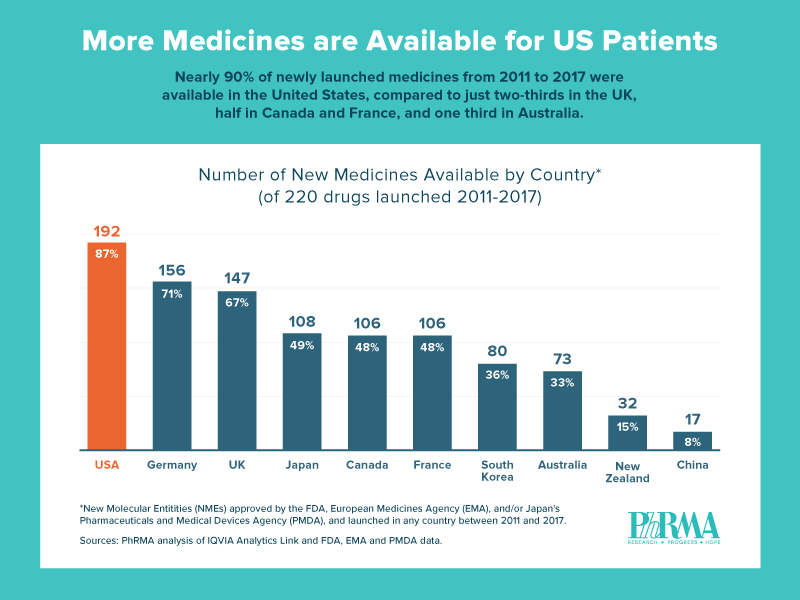
Access to life-saving treatments makes a real difference in the lives of American patients. The National Cancer Institute announced on Tuesday that cancer deaths in the United States steadily declined for all ethnic groups from 1995 to 2015. Our market-based system for prescription drugs helps American patients get more treatments than anywhere else in the world. Patients in the United States have more choices as they work with their doctors to determine the best treatment options.
Kevin Haninger
Kevin Haninger is Senior Vice President of International Advocacy at the Pharmaceutical Research and Manufacturers of America (PhRMA), where he manages market access, intellectual property, trade and global health policy advocacy in key markets. Prior to joining PhRMA, Kevin was Senior Economist in the Office of the Secretary at the U.S. Department of Health and Human Services. Kevin received an undergraduate degree with distinction from Stanford University and a Ph.D. from Harvard University.
Kevin Haninger
New study: HPV vaccination helps prevent cervical cancer deaths
Mass compounding puts patients at risk
America's cancer research progress is real and worth protecting
Ahead of ASCO: Cancer innovation is promising, but policy choices matter
Advancing patient care: A look at new medicines approved in 2025
CAREs 2025: Supporting community-based solutions that improve access to medicines
New analysis finds 340B hospitals push patients toward costly care to boost profits
Price setting policies put cancer gains in jeopardy
Knockoffs of FDA-approved drugs put patients at risk
PDUFA: Essential to America’s edge in drug development and patient access
Health care practitioners sound the alarm on middlemen-imposed barriers to patient care, need for policy change
Improved treatments continue to lead to declining cancer mortality rates in the U.S.
Guest Perspective: Prioritize Innovative Care
Major drug compounder is spending millions on misleading Super Bowl ad
Preventing and fighting disease: A look at the biopharmaceutical progress made for patients in 2024
Post-approval R&D is critical for fighting cancer. The IRA makes it more difficult.
The importance of partnership: A conversation with Takeda
More oversight needed of unapproved medicines that threaten patients’ health
Three things to know about the United Nations’ new HIV/AIDS report
Case study: How seniors could face access disruptions because of the IRA’s price setting provisions
The future of oncology R&D lies in policymakers’ hands
Showcasing the promise of biopharma at ASCO 2024
ICYMI: Misaligned policies undermine patient access
The use of real-world data in drug development
Championing cancer equity: Our drive for healthier AANHPI communities
New analysis: Accelerated approval pathway is changing lives in underserved communities
3 Takeaways from POLITICO’s Health Care Summit
The impact of innovative medicines: A caregiver's perspective
PhRMA awards $250,000 to community-based projects to improve equitable cancer outcomes
Three things to know about antibody drug conjugates
Novel treatments and vaccines approved for U.S. patients in 2023 reach five-year high
Florida’s importation plan puts patients in danger
The Biopharmaceutical Industry Still Needs Clarity from the FDA on Orange Book Listings
New analysis of patient access restrictions in the United Kingdom
The IRA’s pill penalty threatens the future of oncology R&D
New Report: 1,600 cancer treatments and vaccines in clinical development
ICYMI: 3 takeaways on the IRA’s unintended consequences from America’s Physician Groups’ 2023 annual fall conference
R&D leaders to Biden Administration: Your policies are undermining the Cancer Moonshot
Watch: New video series spotlights advances in biopharmaceutical science
Decentralized clinical trials and the future of drug development
Navigating the Patient Experience Survey: Protecting Lifelines to Access and Innovation
Between hope and despair: Improving cancer outcomes
New report shows high-impact R&D happens after cancer medicines are first approved
New report shows how the Inflation Reduction Act stifles innovation for small molecule medicines
How FDA’s modernization strategy could improve drug development
ASCO 2023: Protecting our progress in the fight against cancer
Highlights from ASCO 2023
Setting the record straight on accelerated approval
FDA should remain the authority on the safety and effectiveness of medicines
States can support access to medicine as COVID-19 Public Health Emergency ends
IRA Impacts: Cancer treatment research and development
State policymakers can protect American innovation and help Americans live longer, healthier lives
Minnesota lawmakers are letting PBMs off the hook, and threatening patients’ access to medicines
ICYMI: Cancer death rate continues to decline due to treatment advances
Novel medicines approved in 2022 offer increased treatment options for patients
What you should know about real-world evidence and drug development
In their own words: Insured Americans support policy reforms that address access and affordability concerns
Three things to know about the accelerated approval pathway
Stories from the lab: Researchers discuss innovative treatments for cancers of the blood
ICYMI: PhRMA COO Lori Reilly Esq. speaks with Jacob Van Naarden about the future of cancer research
Protecting treatment advances for breast cancer
PDUFA and BsUFA reauthorizations are wins for patients
Word of the Month: Biomarkers and surrogate endpoints
CMS coverage decision restricts access to treatments for Alzheimer’s disease
Key takeaways from ASCO's annual meeting
Report finds PBMs are increasingly restricting patient access to medicines
ICYMI: First pediatric patient to receive CAR-T cell therapy celebrates 10 years of being cancer-free
Report: More than 500 medicines in development to treat disorders of the blood
Ensuring timely reauthorization of PDUFA and BsUFA
The accelerated approval pathway: Helping patients with serious or life-threatening diseases
4 things to know about biopharmaceutical efforts to fight cancer
The importance of timely PDUFA and BsUFA reauthorization
ICYMI: New approvals by the FDA in 2021 offer greater treatment options for patients
New data show continued decline in death rates for cancer patients related to treatment advances
Biosimilar User Fee Act (III) Performance Goals Letter will help increase options for patients and promote competition
Meeting Tomorrow: Looking ahead to PDUFA VII
The impact of monoclonal antibodies and COVID-19 recovery
Recognizing National Immunization Awareness Month
PDUFA VII is critical for future biopharmaceutical innovation and for patients
How strengthening the biosimilar marketplace benefits patients
The FDA Office of Minority Health and Health Equity: Working to advance health equity through diversity in research
Getting the 340B program back on track in 2021
Action needed to preserve the six protected classes
2020 FDA approvals show innovation despite COVID-19 pandemic challenges
ICYMI: Cancer death rate continues decline due to advances in treatment
Report: More than 1,300 medicines and vaccines in development to help fight cancer
Study finds biopharmaceutical innovation is responsible for 35% of the increase in life expectancy from 1990 to 2015
Growth in innovative, value-based contracts holds promise for the health system and for patients
Innovative contracts drive access for patients and value for the system
New report explores setbacks that bring future cancer success stories
Guest Post: Takeda seeks ‘new normal’ for cancer research during the COVID-19 pandemic
ICYMI: Patients saved nearly $800,000 out of pocket through innovative contracting arrangements
Nearly 400 cell and gene therapies in development to target a broad range of diseases
PhRMA comments on HHS proposed rule on manufacturer cost-sharing assistance and accumulator adjustment programs
Addressing barriers that inhibit value-based contracts
Cancer medicines cost twice as much at hospitals, study finds
ICYMI: 2019 brings innovative medicines to patients
PhRMA comments to Congress on Cures 2.0 call to action
New data show how ICER’s value framework could prevent or delay access to treatments for Medicaid patients across the country
Guest Post: Following my stroke, having access to ground-breaking medical innovation has never been more important
Setting the record straight on international reference pricing
Guest Post: Using the patient voice to go boldly
IP Explained: How Hatch-Waxman successfully balances affordability and innovation
Fact Check: How the Part B International Pricing Index model threatens patient access
New analysis shows 820,000 prescriptions would be in jeopardy if ICER’s value framework is used in Medicaid
Guest post: Hearing from patients on Rare Disease Day
Rare Disease Day: Unmet medical need inspires biopharmaceutical innovation
Why state drug importation pilot programs don’t work
PhRMA comments to administration on Medicare Part D proposed rule
Putting 2018 medicine approvals in context
ICYMI: New study reinforces dangers of proposed IPI model
Groups sound the alarm on administration’s new Part B proposal
4 things you need to know about the administration’s latest Part B proposal
PhRMA submission to the 2019 National Trade Estimate Report urges action to protect U.S. biopharmaceutical innovation
FDA needs best and brightest to advance a new era of medicine with America’s biopharmaceutical companies
Balancing innovation and competition in the biologics marketplace
Saving kids and dogs from shared cancers
How much do you know about Medicare Part B?
ICER’s budget impact threshold: Sounding a false alarm on affordability and access
PhRMA submission to HHS on blueprint to lower drug prices and reduce out-of-pocket costs
Event next week: Supporting the next generation of lifesaving medicines
Guest post: Excellent care for LGBTQ patients requires cultural humility and specific medical knowledge
New analysis shows that HTA organizations may frequently restrict access to cancer treatments
New analysis shows negative impact of ICER’s value framework on patient access in Medicare Part B
New report and resources put cancer in context, showing more than 1,100 medicines and vaccines in development
Event tomorrow: Improving patient access to lifesaving medicines
Event tomorrow: Making the biopharmaceutical supply chain work for patients
Spending on medicines grew less than one percent in 2017
Patients pay the price when hospitals mark up cancer medicines
PPA celebrates 13 years of helping patients access their medicines
Rare Disease Day: Unmet need inspires innovation
Copay coupons can help ease patients’ out-of-pocket costs
Innovation comes in many forms, including new and expanded uses of existing medicines
PhRMA launches new consumer-facing Let’s Talk About Cost website
ICYMI: Why 2017 medicine approvals matter
New surveys find payers and providers want more data from biopharmaceutical companies
Supporting opportunities for enhanced competition in the marketplace
Video: What is a results-based contract?
A new era in cancer
How much are hospitals marking up the price of medicines? The answer may surprise you.
PhRMA, member companies and NIH create public-private partnership for immuno-oncology
VIDEO: PhRMA CEO discusses industry response to opioid crisis on Mornings with Maria
What they are saying: Study on cancer R&D costs is not an accurate representation of marketplace
Protect your health: Important disaster preparedness tips for Harvey and Irma
Opportunities to build upon enhanced competition for medicines in the marketplace
Why reauthorization of PDUFA matters
Medicare Monday: New report highlights progress in fighting cancer with new physician-administered medicines
Foreign government price setting by any name harms innovation and access to medicines
A critical opportunity to prevent prescription drug abuse
More than 240 immuno-oncology treatments in development to fight cancer
Medicines have significantly increased chances of cancer survival around the globe
Compulsory licensing: A misused and abused international trade law
Government-imposed price controls threaten innovation and access
ICYMI: Report highlights overall decrease in cancer death rates
Guest Post: The importance of a modern FDA in drug discovery
Biopharmaceutical industry’s success reducing disparities for African Americans
Medicare Monday: What is IPAB, and why is it bad for patients?
This is not a video game: New TV ad showcases the destruction of a cancer cell by immune system
The 20-year journey yielding a new weapon against cancer
Significant progress fighting cancer: Death rate has dropped 25 percent
New analysis shows that more medicines worldwide are available to U.S. patients
Access
Cancer
FDA
New analysis shows that more medicines worldwide are available to U.S. patients
New analysis shows that more medicines worldwide are available to U.S. patients