not used title
not used title
Over the past 25 years, prescription medicines have transformed the trajectory of many debilitating diseases and conditions, including heart disease, HIV/AIDS, cancer and hepatitis C, resulting in decreased death rates, longer life expectancy and better quality of life for patients.
Today, new medicines are targeting the underlying causes of disease in ways never seen before, and diseases previously regarded as deadly are now manageable and even curable. In this new era of medicine, breakthrough science and personalized therapies are revolutionizing the way we treat patients with a broad range of chronic and rare conditions. Looking forward, continued advances in biopharmaceutical innovation are critical in addressing patient’s unmet needs, improving public health and solving future health care challenges.
But the ecosystem that supports the development of new treatments and cures is complicated. Let’s take a look at a few facts about the development of innovative new medicines and how laws put in place are helping support continued innovation:
- The public and private sectors play complementary roles with government having a largely indirect role in medicine development. While government research often lays the groundwork for developments in medical science, including basic understanding of disease, so too does the biopharmaceutical industry. Biopharmaceutical companies support a range of basic research, not only in their own labs, but in partnership with academia and small and emerging companies. Moreover, biopharmaceutical companies are largely responsible for developing new medicines. One study found that the private sector was responsible for 58% of discovery milestones, 73% of development milestones and 81% of manufacturing milestones.
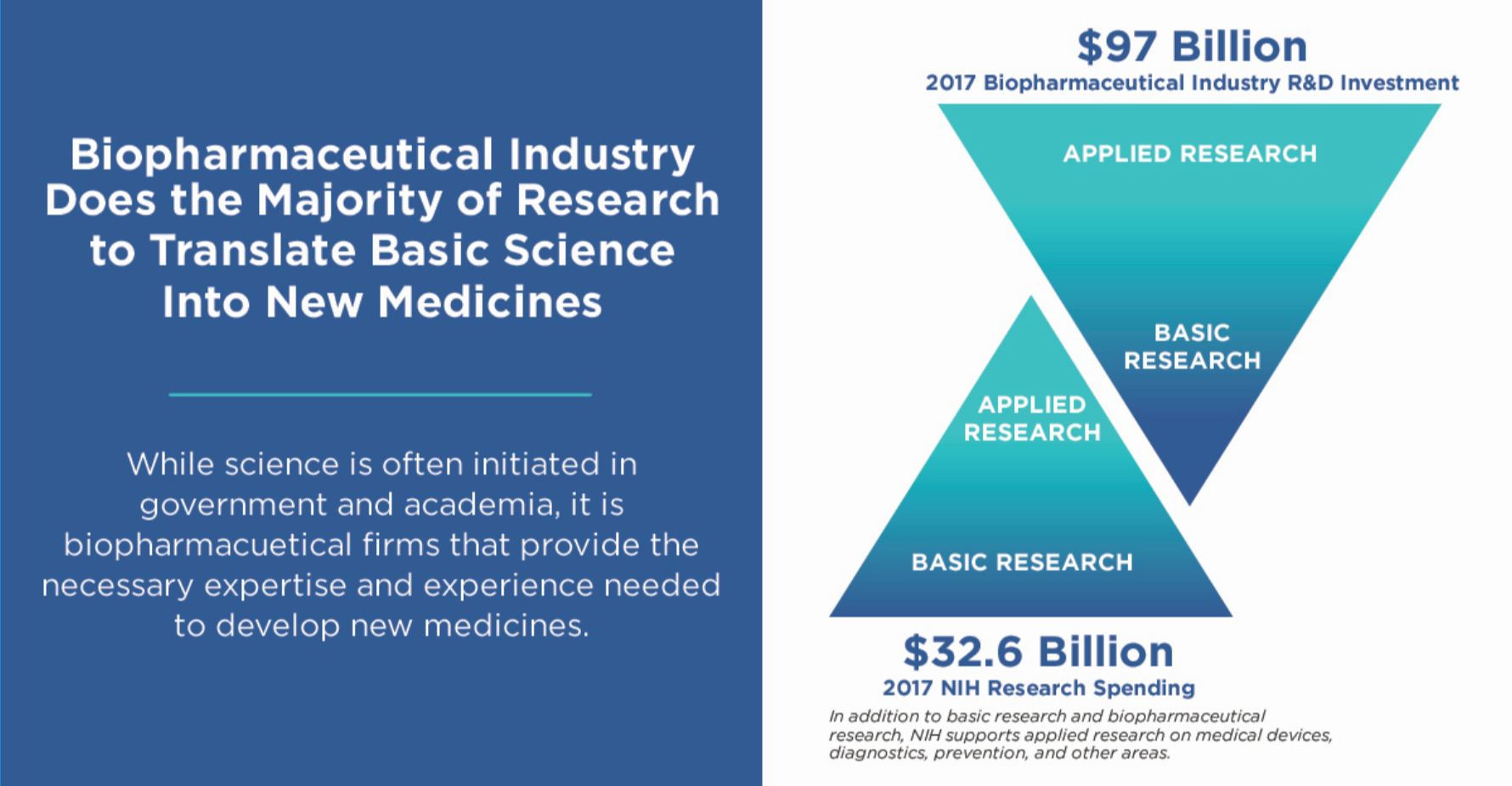
- Translating basic research into new medicines is a long, difficult and expensive process that is taken on by biopharmaceutical companies. The biopharmaceutical industry greatly outspends government and academia when it comes to investment in research and development (R&D). According to most the recent data, in 2017 alone, the biopharmaceutical industry’s investment in R&D reached an estimated $97 billion, which almost triples the National Institutes of Health (NIH) total budget of $32.6 billion in 2017, only part of which goes to research related to drug development.
- In cases where federally-funded research results in a patentable invention that has potential to develop into a therapeutic treatment, laws such as the Bayh-Dole Act have created a framework for translating government-funded research into useful commercial products. This includes allowing institutions that conduct federally-funded research to retain title to the patents covering inventions they have created. This enables these research institutions to license the patents to private sector partners, including biopharmaceutical companies, who then work to develop these inventions into promising treatments or cures. This can lead to royalties to the research institution once commercialization is achieved by biopharmaceutical companies.
- The impact of Bayh-Dole has been far reaching — bolstering the economy and positioning the U.S. as a global leader in technology transfer— that other countries now seek to emulate. Between 1996 and 2015 alone, the licensing activity spurred by Bayh-Dole contributed close to $591 billion to U.S. gross domestic product and supported an estimated 4.2 million jobs in the U.S. In 2016 alone, more than 1,000 start-up companies were formed and nearly 800 commercial products stemming from university research were introduced.
- Bayh-Dole has created an efficient route by which new insights and valuable research results from universities and other institutions can effectively make their way to start-up and established firms across different sectors who assume the full risk and cost of working to transform these inventions into technologically and economically viable products.
- Ultimately, Bayh-Dole has played a key role in not only supporting innovation. But as a Congressional Research Service report noted, “Observers generally agree that the Bayh-Dole Act has successfully met its objectives…The government receives a significant payback through taxes on profits and society benefits from new jobs created and expanded productivity.”
To ensure the continued promise of biopharmaceutical innovation, the current technology transfer framework must be protected. In the same way that the U.S. R&D ecosystem did not develop by accident, it cannot continue without committed support from all stakeholders. It will take intentional, collaborative efforts from policymakers, industry leaders, institutional researchers and patients to ensure the U.S.’ capacity for innovation not only thrives but continues to grow in size and scope.
Andrew Powaleny
Andrew Powaleny is the Deputy Vice President of Public Affairs at PhRMA, where he leads communications on scientific, regulatory and intellectual property issues, highlighting the biopharmaceutical industry’s efforts in developing innovative medicines and vaccines while promoting an environment that encourages necessary risk-taking. For five years starting in 2019, he launched and led PhRMA’s grassroots initiative, Voters for Cures, bringing patients and caregivers together to advocate for access to medicine and biopharmaceutical innovation. He also co-founded and co-chaired PRIDE Umbrella, a resource group for LGBTQ+ individuals. Prior to joining PhRMA in 2015, Andrew worked as a communications consultant in Washington, D.C., and as Deputy Press Secretary for the U.S. House Committee on Energy and Commerce under Chairman Fred Upton. He holds a degree in public policy and government from Eastern Connecticut State University, with a minor in music. Outside of work, Andrew enjoys exercise, musical theater and mentoring college students through The Fund for American Studies alumni association.
Andrew Powaleny
Author Twitter
Author LinkedIn
Bayh-Dole: The fuel for America’s innovation engine
September 2, 2026
ICYMI: Biopharmaceutical companies in America hit new investment milestone
August 14, 2026
Setting the record straight: 3 facts about drug patents
July 13, 2026
New PBM principles don't change the fundamental challenge: Access to lower-cost medicines
July 10, 2026
World Sickle Cell Day: Recognizing the promise of gene therapy
June 19, 2026
MFN could disrupt the affordable medicines patients depend on
June 18, 2026
Intellectual Property and Hatch-Waxman: A blueprint for American leadership and patient savings
June 2, 2026
America's cancer research progress is real and worth protecting
May 28, 2026
Ahead of ASCO: Cancer innovation is promising, but policy choices matter
May 26, 2026
Argentina sets course to enable innovation by rejecting failed patent rules
March 26, 2026
16 years later: How BPCIA continues to expand competition and lower costs
March 23, 2026
Key context is often missing from the debate over the Patent Trial and Appeal Board
March 20, 2026
How AI is transforming the drug innovation lifecycle
March 19, 2026
MFN undermines U.S. biopharmaceutical innovation
February 25, 2026
Updated Analysis Underscores the Need for Brazil to Address Patent Backlogs
February 2, 2026
How post-approval innovation keeps delivering for patients
December 9, 2025
PhRMA calls on USTR to ensure foreign nations pay their fair share
November 4, 2025
Three things to know about Bayh-Dole: Innovation that pays off for taxpayers
October 9, 2025
Delivering breakthroughs and lower costs for patients
September 8, 2025
PBMs, not patents, are blocking access to lower-cost medicines
July 23, 2025
New report: How intellectual property drives U.S. innovation and biopharma's impact
June 30, 2025
What to know about vaccine ingredients: Aluminum and thimerosal
June 24, 2025
Americans are paying a 26% freerider tax on medicines because other countries don’t pay their fair share
June 17, 2025
PhRMA Foundation celebrates 60 years of investing in future scientific leaders
June 11, 2025
New report: Post-approval innovation delivers substantial patient benefits
June 2, 2025
The biopharmaceutical industry is one of the highest contributors to America’s economy among all manufacturers
April 30, 2025
USTR 2025 Special 301 Report corrects course
April 29, 2025
From sound to science: How IP powers innovation in music and hearing
April 25, 2025
How the IRA is impacting the generic drug market
April 8, 2025
3 myths critics get wrong about intellectual property
March 28, 2025
ICYMI: PhRMA submits comments to White House on artificial intelligence
March 17, 2025
4 things to know on Rare Disease Day
February 28, 2025
Biopharmaceutical innovation for a healthier America: PhRMA releases new innovation report
February 21, 2025
New policy agenda charts solutions for a healthier America
February 20, 2025
A successful PhRMA Forum highlights our commitment to a healthier America
February 20, 2025
Guest Perspective: Prioritize Innovative Care
February 11, 2025
Preventing and fighting disease: A look at the biopharmaceutical progress made for patients in 2024
February 3, 2025
A new administration poses new opportunities for patient access
December 17, 2024
Congratulations to our 2024 Working for Cures Employee Champions
December 11, 2024
Post-approval R&D is critical for fighting cancer. The IRA makes it more difficult.
November 13, 2024
PhRMA submission calls for USTR to correct course on trade policy, enforcement
October 18, 2024
New Report: Tackling chronic conditions with preventive treatment
September 30, 2024
40 Years of Hatch-Waxman: How Can We Secure its Legacy?
September 24, 2024
40 Years of Hatch-Waxman: How does the Hatch-Waxman Act help patients?
September 23, 2024
Addressing the mounting threat of antimicrobial resistance
September 23, 2024
40 Years of Hatch-Waxman: What is the Hatch-Waxman Act?
September 19, 2024
New research: American biopharmaceutical investment in R&D drives transformational innovation
September 16, 2024
Biden Administration report debunks myths around patent “evergreening” and “thickets”
September 3, 2024
How to protect your children’s health this school year
August 22, 2024
What to know about the latest effort to break patents using a legally dubious avenue
August 21, 2024
WTAS: Proposed Unsubstantiated USPTO Rule Change is a Threat to American Innovation
August 12, 2024
Industry-backed STEM programs have supported 111 million students and nearly 183,000 teachers
August 1, 2024
Three things to know about the United Nations’ new HIV/AIDS report
July 31, 2024
New Report: Vaccines continue to drive improved health outcomes
July 16, 2024
The future of oncology R&D lies in policymakers’ hands
July 8, 2024
Showcasing the promise of biopharma at ASCO 2024
June 28, 2024
Alzheimer's & Brain Awareness Month: A conversation with Biogen
June 27, 2024
PhRMA launches education campaign on the benefits of America's IP system
June 26, 2024
Alzheimer's & Brain Awareness Month: A conversation with Eisai
June 24, 2024
Alzheimer's & Brain Awareness Month: A conversation with Eli Lilly and Company
June 20, 2024
ICYMI: Misaligned policies undermine patient access
June 6, 2024
Women’s Health Month: A conversation with Astellas
May 31, 2024
ICYMI: Innovation transforms lives but misguided federal policies threaten patient outcomes
May 30, 2024
Experts discuss the value of IP at Senate Judiciary Committee hearing
May 28, 2024
Mental Health Awareness Month: Supporting loved ones and improving mental health in America
May 28, 2024
Women’s Health Month: A conversation with Sage
May 23, 2024
World Trade Week 2024: Time for a more ambitious U.S. trade agenda
May 23, 2024
The use of real-world data in drug development
May 13, 2024
New analysis: Accelerated approval pathway is changing lives in underserved communities
April 30, 2024
World IP Day 2024: Supporting an innovative and sustainable future
April 26, 2024
World Vaccine Congress: Building on vaccine success
April 1, 2024
The impact of innovative medicines: A caregiver's perspective
March 26, 2024
ICYMI: More evidence of the IRA’s harmful consequences on post-approval research and development
March 25, 2024
What new cures would mean to families
March 7, 2024
Watch: A conversation with Dr. Mike Ybarra on Rare Disease Day
February 29, 2024
American Heart Month: A nurse’s perspective
February 27, 2024
International meetings hold big implications for Americans and our innovation ecosystem
February 26, 2024
Proposed march-in framework would chill American innovation
February 7, 2024
Three things to know about antibody drug conjugates
February 2, 2024
PhRMA 2024 Special 301 submission: USTR needs to support American innovation, global access to medicines
January 31, 2024
Powering the next generation of therapies: A conversation with Astellas US President Mark Reisenauer
January 30, 2024
New poll: Americans agree that expanding the TRIPS waiver will harm U.S. global manufacturing and innovation leadership
January 29, 2024
What they are saying: Experts agree that proposed march-in framework would jeopardize innovation
January 25, 2024
Novel treatments and vaccines approved for U.S. patients in 2023 reach five-year high
January 23, 2024
When it comes to the future of innovation, the ball is in policymakers’ court
January 22, 2024
The Biopharmaceutical Industry Still Needs Clarity from the FDA on Orange Book Listings
December 19, 2023
The White House continues to attack American innovation
December 15, 2023
Taking stock of obesity and its costly effects
December 8, 2023
Congratulations to our 2023 Working for Cures Employee Champions
December 6, 2023
Watch: Putting patients front and center for World AIDS Day
November 30, 2023
Biden Administration’s Indo Pacific trade dialogue is a missed opportunity to bolster American exports, innovation
November 29, 2023
Misuse of march-in could stifle innovation
November 27, 2023
WHO Pandemic Agreement offers opportunities and risks for American innovators
November 20, 2023
The IRA’s pill penalty threatens the future of oncology R&D
November 16, 2023
Don't close the door on rare disease research
November 13, 2023
New Report: 1,600 cancer treatments and vaccines in clinical development
November 9, 2023
Word of the Month: The Bayh-Dole Act
November 8, 2023
ICYMI: 3 takeaways on the IRA’s unintended consequences from America’s Physician Groups’ 2023 annual fall conference
November 6, 2023
PhRMA submission: USTR needs more ambition to combat unfair trade barriers
October 24, 2023
R&D leaders to Biden Administration: Your policies are undermining the Cancer Moonshot
October 18, 2023
Three things economists are saying about the Inflation Reduction Act
October 11, 2023
Celebrating Hispanic Heritage Month at PhRMA
October 11, 2023
Word of the Month: AMR
September 27, 2023
It’s PBMs, not patents, blocking competition
September 14, 2023
What you need to know: COVID-19 public health emergency is over, but ideological attacks on IP remain
September 12, 2023
New PhRMA site demonstrates how a technology-driven health care system brings benefits to patients
September 11, 2023
Watch: New video series spotlights advances in biopharmaceutical science
August 24, 2023
Decentralized clinical trials and the future of drug development
August 9, 2023
WTAS on reasonable pricing and public-private partnerships
August 8, 2023
Key considerations as Congress works towards PAHPA reauthorization
July 12, 2023
New report shows high-impact R&D happens after cancer medicines are first approved
July 10, 2023
New report shows how the Inflation Reduction Act stifles innovation for small molecule medicines
June 22, 2023
Biopharmaceutical science powered by PRIDE
June 16, 2023
ASCO 2023: Protecting our progress in the fight against cancer
June 15, 2023
Reject efforts to undermine America’s R&D ecosystem
June 15, 2023
Highlights from ASCO 2023
June 8, 2023
Four ways that America’s biopharmaceutical industry supports jobs and fuels economic growth
May 18, 2023
Mental Health Awareness Month: Fighting the growing mental health crisis and supporting innovation
May 11, 2023
Setting the record straight on the Bayh-Dole Act and March-in
May 10, 2023
Support for continued progress is critical for pediatric drug development
May 8, 2023
New resource underscores the importance of small molecule medicines
May 4, 2023
Policies need to address the growing threat of antimicrobial resistance
April 28, 2023
World IP Day 2023: Celebrating women leaders in innovation
April 26, 2023
CMS guidance on IRA price setting process doubles down on bad policy
April 14, 2023
A guide to MedPAC’s Part B vote today
April 13, 2023
What they are saying: Experts reinforce that TRIPS waiver expansion is harmful and unnecessary
April 13, 2023
New global analysis shows patient access challenges around the world
April 12, 2023
ICYMI: PhRMA President and CEO Stephen J. Ubl discusses patient affordability
April 7, 2023
PhRMA provides comments and testimony to USITC investigation on COVID-19 medicines and the TRIPS Agreement
March 30, 2023
New Report: More than 400 medicines in development for leading chronic conditions affecting older Americans
March 28, 2023
Celebrating the success of the COVID-19 vaccines, and looking to the future
March 27, 2023
IRA Impacts: Cancer treatment research and development
March 23, 2023
PhRMA submits comments to OSTP on enhancing clinical trial diversity
March 21, 2023
U.S. biopharmaceutical exports support jobs, innovation
March 20, 2023
What we’ve learned from three years of fighting COVID-19
March 20, 2023
Will the administration capitalize on the Indo-Pacific Economic Framework to drive medical innovation?
March 13, 2023
Celebrating 40 years of the Orphan Drug Act on Rare Disease Day
February 28, 2023
PhRMA submits comments to USPTO highlighting important role of patent system in medicine development
February 23, 2023
State policymakers can protect American innovation and help Americans live longer, healthier lives
February 9, 2023
U.S. must address IP and market access barriers abroad to protect American innovation
January 31, 2023
Novel medicines approved in 2022 offer increased treatment options for patients
January 23, 2023
ICYMI: PhRMA kicks off the year at the 2023 J.P. Morgan Health Care Conference
January 19, 2023
Biden administration should prioritize innovation in U.S.-Taiwan Initiative on 21st-Century Trade
January 17, 2023
WTAS: Inflation Reduction Act already impacting R&D decisions
January 17, 2023
Stories from the lab: Researchers discuss innovative treatments for cancers of the blood
December 1, 2022
Expanding TRIPS waiver would jeopardize biopharmaceutical research and development
November 17, 2022
Six ways I-MAK is lying about biopharma patents
November 16, 2022
TRIPS waiver expansion risks public health
November 14, 2022
Congratulations to our 2022 Working for Cures Employee Champions
November 10, 2022
New government price setting policy threatens post-approval research
November 10, 2022
Expanding the WTO intellectual property waiver will hurt American jobs
November 9, 2022
ICYMI: PhRMA COO Lori Reilly Esq. speaks with Jacob Van Naarden about the future of cancer research
November 8, 2022
New paper: Addressing the growing crisis of mental health and substance use disorders
November 7, 2022
PhRMA submission to USTR calls for urgent defense of American innovation abroad
November 1, 2022
Protecting treatment advances for breast cancer
October 31, 2022
The law driving technology transfer and fostering innovation
October 24, 2022
Don’t take anti-innovation, activist funded academics at their word
October 18, 2022
Mental Illness Awareness Week – A time for reflection
October 3, 2022
New report ignores benefits of patent system to innovation and patients
September 30, 2022
New Report: Nearly 800 medicines in development to treat chronic conditions
September 29, 2022
Recognizing National Sickle Cell Awareness Month
September 23, 2022
Partnerships are driving global COVID-19 treatment access
September 22, 2022
The dangers of expanding the TRIPS waiver
September 19, 2022
ICYMI: New research builds upon growing body of evidence on value of COVID-19 treatments and vaccines
August 16, 2022
This week’s reading list: All the reasons the Senate-passed drug pricing bill is bad policy
August 10, 2022
Myth vs. Fact: The Senate’s latest price setting proposal
August 5, 2022
An open letter to Congress: Stand with patients and future cures
August 4, 2022
The Senate’s latest price setting proposal will undermine U.S. economic growth
August 3, 2022
New analysis finds deeper impact of drug pricing bill on biopharmaceutical researchers
August 1, 2022
ICYMI: A patient, physician, biotech investor and industry leaders warn about the dangers of government price setting bill
July 29, 2022
The Senate’s latest price setting proposal will undermine: American medical innovation
July 27, 2022
Patent policy changes proposed by USPTO and FDA would leave patients behind
July 22, 2022
PhRMA member companies’ R&D investments reach record high of $102.3 billion in 2021
July 18, 2022
ICYMI: PhRMA’s Ubl pens op-ed on IP waiver for COVID-19 technologies
July 15, 2022
Increase in drug-resistant superbugs during COVID-19 highlights need for policy reforms to address antimicrobial resistance
July 14, 2022
Word of the Month: Biomarkers and surrogate endpoints
July 11, 2022
COVID-19 vaccines and treatments helped save millions of lives and billions in health care costs
July 7, 2022
CMS coverage decision restricts access to treatments for Alzheimer’s disease
June 22, 2022
Key takeaways from ASCO's annual meeting
June 10, 2022
Biopharmaceutical researchers to discuss the value of R&D with Congress
June 9, 2022
Recognizing LGBTQ+ Pride in biopharmaceutical science
June 9, 2022
Intellectual Property waiver on COVID-19 innovation is unnecessary and harmful
May 23, 2022
Report: More than 500 medicines in development to treat disorders of the blood
May 18, 2022
Ensuring timely reauthorization of PDUFA and BsUFA
May 11, 2022
ICYMI: PhRMA COO Lori Reilly spotlights efforts to improve health care in 2022 and beyond
May 9, 2022
Spotlighting a growing mental health challenge
May 9, 2022
Biden Administration details inadequate protection of American intellectual property and foreign barriers to innovation abroad
April 29, 2022
ICYMI: New resource catalogs biopharmaceutical industry lessons learned from COVID-19
April 28, 2022
The biopharmaceutical industry leads in helping women achieve new heights, according to IAM’s diversity 100
April 20, 2022
PhRMA encourages Biden administration to pursue ambitious Indo-Pacific Economic Framework
April 13, 2022
Report: More than 600 medicines in development for diseases affecting women
March 31, 2022
The accelerated approval pathway: Helping patients with serious or life-threatening diseases
March 17, 2022
Biopharmaceutical industry drives economic growth in all 50 states
March 14, 2022
Biopharmaceutical research and development has ushered in a decade of innovation in rare disease
February 28, 2022
4 things to know about biopharmaceutical efforts to fight cancer
February 24, 2022
What you need to know about newly authorized COVID-19 antiviral treatments
February 22, 2022