For three decades, The Drug Price Competition and Patent Term Restoration Act, more commonly known as the Hatch-Waxman Act, has fostered innovation, spurred competition and helped the United States remain a leader in biopharmaceutical research and development (R&D). In today’s IP Explained, we’re taking a look at how Hatch-Waxman successfully streamlined the process for generic medicine approvals while preserving incentives for innovation.
The development of new medicines is a lengthy, complex, uncertain and expensive process. In fact, from drug discovery through FDA approval, developing a new medicine takes 10 to 15 years and costs an average of $2.6 billion. In order to balance innovation and affordability, Congress enacted the Hatch-Waxman Act, which provides biopharmaceutical companies with time and incentives to develop safe and effective medicines and generate revenues to put back into future R&D. Under the framework, innovator companies are given a 5-year exclusivity period for new chemical entities during which generic manufactures generally cannot submit FDA applications for new generic versions. Hatch-Waxman also allows for innovators to seek to restore some of the patent term lost due to the FDA approval process.
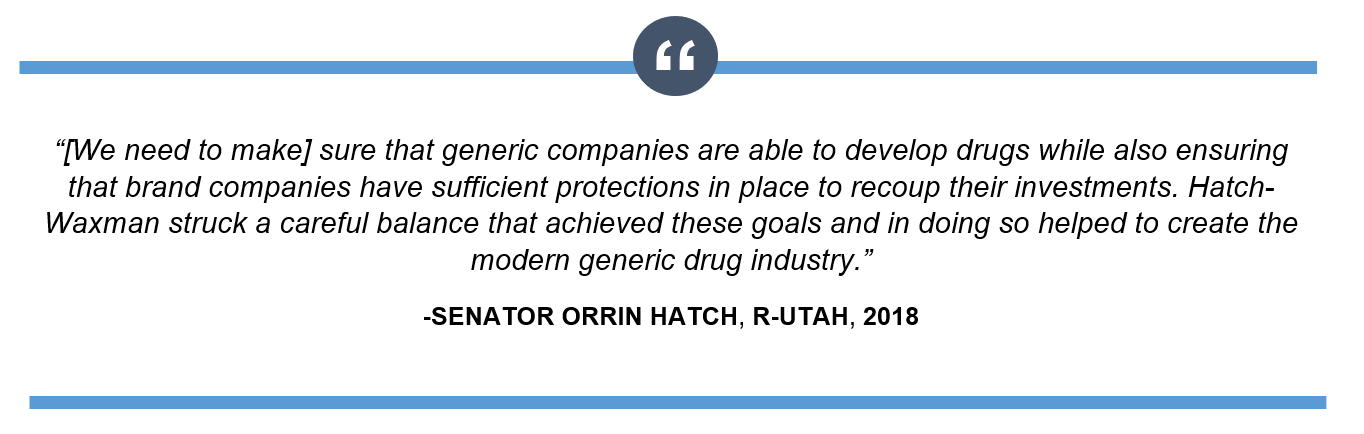
In addition to fostering biopharmaceutical innovation, Hatch-Waxman increases competition and affordability by creating an abbreviated regulatory approval path for generic products. Abbreviated new drug applications, commonly referred to as ANDAs, allow generic manufacturers to reference the brand manufacturer’s clinical data instead of having to fund their own trials. A defined patent litigation framework and 180-day exclusivity period incentivize generic manufacturers to challenge patents in federal court and improve patient access to generics. Under the framework, generic manufacturers are also protected by a “safe harbor” provision that exempts them from patent infringement liability for development work before the brand drug patent expires.
Prior to the enactment of Hatch-Waxman, only 19 percent of U.S. prescriptions were filled with generics and it took, on average, 3 to 5 years after patent expirations for a generic to enter the market. Since then, the generic pharmaceutical industry has seen enormous growth, and nearly 90 percent of prescriptions are now filled with generics. With this increase in brand and generic competition, Hatch-Waxman created $1.67 trillion in savings from 2007 to 2016.
The Hatch-Waxman Act has successfully balanced innovation and affordability by promoting competition and ensuring the United States continues to deliver life-saving treatments to patients. Strong patent protections give researchers the ability to continue investing in the R&D for new, cutting-edge medicines and approaches that can save and improve millions of lives. We must ensure the U.S. patent system continues to protect these inventions while also incentivizing competition.
Learn more about intellectual property on our IP page and check back for next week’s IP Explained blog.
Tom Wilbur
Tom Wilbur is Deputy Vice President of Public Affairs at PhRMA where he leads the state public affairs team and Voters for Cures, PhRMA’s grassroots advocacy initiative. Prior to joining PhRMA in 2019, Tom served as a senior aide on Capitol Hill for U.S. Rep. Fred Upton and the House Energy and Commerce Committee. Tom holds an M.A. in strategic communications from Michigan State University and a B.A. in social science and history from Central Michigan University. He enjoys spending time with family and friends, volunteering, reading and golfing.
Bayh-Dole: The fuel for America’s innovation engine
Mass compounding puts patients at risk
Setting the record straight: 3 facts about drug patents
New PBM principles don't change the fundamental challenge: Access to lower-cost medicines
MFN could disrupt the affordable medicines patients depend on
Intellectual Property and Hatch-Waxman: A blueprint for American leadership and patient savings
Argentina sets course to enable innovation by rejecting failed patent rules
16 years later: How BPCIA continues to expand competition and lower costs
Key context is often missing from the debate over the Patent Trial and Appeal Board
MFN undermines U.S. biopharmaceutical innovation
Updated Analysis Underscores the Need for Brazil to Address Patent Backlogs
Advancing patient care: A look at new medicines approved in 2025
How post-approval innovation keeps delivering for patients
Knockoffs of FDA-approved drugs put patients at risk
PhRMA calls on USTR to ensure foreign nations pay their fair share
PDUFA: Essential to America’s edge in drug development and patient access
Three things to know about Bayh-Dole: Innovation that pays off for taxpayers
Delivering breakthroughs and lower costs for patients
PBMs, not patents, are blocking access to lower-cost medicines
New report: How intellectual property drives U.S. innovation and biopharma's impact
New report: Post-approval innovation delivers substantial patient benefits
The biopharmaceutical industry is one of the highest contributors to America’s economy among all manufacturers
USTR 2025 Special 301 Report corrects course
From sound to science: How IP powers innovation in music and hearing
How the IRA is impacting the generic drug market
3 myths critics get wrong about intellectual property
ICYMI: PhRMA submits comments to White House on artificial intelligence
Major drug compounder is spending millions on misleading Super Bowl ad
PhRMA submission calls for USTR to correct course on trade policy, enforcement
40 Years of Hatch-Waxman: How Can We Secure its Legacy?
40 Years of Hatch-Waxman: How does the Hatch-Waxman Act help patients?
40 Years of Hatch-Waxman: What is the Hatch-Waxman Act?
New research: American biopharmaceutical investment in R&D drives transformational innovation
Biden Administration report debunks myths around patent “evergreening” and “thickets”
What to know about the latest effort to break patents using a legally dubious avenue
WTAS: Proposed Unsubstantiated USPTO Rule Change is a Threat to American Innovation
More oversight needed of unapproved medicines that threaten patients’ health
PhRMA launches education campaign on the benefits of America's IP system
ICYMI: Innovation transforms lives but misguided federal policies threaten patient outcomes
Experts discuss the value of IP at Senate Judiciary Committee hearing
World Trade Week 2024: Time for a more ambitious U.S. trade agenda
The use of real-world data in drug development
New analysis: Accelerated approval pathway is changing lives in underserved communities
World IP Day 2024: Supporting an innovative and sustainable future
International meetings hold big implications for Americans and our innovation ecosystem
Proposed march-in framework would chill American innovation
PhRMA 2024 Special 301 submission: USTR needs to support American innovation, global access to medicines
Powering the next generation of therapies: A conversation with Astellas US President Mark Reisenauer
New poll: Americans agree that expanding the TRIPS waiver will harm U.S. global manufacturing and innovation leadership
What they are saying: Experts agree that proposed march-in framework would jeopardize innovation
Novel treatments and vaccines approved for U.S. patients in 2023 reach five-year high
Florida’s importation plan puts patients in danger
The Biopharmaceutical Industry Still Needs Clarity from the FDA on Orange Book Listings
The White House continues to attack American innovation
Biden Administration’s Indo Pacific trade dialogue is a missed opportunity to bolster American exports, innovation
Misuse of march-in could stifle innovation
WHO Pandemic Agreement offers opportunities and risks for American innovators
Word of the Month: The Bayh-Dole Act
PhRMA submission: USTR needs more ambition to combat unfair trade barriers
It’s PBMs, not patents, blocking competition
What you need to know: COVID-19 public health emergency is over, but ideological attacks on IP remain
Decentralized clinical trials and the future of drug development
WTAS on reasonable pricing and public-private partnerships
Key considerations as Congress works towards PAHPA reauthorization
How FDA’s modernization strategy could improve drug development
Reject efforts to undermine America’s R&D ecosystem
Setting the record straight on accelerated approval
Four ways that America’s biopharmaceutical industry supports jobs and fuels economic growth
Setting the record straight on the Bayh-Dole Act and March-in
World IP Day 2023: Celebrating women leaders in innovation
What they are saying: Experts reinforce that TRIPS waiver expansion is harmful and unnecessary
New global analysis shows patient access challenges around the world
FDA should remain the authority on the safety and effectiveness of medicines
PhRMA provides comments and testimony to USITC investigation on COVID-19 medicines and the TRIPS Agreement
U.S. biopharmaceutical exports support jobs, innovation
Will the administration capitalize on the Indo-Pacific Economic Framework to drive medical innovation?
PhRMA submits comments to USPTO highlighting important role of patent system in medicine development
U.S. must address IP and market access barriers abroad to protect American innovation
Biden administration should prioritize innovation in U.S.-Taiwan Initiative on 21st-Century Trade
What you should know about real-world evidence and drug development
Three things to know about the accelerated approval pathway
Expanding TRIPS waiver would jeopardize biopharmaceutical research and development
Six ways I-MAK is lying about biopharma patents
TRIPS waiver expansion risks public health
Expanding the WTO intellectual property waiver will hurt American jobs
PhRMA submission to USTR calls for urgent defense of American innovation abroad
The law driving technology transfer and fostering innovation
Don’t take anti-innovation, activist funded academics at their word
PDUFA and BsUFA reauthorizations are wins for patients
New report ignores benefits of patent system to innovation and patients
Partnerships are driving global COVID-19 treatment access
The dangers of expanding the TRIPS waiver
ICYMI: New research builds upon growing body of evidence on value of COVID-19 treatments and vaccines
Patent policy changes proposed by USPTO and FDA would leave patients behind
ICYMI: PhRMA’s Ubl pens op-ed on IP waiver for COVID-19 technologies
Word of the Month: Biomarkers and surrogate endpoints
Intellectual Property waiver on COVID-19 innovation is unnecessary and harmful
Ensuring timely reauthorization of PDUFA and BsUFA
Biden Administration details inadequate protection of American intellectual property and foreign barriers to innovation abroad
PhRMA encourages Biden administration to pursue ambitious Indo-Pacific Economic Framework
The accelerated approval pathway: Helping patients with serious or life-threatening diseases
The importance of timely PDUFA and BsUFA reauthorization
Research and development continues long after a medicine is initially approved
Protecting U.S. innovation abroad to support economic and pandemic recovery
ICYMI: New approvals by the FDA in 2021 offer greater treatment options for patients
Legislation threatens patent protections and future innovation
Global COVID-19 vaccination matters now and for the future
New report highlights importance of IP-intensive manufacturing industries to the U.S. economy
PhRMA submission to 2022 National Trade Estimate Report underscores need for pro-innovation U.S. trade policy to combat COVID-19
Biosimilar User Fee Act (III) Performance Goals Letter will help increase options for patients and promote competition
Meeting Tomorrow: Looking ahead to PDUFA VII
Patients and innovators lose if the government pursues ‘march-in’
The impact of monoclonal antibodies and COVID-19 recovery
PDUFA VII is critical for future biopharmaceutical innovation and for patients
Supporting country readiness to boost global vaccine access
Ensuring global vaccine equity requires eliminating trade and regulatory barriers
Increasing global access to vaccines by optimizing production
Dose sharing as a part of the COVID-19 global vaccine equity strategy
Promoting global vaccine equity while protecting innovation
IP Explained: How does the U.S. patent process work?
How strengthening the biosimilar marketplace benefits patients
New polling shows Americans are sounding the alarm on the TRIPS IP waiver
The Biden Administration allows politics to upend a pragmatic pandemic response
The FDA Office of Minority Health and Health Equity: Working to advance health equity through diversity in research
New report demonstrates development of new medicines relies on private sector expertise and investment
American leadership on innovation policy is essential to global health progress
Key excerpts: PhRMA submits comments to NIST in effort to safeguard intellectual property protections
Intellectual property is the key to vaccine development, manufacturing and technology sharing
The latest: What they are saying: Intellectual property protections vital to COVID-19 research, development and manufacturing
Preserving U.S. innovation worldwide is more important than ever
2020 FDA approvals show innovation despite COVID-19 pandemic challenges
New video: See how strong IP protections lead to stronger treatments for patients
Why the U.S. biopharmaceutical industry is leading the charge against COVID-19
New Graphic: Public-Private collaboration fuels the U.S. biopharmaceutical ecosystem
The latest: What they are saying: intellectual property protections critical as we work to defeat COVID-19
R&D Focus: 5 things to know about the biopharmaceutical research ecosystem
The latest: What they are saying: Importance of intellectual property protections to combat COVID-19
The latest: What they are saying: Intellectual property protections critical as we work to defeat COVID-19
IP Explained: Intellectual property system working to combat COVID-19
What they are saying: Intellectual property protections are critical as we work to defeat COVID-19
The continued imperative to protect U.S. innovation worldwide
Nearly 400 cell and gene therapies in development to target a broad range of diseases
IP Explained: Four key takeaways from new Bayh-Dole white paper
Trump administration must defend and protect U.S. innovation
ICYMI: 2019 brings innovative medicines to patients
PhRMA comments to Congress on Cures 2.0 call to action
IP Explained: By the Numbers: How reliable IP protections promote a strong U.S. economy
IP Explained: FACT CHECK: March-In Authority and the Bayh-Dole Act
IP Explained: Four things to know about the Bayh-Dole Act
IP Explained: Three forms of IP protections for medicines
IP Explained: How patents support innovation throughout the biopharmaceutical lifecycle
IP Explained: Understanding biopharmaceutical innovation
IP Explained: Why IP protections are important for biologic medicines
IP Explained: What is Section 101 and why reforms are needed
Guest Post: Using the patient voice to go boldly
World Trade Month: How we can expand world-class pro-innovation standards
IP Explained: Myth vs. fact about strong patent protections in the biopharmaceutical industry
IP Explained: What they are saying on the importance of strong intellectual property protections
IP Explained: Why patents are so critical to biopharmaceutical innovation
New report: Using march-in authority would jeopardize U.S. innovation
Special 301 submission calls for a level playing field for American innovators
Guest post: Hearing from patients on Rare Disease Day
Rare Disease Day: Unmet medical need inspires biopharmaceutical innovation
Fact Check: Biologics, regulatory data protection and the United States-Mexico-Canada Agreement
Why state drug importation pilot programs don’t work
Putting 2018 medicine approvals in context
PhRMA submission to the 2019 National Trade Estimate Report urges action to protect U.S. biopharmaceutical innovation
FDA needs best and brightest to advance a new era of medicine with America’s biopharmaceutical companies
Balancing innovation and competition in the biologics marketplace
Five myths about global efforts to combat tuberculosis
Here’s how America’s biopharmaceutical companies lead the way in development of innovative new medicines
Celebrating U.S. innovation as USPTO issues the 10 millionth patent
New analysis shows that more medicines worldwide are available to U.S. patients
To continue to drive the innovation economy and exports, American biopharmaceutical sector depends on fair trade agreements
Spending on medicines grew less than one percent in 2017
What is inter partes review and why does it matter?
Rare Disease Day: Unmet need inspires innovation
Innovation comes in many forms, including new and expanded uses of existing medicines
ICYMI: Why 2017 medicine approvals matter
New surveys find payers and providers want more data from biopharmaceutical companies
Supporting opportunities for enhanced competition in the marketplace
VIDEO: PhRMA CEO discusses industry response to opioid crisis on Mornings with Maria
Biopharma leads sustained economic growth driven by IP-intensive industries
Opportunities to build upon enhanced competition for medicines in the marketplace
Why reauthorization of PDUFA matters
Foreign government price setting by any name harms innovation and access to medicines
A critical opportunity to prevent prescription drug abuse
Compulsory licensing: A misused and abused international trade law
ICYMI: Ubl weighs in on how fair trade protects US biopharmaceutical innovation
Illegal trade barriers discriminate against U.S. innovators
Trading fair means upholding the law: A focus on patents
Enforcing unmet trade obligations protects U.S. innovation
NAFTA tribunal fails to rule on Canada’s patent utility doctrine
Guest Post: The importance of a modern FDA in drug discovery
PhRMA urges USTR to protect American innovators abroad
IP Explained: How Hatch-Waxman successfully balances affordability and innovation