not used title
not used title
Stakeholder after stakeholder has raised concerns that the Department of Health and Human Services’ proposed International Pricing Index (IPI) Model would put patient access to medicines in Medicare Part B at risk – medicines that are necessary to treat complex conditions like cancer, rheumatoid arthritis and autoimmune diseases. One of the most common concerns is that patients in the United States will experience the same access restrictions that patients face abroad if the U.S. government proceeds with copying the flawed pricing practices of foreign governments. Recently, IHS Markit released a study that shows the effect that reduced access to medicines has on patient outcomes. As a chorus of groups has stated, it is likely we will see similar harm to patient access and outcomes in the United States if the proposed IPI model moves forward.
The IHS Markit analysis estimated the impact of innovative treatments for locally advanced or metastatic non-small cell lung cancer (NSCLC) in the United States from 2006 to 2017. The study then estimated treatment gains if American patients faced the access restrictions found in five foreign countries (Australia, Canada, France, South Korea and the United Kingdom) that rely on health technology assessment frameworks to decide access to medicines. The analysis shows that U.S. patients gained 201,700 life years in total due to innovative medicines being made available with little to no delay after regulatory approval.
According to IHS Markit, Americans diagnosed with locally advanced or metastatic NSCLC between 2006 and 2017 would have lost half of their survival gains if the United States adopted health technology assessment frameworks like those used by foreign governments to determine access to care – meaning half of the life years they gained from new treatments.
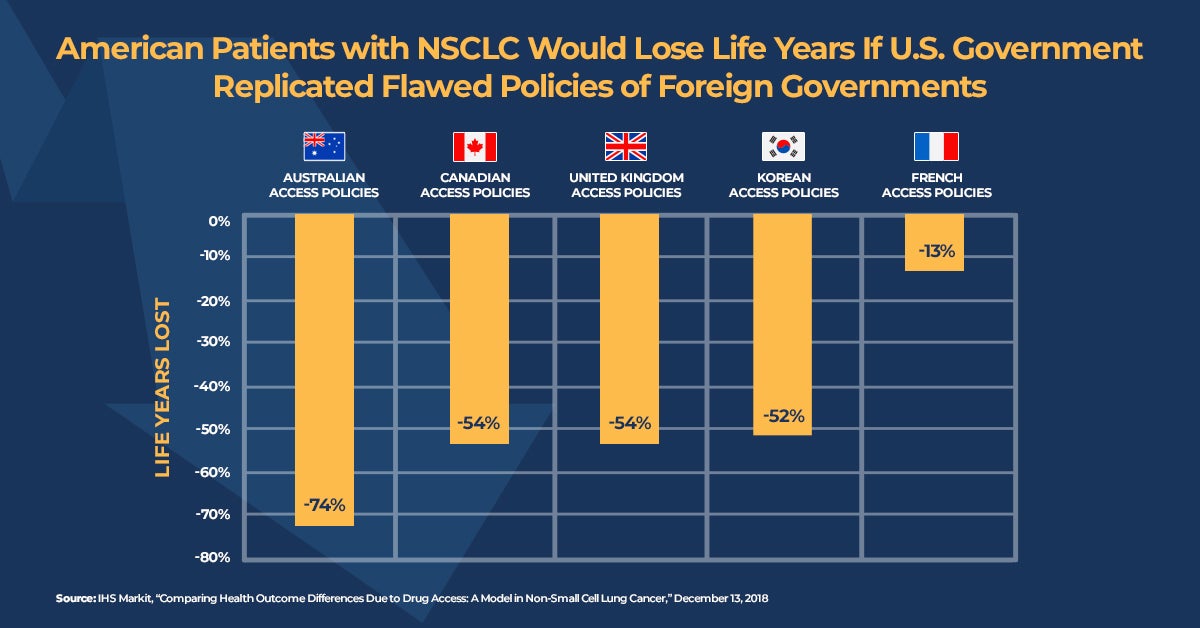
This is just the latest piece of evidence demonstrating the very real threat to health outcomes posed by the IPI model. The White House Council of Economic Advisers released a report in October that also concluded replicating foreign policies would be bad for American patients. Specifically, the report found increases in mortality for patients 55 and older in the United States if European-style price controls were adopted here.
In addition, the administration's suggestion that the IPI model would lower out-of-pocket costs for seniors does not tell the whole story. Avalere conducted a study and concluded most seniors will not see a reduction in out-of-pocket costs. In fact, Avalere estimates that, if the model included the 27 medicines listed in the Office of the Assistant Secretary of Planning and Evaluation report, less than 1 percent of seniors in Medicare would potentially see reduced out-of-pocket costs. This analysis takes into account that more than 87 percent of Part B beneficiaries have supplemental insurance to cover their out-of-pocket costs.
Study after study underscores that the administration should stop this harmful proposal and instead pursue reforms that strengthen market competition and the move toward value-based care, which can control costs while supporting better outcomes for patients.
Nicole Longo
Nicole Longo is Deputy Vice President of public affairs at PhRMA focusing on Medicare, 340B, importation and more. She previously worked for a D.C.-based public affairs firm where she assisted a wide range of clients with communications efforts on everything from trade policy to agriculture policy to health care policy. Outside the office, Nicole can be found trying new restaurants (usually Italian), taking an occasional barre class and cheering on the Cincinnati Bengals.
Nicole Longo
Author Twitter
Author LinkedIn
What AARP isn’t telling seniors about MFN
August 24, 2026
CMS proposal could discourage patient-centered innovation
August 18, 2026
Nearly 1 in 4 patients initially denied access to IRA medicines
August 6, 2026
Medicare Part D at 20: Building on a strong foundation
July 23, 2026
MFN won’t lower costs when insurers call the shots
May 8, 2026
Guest Blog: How MFN price controls could decide my health care
April 30, 2026
States should avoid repeating the IRA’s price‑setting mistakes
April 21, 2026
Insurers routinely block seniors’ access to medicines in Medicare Part D
March 18, 2026
MFN undermines U.S. biopharmaceutical innovation
February 25, 2026
CMS puts patients and innovation at risk with MFN
February 24, 2026
New list of selected drugs highlights growing consequences of government price setting
January 28, 2026
Guest blog: Making the most of the Medicare Prescription Payment Plan
December 8, 2025
What seniors can expect this open enrollment
October 14, 2025
Part D premiums are going up, while choices are going down
October 8, 2025
Delivering breakthroughs and lower costs for patients
September 8, 2025
Celebrating 60 Years of Medicare
July 30, 2025
Medicare patients face higher drug costs, despite IRA promises
July 22, 2025
Medicare Part D plans initially denied medicines for more than 70% of patients in four chronic disease areas
June 16, 2025
Health care practitioners sound the alarm on middlemen-imposed barriers to patient care, need for policy change
March 13, 2025
CMS, don’t fall behind the rest of the medical community on obesity
February 14, 2025
A new administration poses new opportunities for patient access
December 17, 2024
Is CMS paying attention to the growing access barriers for Medicare patients under the IRA?
October 18, 2024
Did the administration consider the importance of blood cancer medicines to patients in price setting process?
October 8, 2024
Did the administration consider the importance of blood clot medicines to patients in the price setting process?
September 25, 2024
The Inflation Reduction Act could increase costs and reduce access for millions of seniors
September 17, 2024
Are the IRA’s Part B inflation rebates lowering costs for Medicare patients? No.
September 16, 2024
Did the administration consider the value of innovative diabetes medicines in price setting process?
August 28, 2024
New survey: Insurers confirm IRA will reduce patient treatment options
August 20, 2024
The unintended consequences of government price setting in Medicare Part D
August 16, 2024
Don’t put the government between patients and their medicines
August 7, 2024
Biosimilars continue to drive market competition and increase savings for seniors
August 6, 2024
What is the low-income subsidy program and how is it changing?
July 31, 2024
Three things to know about the United Nations’ new HIV/AIDS report
July 31, 2024
Case study: How seniors could face access disruptions because of the IRA’s price setting provisions
July 22, 2024
PhRMA reiterates concerns with IRA price setting program, urges CMS to mitigate harm
July 3, 2024
The IRA could lead to higher out-of-pocket costs for 3.5 million Medicare patients in 2026
June 25, 2024
ICYMI: Misaligned policies undermine patient access
June 6, 2024
IRA is already negatively impacting access to medicines in Part D
April 25, 2024
New study finds insurers and PBMs increasing access restrictions in Medicare Part D
April 16, 2024
New analysis: Flawed assessments of a medicine’s value jeopardize patient access
April 11, 2024
3 Takeaways from POLITICO’s Health Care Summit
April 3, 2024
As the administration continues to falsely claim Medicare “negotiation,” keep these points in mind
February 1, 2024
New analysis of patient access restrictions in the United Kingdom
November 21, 2023
ICYMI: 3 takeaways on the IRA’s unintended consequences from America’s Physician Groups’ 2023 annual fall conference
November 6, 2023
ICYMI: Government watchdog report finds patients in Medicare Part D paid billions more for medicines than insurers and PBMs
September 28, 2023
IRA threatens seniors’ access to robust treatment options
September 26, 2023
Medicare Prescription Payment Plan will benefit patients if implemented correctly
September 21, 2023
Correcting the record: IRA’s government price setting provisions are unconstitutional
September 8, 2023
IRA changes to Part D risk access to medicines
August 24, 2023
With the first list of medicines out, let’s not forget why government price setting is bad policy
August 22, 2023
One year later IRAs unintended consequences are becoming reality
August 16, 2023
AARP’s latest misleading report
August 11, 2023
Navigating the Patient Experience Survey: Protecting Lifelines to Access and Innovation
July 26, 2023
Four things for CMS to keep in mind as they implement changes to Part D
June 7, 2023
CMS guidance on IRA price setting process doubles down on bad policy
April 14, 2023
A guide to MedPAC’s Part B vote today
April 13, 2023
MedPAC proposal threatens access to medicines in Part B
April 6, 2023
States can support access to medicine as COVID-19 Public Health Emergency ends
April 5, 2023
CMS coverage policy is detrimental to Alzheimer’s patients
April 4, 2023
How Part B’s ASP system helps control costs for the government and seniors
March 30, 2023
Medicare Part B spending in four points
March 28, 2023
Minnesota lawmakers are letting PBMs off the hook, and threatening patients’ access to medicines
January 31, 2023
In their own words: Insured Americans support policy reforms that address access and affordability concerns
December 14, 2022
Medicare Part D open enrollment and what recent changes mean for beneficiaries
November 17, 2022
Many seniors are paying more for Part D medicines than their insurer
October 18, 2022
Biosimilar uptake is increasing and so are health savings
October 17, 2022
Busting 3 Myths About Copay Coupons
October 5, 2022
CMS coverage policies restrict patient access to important treatment options for Alzheimer’s disease
September 1, 2022
Myth vs. Fact: The Senate’s latest price setting proposal
August 5, 2022
The Senate’s latest price setting proposal will undermine U.S. economic growth
August 3, 2022
Celebrating Medicare’s 57th anniversary
August 2, 2022
The Senate’s latest price setting proposal will undermine: Our health care system
July 28, 2022
The Senate’s latest price setting proposal will undermine: Patient access to medicines
July 26, 2022
New research shows competition driven by biosimilars helps control costs in Part B
July 19, 2022
Polling continues to show voters reject so-called Medicare “negotiation” once they learn about consequences for patients
July 12, 2022
CMS coverage decision restricts access to treatments for Alzheimer’s disease
June 22, 2022
Report finds PBMs are increasingly restricting patient access to medicines
May 25, 2022
Annual projections from NHE compared to actual health care spending
May 5, 2022
Three charts show how the Medicare Part D program could be improved to work better for seniors and people with disabilities
April 27, 2022
Part D 101: Three charts show how the program provides comprehensive prescription drug coverage
April 26, 2022
Government price setting leaves behind families counting on new medicines
February 23, 2022
Part B 101: Three charts show the program helps control costs for health care system and enrollees
February 18, 2022
PhRMA submits comments urging CMS to withdraw coverage proposal
February 11, 2022
Government price setting won’t stop insurers from shifting costs to patients
February 2, 2022
Research and development continues long after a medicine is initially approved
February 1, 2022
It’s a new year, but sadly Congress is still pursuing flawed price setting policies
January 25, 2022
Post-approval research save lives. Why is Congress trying disincentivize it?
December 17, 2021
A price control by any other name would still put patients at risk and threaten innovation
December 9, 2021
Making medicines more affordable: Making insurance work like insurance
December 8, 2021
3 things to know about the importance of post-approval research and development
December 6, 2021
Guest post: Congress should not put future innovation at risk
November 29, 2021
What is missing in the current drug pricing plan
November 23, 2021
ICYMI: PhRMA CEO speaks at STAT Summit about government price setting
November 19, 2021
Three things to know about so-called Medicare negotiation polling
November 18, 2021
In the current health care debate, Congress has lost sight of what matters to U.S. voters
November 15, 2021
Making medicines more affordable: Modernizing Medicare
November 11, 2021
What they are saying: Government price setting for medicines is not the answer
November 4, 2021
CMS finds medication adherence saved Medicare up to 46.6B in avoided health care costs between 2013 and 2018
October 19, 2021
ICYMI: New study confirms policies like H.R. 3 could significantly reduce drug development
October 18, 2021
New poll shows Americans reject Medicare negotiation once they learn more about the policy
October 15, 2021
What is Kaiser Family Foundation up to?
October 12, 2021
Industry leaders discuss the impact of the drug pricing debate
September 23, 2021
Five reasons tying VA prices to Medicare Part D misses the mark
September 22, 2021
America’s biopharmaceutical companies to Congress: Government “negotiation” is the wrong approach
September 15, 2021
Recent polling misrepresents public support for Medicare “negotiation”
August 31, 2021
What they’re saying: Patient advocates want to protect Medicare from government interference
August 24, 2021
Myth vs. fact: Polling and Medicare “negotiation”
August 12, 2021
ICYMI: Event spotlights how we can make Medicare work better for patients
August 4, 2021
Celebrating Medicare’s 56th anniversary
July 30, 2021
Government “negotiation” could have devastating consequences for Medicare enrollees
July 23, 2021
Protecting Medicare from government interference
July 21, 2021
Data shows voters strongly support protecting access to their medicines
July 15, 2021
Medicare “negotiation” proposals threaten Americans’ access to medicines
June 30, 2021
The ABCs (and Ds) of Medicare
May 13, 2021
ICYMI: Bipartisan lawmakers urge new administration to oppose changes to six protected classes policy
March 11, 2021
Getting the 340B program back on track in 2021
March 10, 2021
Key excerpts: PhRMA submits comments to keep the six protected classes protected
February 19, 2021
Action needed to preserve the six protected classes
February 3, 2021
End of year Part D reading List
December 18, 2020
New analysis finds stark difference in coverage of breast cancer medicines for seniors in the United States and England
December 10, 2020
No matter how you look at it, the Most Favored Nation rule is bad policy
December 1, 2020
Final rebate rule represents right way to change Medicare
December 1, 2020
Open Enrollment: How to find a Medicare plan that meets your needs
October 14, 2020
Three reasons why repealing the Part D non-interference clause is a bad idea
October 1, 2020
Growth in innovative, value-based contracts holds promise for the health system and for patients
September 24, 2020
Innovative contracts drive access for patients and value for the system
September 9, 2020
Supporting access to vaccines for Part D beneficiaries
August 12, 2020
Medicare’s 55th anniversary: Celebrating the success of Part D
July 30, 2020
PhRMA submits comments to CMS on policy changes for in-home care under Part B during COVID-19
May 6, 2020
ICYMI: Patients saved nearly $800,000 out of pocket through innovative contracting arrangements
April 20, 2020
PhRMA comments on HHS proposed rule on manufacturer cost-sharing assistance and accumulator adjustment programs
March 3, 2020
Addressing barriers that inhibit value-based contracts
February 21, 2020
Three reasons the Administration should abandon its International Pricing Index proposal
January 31, 2020
New data show how ICER’s value framework could prevent or delay access to treatments for Medicaid patients across the country
November 4, 2019
Event tomorrow: Maintaining America’s leadership in access and innovation
October 16, 2019
Pelosi’s radical plan would leave Alzheimer’s patients behind
October 16, 2019
What they are saying: Broad opposition to Pelosi’s radical drug pricing plan
October 10, 2019
Guest Post: Following my stroke, having access to ground-breaking medical innovation has never been more important
September 4, 2019
New analysis: Government intervention in Part B threatens patient access to medicines
August 19, 2019
Setting the record straight on international reference pricing
July 16, 2019
No matter how you structure it, government arbitration is wrong for Medicare drug coverage
June 27, 2019
What you should know: Government arbitration is the wrong way to change Medicare
June 10, 2019
By the numbers: A look at the Part B International Pricing Index Model
June 6, 2019
How the rebate rule would help reduce patients’ out-of-pocket costs
June 3, 2019
Ask About Adherence: Improving adherence among osteoporosis patients could save up to $6.52 billion
May 29, 2019
Ask About Adherence: OIG proposed rule to reform the rebate system could improve adherence
May 15, 2019
4 Things to know about the IQVIA “Medicine Use and Spending” report
May 9, 2019
Event tomorrow: Improving access and affordability for America’s seniors
May 7, 2019
Fact Check: How the Part B International Pricing Index Model replaces market competition with government-set prices
May 3, 2019
Six policy solutions to help patients afford their insulin
April 9, 2019
PhRMA comments on OIG proposed rule to reform the rebate system
April 8, 2019
340B continues to drive shift in site of care for physician-administered medicines to more expensive hospital settings
April 5, 2019
Fact Check: How the Part B International Pricing Index model threatens patient access
March 29, 2019
OIG proposed rule could help strengthen the Part D market
March 28, 2019
Rebate rule would help ensure seniors with diabetes don’t pay more for their medicine than their insurer
March 25, 2019
Bipartisan lawmakers urge Administration to rethink proposed changes to six protected classes policy
March 22, 2019
New analysis shows 820,000 prescriptions would be in jeopardy if ICER’s value framework is used in Medicaid
March 20, 2019
New analysis finds Average Sales Price system has led to significant cost savings for Medicare and seniors
March 7, 2019
New “Prescription for Medicare” campaign focuses on impacts of wrong and right solutions for Medicare
March 6, 2019
New study shows why insurers should share rebates with Medicare Part D beneficiaries on a mandatory basis
February 14, 2019
In survey, PhRMA member companies highlight impact of IPI on R&D
February 5, 2019
PhRMA comments to administration on Medicare Part D proposed rule
January 25, 2019
New research shows changes to the six protected classes would harm most vulnerable patients and are unnecessary
January 24, 2019
Keep the Six Protected Classes, protected
January 22, 2019
PhRMA comments to administration on International Pricing Index Model
January 3, 2019
10 things you should know about medicine spending and costs
January 2, 2019
ICYMI: WSJ and NYT highlight concerns with Part B International Pricing Index Model
December 19, 2018
Groups sound the alarm on administration’s new Part B proposal
November 14, 2018
4 things you need to know about the administration’s latest Part B proposal
November 5, 2018
PhRMA submission to the 2019 National Trade Estimate Report urges action to protect U.S. biopharmaceutical innovation
November 2, 2018
PhRMA comments in response to request for information on competitive bidding program in Medicare Part B
September 25, 2018
What if a couple of small fixes could protect seniors in the donut hole and save them money on out-of-pocket costs?
September 13, 2018
Fact Check Friday: Getting the facts straight about negotiation in Medicare Part B
August 24, 2018
How much do you know about Medicare Part B?
July 31, 2018
ICER’s budget impact threshold: Sounding a false alarm on affordability and access
July 24, 2018
PhRMA submission to HHS on blueprint to lower drug prices and reduce out-of-pocket costs
July 16, 2018
Event next week: Supporting the next generation of lifesaving medicines
July 12, 2018
Pass-through rebates do not violate non-interference clause but they do increase savings for seniors
July 2, 2018
Guest post: Excellent care for LGBTQ patients requires cultural humility and specific medical knowledge
June 28, 2018
Medicare Part D cliff ahead
June 21, 2018
Part D cliff looms for seniors, as program stability could be in jeopardy
June 18, 2018
New analysis shows that more medicines worldwide are available to U.S. patients
June 5, 2018
New analysis shows that HTA organizations may frequently restrict access to cancer treatments
June 1, 2018
New analysis shows negative impact of ICER’s value framework on patient access in Medicare Part B
May 31, 2018
Event tomorrow: Improving patient access to lifesaving medicines
May 22, 2018
Sharing negotiated discounts at the pharmacy counter could save seniors with diabetes more than $350 annually
May 17, 2018
New “Let’s Talk About Medicare” campaign focuses on solutions to improve affordability and predictability for seniors in Part D
May 9, 2018
Event tomorrow: Making the biopharmaceutical supply chain work for patients
May 2, 2018
Medicare Monday: New Xcenda white paper looks at four strengths of Part B
April 30, 2018
PPA celebrates 13 years of helping patients access their medicines
April 5, 2018
Medicare Monday: Moran finds Part B medicine prices are stable, not a key driver of Medicare costs
March 26, 2018
ICYMI: Two PBM reports show dramatic slowdown in medicine spending growth
March 2, 2018
Copay coupons can help ease patients’ out-of-pocket costs
February 16, 2018
PhRMA launches new consumer-facing Let’s Talk About Cost website
January 24, 2018
Guess what? Part B drug spending remains stable share of Medicare spending
January 23, 2018
PhRMA urges CMS to share the savings with seniors
January 17, 2018