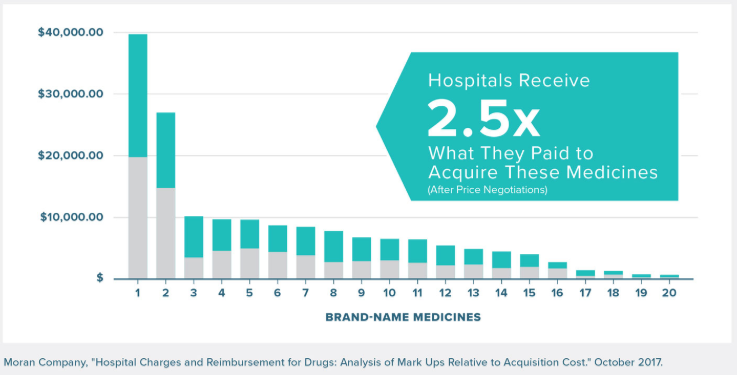
Hospitals mark up medicine prices, on average, nearly 500 percent, according to a new analysis from the Moran Company that was commissioned by the Pharmaceutical Research and Manufacturers of America (PhRMA). The analysis of 20 medicines also found the amount hospitals receive after negotiations with commercial payers is, on average, more than 250 percent what they paid to acquire the medicine. This means a hospital is paid two and a half times what the biopharmaceutical company, who brought the medicine to market, receives. This hidden threat to affordability is a driver of higher cost sharing and premiums for patients across the country.
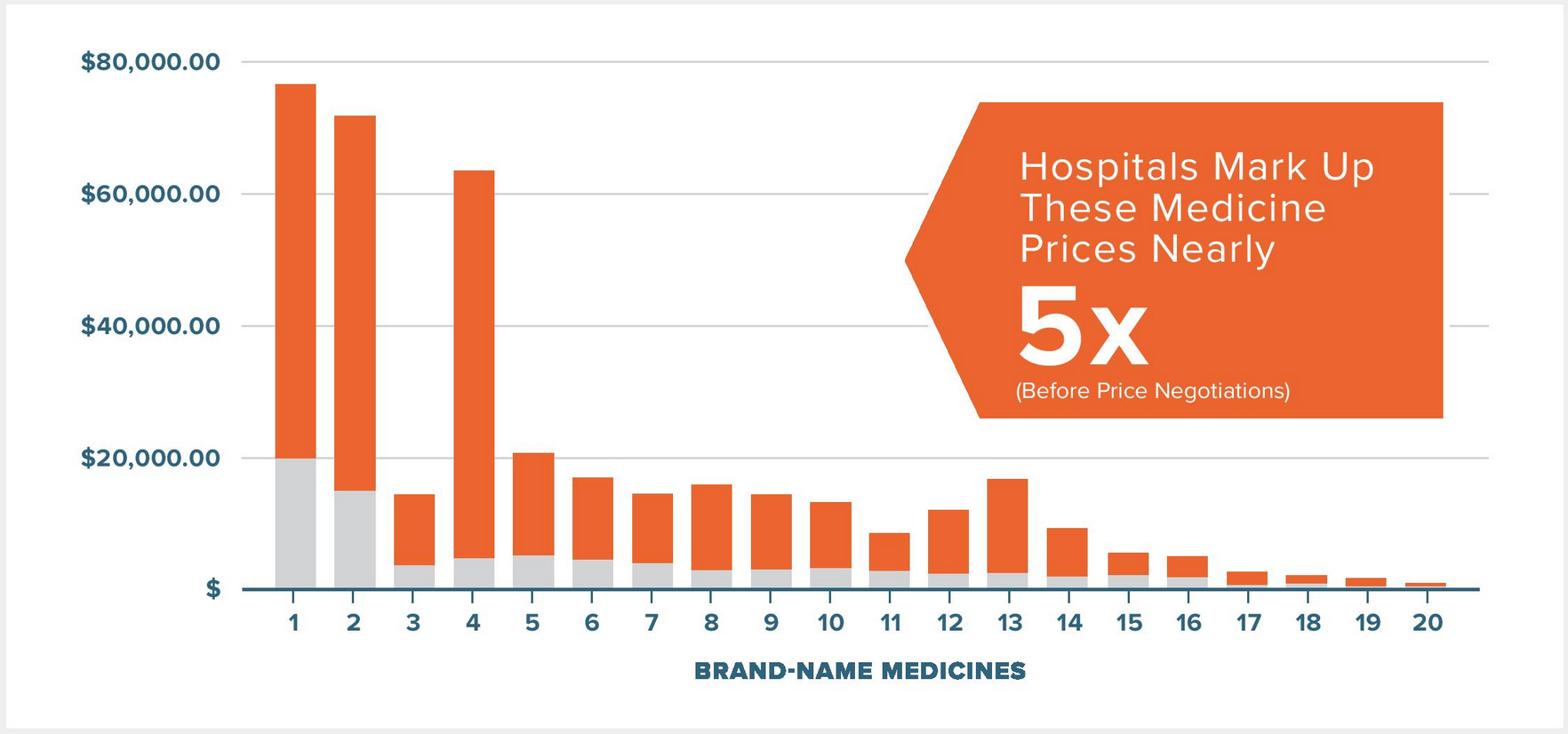
Insurers pay for medicines administered in hospital outpatient settings differently than when they are purchased at a pharmacy. For example, many cancer treatments are provided in a hospital facility where the hospital purchases the medicine directly and is then reimbursed by the patient’s insurer – often with a steep markup. How much a hospital can charge for a medicine and what they get paid varies widely based on local hospital and insurer market dynamics. When hospitals gain market power through consolidation, they are able to demand higher reimbursement from commercial payers.
The Moran analysis evaluated 20 different physician-administered medicines across a range of therapeutic areas, such as cancer, autoimmune disorders and arthritis, and found that hospitals are significantly marking up the prices of these medicines. Even after negotiations with commercial payers, hospitals are often paid tens of thousands of dollars more than the amount the hospital paid to buy the medicine.
Importantly, the Moran findings are a conservative estimate of hospital markups and margins for these medicines reimbursed by commercial payers because the analysis did not take into account the impact of the 340B program. On average, 340B prices are significantly lower than the average sales price (ASP) – about 22.5 percent below ASP, according to the Medicare Payment Advisory Commission (MedPAC) – which is why medicines purchased by hospitals at 340B prices could have even larger margins.
While hospital markups lead to higher costs for patients, employers and payers, these markups are often overlooked in conversations about medicine costs. As the provider market continues to become more concentrated and the number of medicines being administered in hospital-owned facilities is growing, the amount hospitals mark up medicine prices needs greater scrutiny.
We welcome conversations about costs, but we need to take into account the entire biopharmaceutical supply chain, including the impact hospital markups have on access and affordability of medicines.
View the full analysis here. View the analysis infographics here. Learn more at www.LetsTalkAboutCost.org.
Robert Zirkelbach
Robert Zirkelbach is an accomplished public affairs executive with more than 20 years of experience shaping the debate and influencing policy on behalf of highly regulated industries and corporations. As Chief Public Affairs Officer & Head of Strategic Initiatives at the Pharmaceutical Research and Manufacturers of America (PhRMA), Zirkelbach leads public affairs, strategic initiatives and membership on behalf of America’s biopharmaceutical industry.
He oversees integrated public affairs campaigns that advance patient-first solutions, strengthen our health care system and preserve the role of the U.S. as the world leader in biopharmaceutical innovation. Since returning to PhRMA in 2023, he has elevated the industry’s voice in Washington, expanded PhRMA’s membership and spearheaded the organization’s five-year strategic plan.
Previously, Zirkelbach served as Global Head of Issues and Advocacy at ExxonMobil, where he led high-impact advocacy campaigns on issues central to the company’s mission, including climate change and plastic waste. During his tenure, he also oversaw a strategic risk function responsible for identifying and mitigating potential policy, geopolitical and reputation risks facing the company. Zirkelbach served as spokesman for America’s Health Insurance Plans (AHIP) during the pivotal debate and implementation of the Affordable Care Act. He started his career on Capitol Hill as press secretary for Congressman Jim Nussle (R-IA).
Zirkelbach is a graduate of Central College. He lives with his wife and two children in Washington, DC.
Robby Zirklebach
https://www.linkedin.com/in/robzirk/
Chief Public Affairs Officer & Head of Strategic Initiatives
Employers faced $12.8 billion in higher costs due to 340B in 2025
New Report: Hospitals, clinics and for-profit partners pocketed $142B in 2025 from 340B
Hospitals are hiding information that could lower costs for patients
As football season kicks off, hospitals keep scoring on 340B
ICYMI: Hospital consolidation is driving up health care costs
It's time to modernize 340B: The case for a rebate model
ICYMI: Fox business hosts call 340B a ‘Rotten System’ and ‘Cash Cow’ for hospitals
340B’s reality: A booming business for hospitals, pharmacies and corporate giants
340B’s lack of guardrails lets big hospital systems turn it into an oversight-free revenue stream
Private equity's new play? Become a nonprofit to profit off 340B.
340B is growing, but it is unclear if Illinois patients benefit
Fox Business spotlights hospitals abuse of the 340B program
The Wall Street Journal raises new alarms about 340B
Hospitals in the hot seat: Congress sharpens focus on 340B, consolidation and rising costs
New "Goldmine” ad reveals hospitals hide how they profit from 340B markups
A program off track: How 340B drives both hospital consolidation and system gaming
Washington Post Editorial Board says 340B has become “corporate welfare”
Modernizing 340B using rapid verification: The case for a rebate model
Hospitals drive nearly 80% of the U.S. health spending gap
Congress should look under the hood of 340B, hospitals don't want them to
340B hospitals buy low and sell high, a new analysis shows
New report from Minnesota: 340B is generating billions for big hospitals
340B hospital markup scheme is costing states, taxpayers billions
Questions mount over 340B program and increased cost to everyone
PhRMA Forum 2026 highlights the importance of fostering the next era of American leadership
50-state poll says Americans are concerned that hospital markups hurt patients
New analysis finds 340B hospitals push patients toward costly care to boost profits
Data shows tax-exempt hospital profit-seeking behavior, not drug prices, is driving explosive 340B expansion
Big, tax-exempt hospitals are charging cancer patients, employers massive medicine markups
340B’s billion-dollar boom: Oversight lags as spending soars
New study: 340B rebate model pilot won’t hurt cash flow for providers
One thing the Senate can agree on: It’s time to fix 340B
Middlemen mark up drug prices and keep discounts meant for you
The Administration approves manufacturers’ 340B rebate pilot plans
340B abuses are fueling higher Medicare costs, new BRG report shows
ICYMI: The Wall Street Journal calls 340B reform a “good idea to cut drug costs”
340B hospitals use scare tactics to evade accountability
Why states struggle to deliver savings: Middlemen and 340B siphon dollars from patients and states
CBO: 340B program costs taxpayers, no evidence patients benefit
PhRMA stresses importance of 340B Rebate Model Pilot
New “Meet Mark” ad exposes how the 340B hospital markup program drives up costs for everyone
New study unmasks how big-city hospitals exploit 340B by posing as rural providers
Study: 340B hospitals drive up patient drug costs
Curbing 340B abuse and rising costs with the rebate model
The hidden cost of 340B: A multi-billion-dollar burden on taxpayers and Medicaid
Latest analysis from Ohio exposes growing abuses of the 340B markup program
New report finds rampant abuse of the 340B program
How the 340B hospital markup program could hurt Michigan patients
New “Balance the Scales” campaign highlights why Americans pay more for prescription medicines
How the 340B hospital markup program and PBMs drive up costs for U.S. patients
Foreign first pricing schemes don’t address why Americans pay more
When hospitals have free rein to mark up drug prices, who pays the price?
New report finds more abuse of 340B program by hospitals and drug middlemen
A closer look at how health care consolidation drives up patient costs, creates barriers to care
Health care practitioners sound the alarm on middlemen-imposed barriers to patient care, need for policy change
340B markup program is a hidden tax, increasing costs for employers, straining state and federal budgets
New report sheds light on payment flows in the pharmaceutical supply chain, including the role of 340B and vertical integration
Wrapping up the J.P. Morgan Healthcare Conference
NYT exposes hospitals, middlemen make millions off a hospital markup program
PhRMA CEOs Tee Up Next Week's Health Care Conference
New study: Entities that don’t make medicines get half of what is spent on those medicines
A new administration poses new opportunities for patient access
New 340B report from Minnesota exposes steep hospital markups on medicines, patient benefits remain unclear
Michigan hospitals using federal program to markup cost of medicines, gouging patients
340B spending is exploding, forcing prices up for patients, employers and government programs
Three things to know about 340B contract pharmacies
PhRMA urges HRSA not to impede new 340B pricing approaches to improve transparency and integrity
Illegal abuse of 340B hurts us all
Three things to know about the United Nations’ new HIV/AIDS report
Case study: How seniors could face access disruptions because of the IRA’s price setting provisions
340B sales go up, free or reduced-cost care offered at hospitals goes down
ICYMI: Health care policy should be driven by patients, not politics
ICYMI: Misaligned policies undermine patient access
The hidden bill patients don’t know they are paying
340B grows and grows, but patients do not see the savings
340B grows and grows, but patients do not see the savings
3 Takeaways from POLITICO’s Health Care Summit
PBMs using 340B program to drive profits at patients’ expense
What’s the 340B program like in your state?
New year, same exploitation of the 340B program
How the 340B program became a PBM giveaway
New analysis of patient access restrictions in the United Kingdom
New report adds to questions about nonprofit status of 340B hospitals
ICYMI: 3 takeaways on the IRA’s unintended consequences from America’s Physician Groups’ 2023 annual fall conference
By the Numbers: 340B continues to climb in profits, dwindle with patient support
New 340B Mega Guidance
New report: Hospitals mark up medicine prices 500%
read more
PhRMA responds to Senate: Today’s 340B program leaves patients behind | PhRMA
Navigating the Patient Experience Survey: Protecting Lifelines to Access and Innovation
New studies add to body of evidence questioning 340B efficacy
340B program reaches $100 billion in sales, while patients are left behind
Nonprofit hospitals fall short on community benefit, studies show
States can support access to medicine as COVID-19 Public Health Emergency ends
Why Congress should prioritize fixing the 340B program
What they are saying: Nonprofit hospitals are gaming the system at the expense of patients
Minnesota lawmakers are letting PBMs off the hook, and threatening patients’ access to medicines
ICYMI: PhRMA kicks off the year at the 2023 J.P. Morgan Health Care Conference
340B program continues to drive shift in care to more expensive hospital settings
In their own words: Insured Americans support policy reforms that address access and affordability concerns
The 340B program is interfering with the U.S. biosimilars market and impacting patient costs
Three ways 340B is failing vulnerable patients
If patients aren’t benefiting from the 340B program, who is?
New data: The 340B program is driving up costs for patients and our health care system
Word of the Month: 340B covered entity
340B program remains second largest federal drug program, yet little solid evidence of benefits to patient
Study after study after study: Contract pharmacy expansion not aligned in communities 340B is meant to serve
CMS coverage decision restricts access to treatments for Alzheimer’s disease
New research finds gaps in charity care provided by 340B hospitals
Report finds PBMs are increasingly restricting patient access to medicines
New analysis confirms hospitals markup prices for oncology therapies
By the numbers: Contract pharmacy participation in the 340B program
340B 101: Three charts show the program maximizes hospitals’ bottom line with little consideration for patients
New study finds more than half of brand medicine spending goes to the supply chain and others
Making medicines more affordable: Preserving safety-net programs like 340B
Fact Check: Do contract pharmacies help patients access 340B medicines? No.
New video: Why changes to the 340B program are essential for patients
To drive up profits, hospitals continue unnecessary medicine mark-ups, burdening patients, employers and health care system
New analysis adds to research questioning whether 340B is working as Congress intended
340B hospitals among those that provide lowest levels of community benefit across the country
Getting the 340B program back on track in 2021
Correcting the record: Biopharmaceutical companies remain committed to the 340B program and helping patients
Fact Check: How hospitals continue to drive health care spending
PhRMA submits comments on ways to refocus the 340B program on America’s vulnerable patients
340B hospitals and for-profit pharmacies generating significant revenue from program meant to help needy patients
Survey found insurance premiums grew faster than inflation in 2020
Growth in 340B program has not translated to improvements for patients
Growth in innovative, value-based contracts holds promise for the health system and for patients
Innovative contracts drive access for patients and value for the system
ICYMI: Patients saved nearly $800,000 out of pocket through innovative contracting arrangements
PhRMA comments on HHS proposed rule on manufacturer cost-sharing assistance and accumulator adjustment programs
Addressing barriers that inhibit value-based contracts
Cancer medicines cost twice as much at hospitals, study finds
New GAO report: Some hospitals participating in 340B may not be eligible for the program
Nearly 50% of brand medicine spending goes to the supply chain and others
New NHE data: Medicine prices declined, and hospitals were biggest driver of health care spending in 2018
New data show how ICER’s value framework could prevent or delay access to treatments for Medicaid patients across the country
Hospitals make 9 times more than physicians’ offices on provider-administered medicines
Guest Post: Following my stroke, having access to ground-breaking medical innovation has never been more important
340B Spotlight: How for-profit middlemen are taking advantage of a program meant to support nonprofit entities and patients
Setting the record straight on international reference pricing
Study finds hospitals continue to mark up medicines up to 500% of their cost
Fresh data show, yet again, 340B is growing while charity care dwindles at many 340B hospitals
New study finds hospitals continue to push patients to costlier outpatient settings
340B continues to drive shift in site of care for physician-administered medicines to more expensive hospital settings
Fact Check: How the Part B International Pricing Index model threatens patient access
New analysis shows 820,000 prescriptions would be in jeopardy if ICER’s value framework is used in Medicaid
PhRMA comments to administration on Medicare Part D proposed rule
ICYMI: New study reinforces dangers of proposed IPI model
New study finds hospitals prescribe more medicines, and more expensive medicines, after joining 340B program
Groups sound the alarm on administration’s new Part B proposal
4 things you need to know about the administration’s latest Part B proposal
PhRMA submission to the 2019 National Trade Estimate Report urges action to protect U.S. biopharmaceutical innovation
New study finds some hospitals mark up medicine prices at least 700 percent
New analysis finds 340B medicine sales hit record high in 2017 and continue to grow as a share of total drug spending
How much do you know about Medicare Part B?
ICER’s budget impact threshold: Sounding a false alarm on affordability and access
PhRMA submission to HHS on blueprint to lower drug prices and reduce out-of-pocket costs
Event next week: Supporting the next generation of lifesaving medicines
GAO again recommends improvements to 340B program
Guest post: Excellent care for LGBTQ patients requires cultural humility and specific medical knowledge
ICYMI: Analysis finds higher outpatient drug spending at 340B hospitals
New analysis shows that more medicines worldwide are available to U.S. patients
New analysis shows that HTA organizations may frequently restrict access to cancer treatments
New analysis shows negative impact of ICER’s value framework on patient access in Medicare Part B
Event tomorrow: Improving patient access to lifesaving medicines
New 340B analysis: Hospitals raking in billions while uncompensated care drops by billions
Event tomorrow: Making the biopharmaceutical supply chain work for patients
Patients pay the price when hospitals mark up cancer medicines
PPA celebrates 13 years of helping patients access their medicines
340B Spotlight: How much money are hospitals pocketing under 340B and what are they doing with those profits?
Copay coupons can help ease patients’ out-of-pocket costs
340B Spotlight: Hospital system adds voice to comments about flawed 340B program
Fact Check Friday: The truth about the cost of 340B to patients
PhRMA launches new consumer-facing Let’s Talk About Cost website
340B Spotlight: New pieces of legislation continue momentum to fix 340B program
Video: What is a results-based contract?
340B Spotlight: ICYMI – 340B hearing, new reports highlight growing need for program reform
340B Spotlight: New analysis finds 340B program growth continues to accelerate despite false claims
340B Spotlight: ICYMI – AJC looks at how some Georgia hospitals are profiting off 340B
Foreign government price setting by any name harms innovation and access to medicines
Compulsory licensing: A misused and abused international trade law
Government-imposed price controls threaten innovation and access
340B Spotlight: 340B hospitals continue to benefit from consolidation at expense of patients
Biopharmaceutical industry’s success reducing disparities for African Americans
Medicare Monday: What is IPAB, and why is it bad for patients?
340B Spotlight: Audit findings show importance of increased oversight of 340B program
How much are hospitals marking up the price of medicines? The answer may surprise you.
340B
Access
Hospitals
340B Spotlight
How much are hospitals marking up the price of medicines? The answer may surprise you.
How much are hospitals marking up the price of medicines? The answer may surprise you.