
The extraordinary financial pressure COVID-19 is creating for the U.S. economy underscores the need for a renewed push toward a more value-driven health care system that prioritizes patient access and affordability. Now more than ever, we need to make sure we’re spending our health resources wisely. That’s why it’s heartening to see the number of innovative contracts grow between biopharmaceutical companies and insurance companies as potential solutions for better affordability and better outcomes.
From 2009 through the first half of 2020, the number of publicly announced innovative contracts grew from two to 77. These contracts were undertaken by over two dozen biopharmaceutical companies and cover 49 brand medicines that address a wide range of diseases, including treatments for debilitating chronic conditions like multiple sclerosis and rheumatoid arthritis, as well as cutting-edge gene therapies for rare genetic disorders.
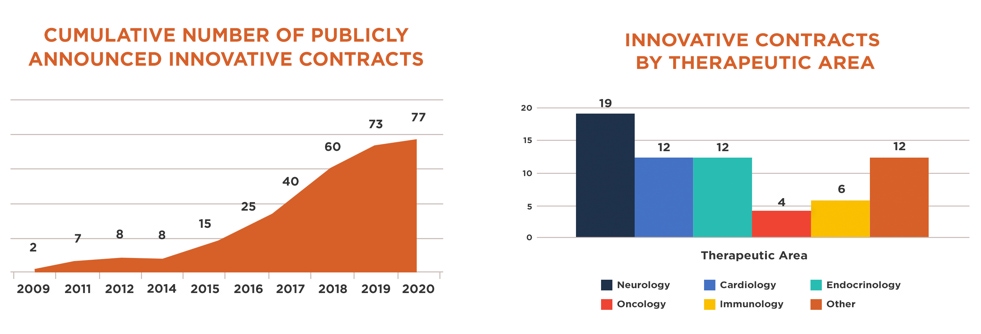
Innovative contracts help reduce cost pressures on the health care system by basing payment for medicines on how well they work for patients – as is the case with value-based contracts – or by allowing for a more flexible and sustainable approach to payment – such as with alternative financing arrangements like pay-over-time or subscription models. And by alleviating cost challenges for the system, they may enable broader patient access to life-saving medicines. In some cases, they’ve been shown to lower out-of-pocket costs for patients, which is particularly important given recent data indicate an upward trend in patient cost-sharing for brand medicines.
On top of the potential cost-saving benefits for patients and the system, innovative contracts can enable patient access without disrupting incentives for future innovation, which is essential as biopharmaceutical companies work around the clock to develop new treatments and vaccines to beat COVID-19.
As we seek to move our health care system from a fee-for-service model towards a more resilient, value-driven health care system that is better prepared for the next health crisis, it’s important that we pursue and advance policy solutions that improve access while maintaining incentives for the biopharmaceutical innovation.
To learn more, visit www.phrma.org/value-collaborative.
Katie Koziara
Katie Koziara is Senior Director of public affairs at PhRMA focusing on the organization’s executive visibility work and media relations strategy. She previously ran the social media strategy for a D.C.-based non-profit working on federal management and leadership issues. Katie earned her B.A. in Public Policy from the University of Michigan’s Ford School and is currently earning her M.A. in Fiction Writing from Johns Hopkins University.
Katie Koziara
Health care practitioners sound the alarm on middlemen-imposed barriers to patient care, need for policy change
Three things to know about the United Nations’ new HIV/AIDS report
Case study: How seniors could face access disruptions because of the IRA’s price setting provisions
ICYMI: Misaligned policies undermine patient access
3 Takeaways from POLITICO’s Health Care Summit
New analysis of patient access restrictions in the United Kingdom
ICYMI: 3 takeaways on the IRA’s unintended consequences from America’s Physician Groups’ 2023 annual fall conference
Incomplete evaluations undermine patient access to transformational medicine
Navigating the Patient Experience Survey: Protecting Lifelines to Access and Innovation
States can support access to medicine as COVID-19 Public Health Emergency ends
Minnesota lawmakers are letting PBMs off the hook, and threatening patients’ access to medicines
In their own words: Insured Americans support policy reforms that address access and affordability concerns
CMS coverage decision restricts access to treatments for Alzheimer’s disease
You won’t fix what you don’t value: Two reasons why traditional cost-effective analyses can perpetuate health inequities
PhRMA presents research at ISPOR 2022
Report finds PBMs are increasingly restricting patient access to medicines
Innovative contracts continue to gain traction and improve quality of care
Study finds nearly half of payers believe innovative contracts can lead to lower patient out-of-pocket costs
Getting the 340B program back on track in 2021
Innovative contracts drive access for patients and value for the system
ICYMI: Patients saved nearly $800,000 out of pocket through innovative contracting arrangements
PhRMA comments on HHS proposed rule on manufacturer cost-sharing assistance and accumulator adjustment programs
Low-value health care costs $345B each year and provides little benefit
Addressing barriers that inhibit value-based contracts
Guest post: Value-based agreements can improve outcomes and even save patients money at the pharmacy counter
New data show how ICER’s value framework could prevent or delay access to treatments for Medicaid patients across the country
Guest Post: Following my stroke, having access to ground-breaking medical innovation has never been more important
Setting the record straight on international reference pricing
5 Ways to improve ICER’s value assessment framework
Assessing value top of mind at ISPOR 2019
Fact Check: How the Part B International Pricing Index model threatens patient access
New analysis shows 820,000 prescriptions would be in jeopardy if ICER’s value framework is used in Medicaid
Value assessments should include all the outcomes that matter to patients and families
PhRMA comments to administration on Medicare Part D proposed rule
ICYMI: New study reinforces dangers of proposed IPI model
Groups sound the alarm on administration’s new Part B proposal
4 things you need to know about the administration’s latest Part B proposal
PhRMA submission to the 2019 National Trade Estimate Report urges action to protect U.S. biopharmaceutical innovation
Event tomorrow: Leaders convene to discuss solutions to advance value-driven health care
New whitepaper identifies reasons why ICER’s cost-effectiveness analyses are not useful for payers
Guest post: Developing new payment models to ensure patients have access to high-investment therapies
Number of value-based contracts continues to rise
How much do you know about Medicare Part B?
ICER’s budget impact threshold: Sounding a false alarm on affordability and access
PhRMA submission to HHS on blueprint to lower drug prices and reduce out-of-pocket costs
Event next week: Supporting the next generation of lifesaving medicines
How ICER’s assessment of a new class of migraine treatments fails patients
Guest post: Excellent care for LGBTQ patients requires cultural humility and specific medical knowledge
Aspen Spotlight Health: Discussing the forefront of innovation
New analysis shows that more medicines worldwide are available to U.S. patients
New analysis shows that HTA organizations may frequently restrict access to cancer treatments
New analysis shows negative impact of ICER’s value framework on patient access in Medicare Part B
ICYMI: Recent survey adds to growing body of research on barriers to innovative payment approaches
Event tomorrow: Improving patient access to lifesaving medicines
Event tomorrow: Making the biopharmaceutical supply chain work for patients
Reality check: Value-based contracts are good for patients
Video: Barriers to results-based contracts
PPA celebrates 13 years of helping patients access their medicines
Improving care quality by engaging patients in shared decision making
ICYMI: Research shows promise of innovative payment arrangements in reducing costs, improving access
Copay coupons can help ease patients’ out-of-pocket costs
PhRMA launches new consumer-facing Let’s Talk About Cost website
Clarity around anti-kickback statute needed to promote innovative payment arrangements
Video: What is a results-based contract?
How much are hospitals marking up the price of medicines? The answer may surprise you.
PhRMA Foundation recognizes inaugural Challenge Award recipients
Johnson & Johnson, Pfizer, Walgreens and other CEOs discuss value in the future of health care
The journey to better health care requires a holistic view
Medicare Monday: How Part B has evolved over the years
Modernizing FDA regulations to advance a value-driven health care system
Foreign government price setting by any name harms innovation and access to medicines
PhRMA CEO in Forbes - How to negotiate better deals for prescription medicines
ICYMI: Avalere and FasterCures develop new value framework from patient perspective
Compulsory licensing: A misused and abused international trade law
Government-imposed price controls threaten innovation and access
ICYMI: Innovative payment models helping provide patient access to new medicines
RA medicines often demonstrate far greater benefits to patients than initially understood
New analysis: More than half of patients’ out-of-pocket spending for brand medicines is based on full list price
Stakeholders Agree: Modernize the legal framework to support move to value-driven health care
How do multiple sclerosis patients define value?
Biopharmaceutical industry’s success reducing disparities for African Americans
Medicare Monday: What is IPAB, and why is it bad for patients?
PhRMA CEO talks White House meeting, innovation & jobs with POLITICO’s Pulse Check
VIDEO: PhRMA CEO discusses #GOBOLDLY campaign and White House meeting with CNNMoney’s Maggie Lake
The Value Collaborative: Advancing private market solutions to achieve better health, lower costs
"Growth in innovative, value-based contracts holds promise for the health system and for patients"
Access
Value-Driven Health Care
The Value Collaborative
Growth in innovative, value-based contracts holds promise for the health system and for patients
"Growth in innovative, value-based contracts holds promise for the health system and for patients"