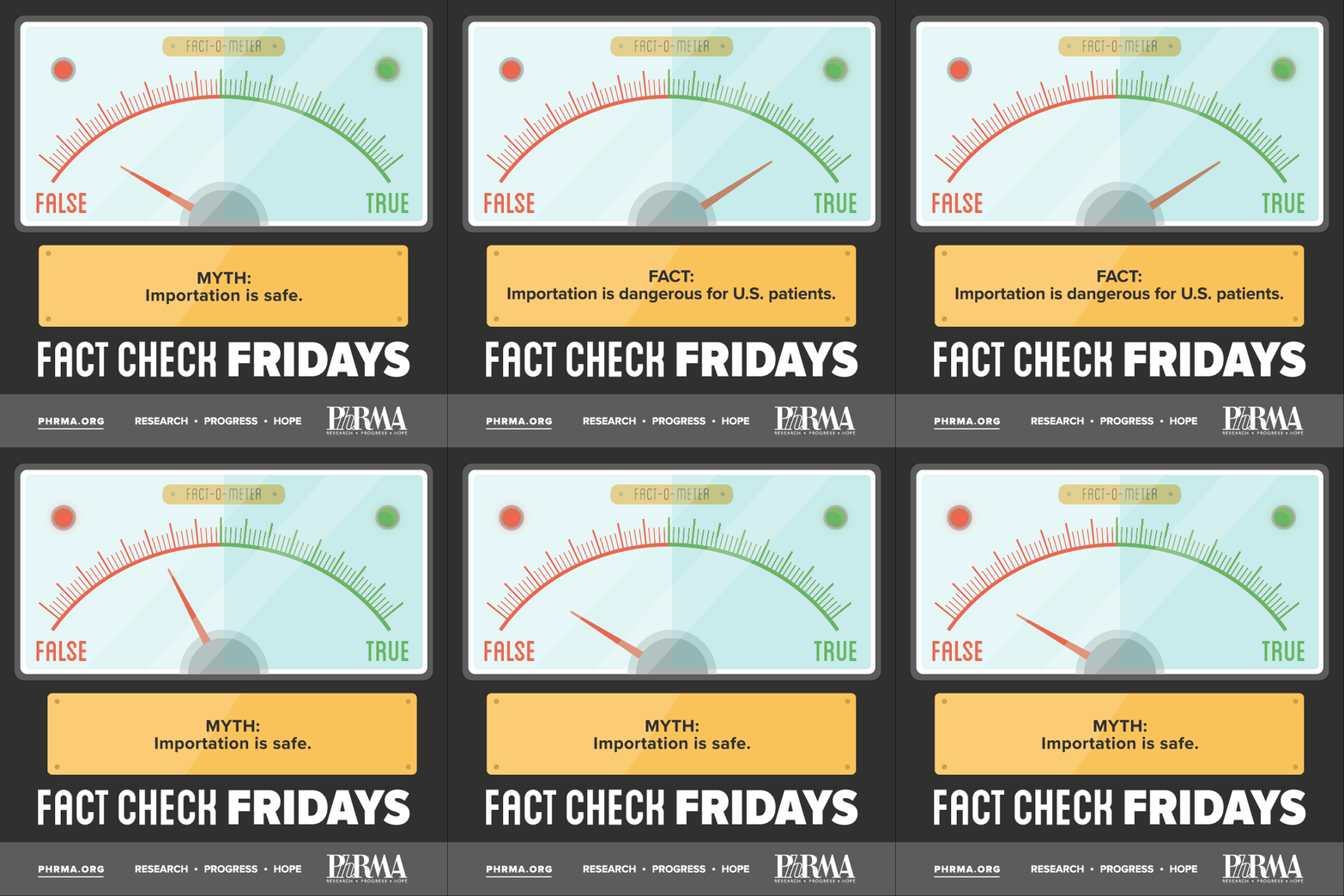
 This week on Fact Check Friday, we’re discussing the truth about proposals to allow the importation of medicines from other countries and what these proposals mean for patients.
MYTH: Importation is safe.
FACT: Importation is dangerous for U.S. patients.
Allowing the importation of drugs from other countries into the United States would be unsafe and lead to potentially dangerous outcomes for patients. Importation exposes Americans to the risk of counterfeit, diverted, adulterated, improperly stored or repackaged medicines. Importation also lacks proper oversight and enforcement and increases the potential to compromise the safety of the U.S. drug supply system.
- Counterfeit drugs are a serious threat to patient safety. When medicines enter the United States from other countries via importation schemes, there is no guarantee they contain the right amount of active ingredients – or that they include the declared ingredients at all. Additionally, American scientists have tested counterfeit drugs to see what they’re made of and have found toxic ingredients, such as arsenic, antifreeze and paint thinner. Sadly, patients around the world, including in the United States, have died due to online purchases from seemingly legitimate pharmacy websites of contaminated, fake and improperly stored medicines—often purchased without a prescription as required in the United States.
- The U.S. government cannot guarantee that drugs shipped into the United States from other countries will meet our strict safety standards. The Secretary of Health and Human Services has the ability to allow the importation of drugs from Canada, but only if the Secretary can certify the imports pose no additional risk to public health and safety, and generate cost-savings for American consumers. The Secretary has had this power since the early 2000s, and yet, not a single Secretary, either Democratic or Republican, has been able to make that certification. The U.S. Food and Drug Administration has raised similar concerns. Dr. Robert Califf, former FDA Commissioner, stated that the “FDA would not be able to make safety and quality determinations for prescription drugs offered for import into the United States that have not gone through the U.S. regulatory process.” Meanwhile, other countries have stated they cannot and will not ensure these medicines meet the United States’ rigorous safety and efficacy standards.
- Drug importation would disrupt the existing safety features of the U.S. drug supply system. By allowing medicines that do not meet U.S. standards to enter the country, importation opens the secure U.S. supply system to potentially counterfeit or adulterated products. To protect patients, the United States must keep its closed distribution system, ensuring FDA oversight and jurisdiction at all times. Importation would undermine this system and strip patients of the protection it provides. In 2013, Congress passed with bipartisan support the Drug Quality and Security Act focused on further securing our distribution system by requiring documentation and electronic tracking of the movement of prescription pharmaceuticals throughout the supply chain. An importation scheme would render these efforts null and void, increasing the risk of counterfeit, adulterated or substandard products entering our drug supply.
Get the facts about drug importation here.
To read more about the consequences of drug importation, visit PhRMA.org/Importation.
Allyson Funk
Ally is a former senior director of public affairs at PhRMA.
Allyson Funk
More oversight needed of unapproved medicines that threaten patients’ health
What they are saying: Florida Drug Importation Program is Unfeasible and Dangerous
Florida’s importation plan puts patients in danger
Three things to know about the accelerated approval pathway
ICYMI: Antimicrobial resistance spotlighted as growing public health threat
Why drug importation is bad for Americans
PhRMA submits comments on FDA’s proposed rule on drug importation
Drug importation: An old idea that is still a bad idea
What they’re saying: Safety is top concern for recent drug importation proposal
ICYMI: Canadian government, stakeholders voice concerns with drug importation proposals
PhRMA responds to Florida’s request for information on drug importation
PhRMA CEO raises concerns with Florida importation proposal, highlights reforms needed to lower costs for patients
Look at the facts. Drug importation is dangerous.
Why state drug importation pilot programs don’t work
ICYMI: Wall Street Journal highlights dangers of counterfeit medicines entering the United States through drug importation
Securely dispose of your unwanted medicines on National Take Back Day
The Washington Post retracts PhRMA claim in opioid story
PhRMA response to Washington Post and 60 Minutes stories
VIDEO: PhRMA CEO discusses industry response to opioid crisis on Mornings with Maria
Protect your health: Important disaster preparedness tips for Harvey and Irma
PhRMA Supports President’s Commission’s Holistic Approach on Opioid Crisis
Opportunities to build upon enhanced competition for medicines in the marketplace
A critical opportunity to prevent prescription drug abuse
Former law enforcement officials raise concerns with drug importation proposals
The risks of counterfeit imported medicines
Resources for understanding the dangers of drug importation
ICYMI: What the experts are saying about importation
How drug importation schemes could increase U.S. law enforcement burdens
Case Study: How one online pharmacy knowingly endangered U.S. consumers
Why drug importation threatens patient safety
What you don’t know about importation from Canada
Discovery of counterfeit hepatitis C drug is another example of why importation is bad for patients
Fact Check Friday: The truth about drug importation and patient safety
Counterfeit Drugs
Prescription Drug Safety
Importation
Fact Check Friday: The truth about drug importation and patient safety
Fact Check Friday: The truth about drug importation and patient safety