April marks Medicaid Awareness Month –– a time to recognize the profound impact of the Medicaid program on the more than 80 million low-income Americans whom it serves, as well as the vital role the biopharmaceutical industry plays in ensuring these patients can access affordable medicines and treatments. Established in 1965 as part of President Lyndon B. Johnson’s “Great Society,” for six decades the program has served as a vital lifeline for our nation’s most vulnerable patient populations. Fast forward to today, Medicaid provides health insurance to one out of every five Americans.
Here are just a few things Medicaid provides coverage for:
- Four out of every 10 births in the United States.
- Health insurance for 80% of children living below the federal poverty level.
- Five out of eight nursing home residents.
- Nearly one out of every three non-elderly adults living with a mental health condition.
The biopharmaceutical industry works in support of patients to provide robust access to affordable prescription drugs through a collaboration with the federal government and state Medicaid programs. This collaboration enables the Medicaid program to provide robust access to affordable prescription drugs in which patients have little to no copay.
Approximately 780 drug manufacturers participate in Medicaid, providing significant drug rebates to state Medicaid programs. In exchange, states agree to cover all of a manufacturer’s medicines in their Medicaid program. The idea behind this arrangement is to make sure patients get the medicines they need and Medicaid generally gets the best (lowest) price among a manufacturer’s customers.
The impact of this collaboration is considerable with Medicaid covering treatments for a wide range of chronic conditions, including heart disease, hypertension, diabetes, cancer, asthma and depression. These conditions represent significant areas of unmet medical need, and Medicaid's and industry’s collaboration is vital in addressing the challenges these diseases present.
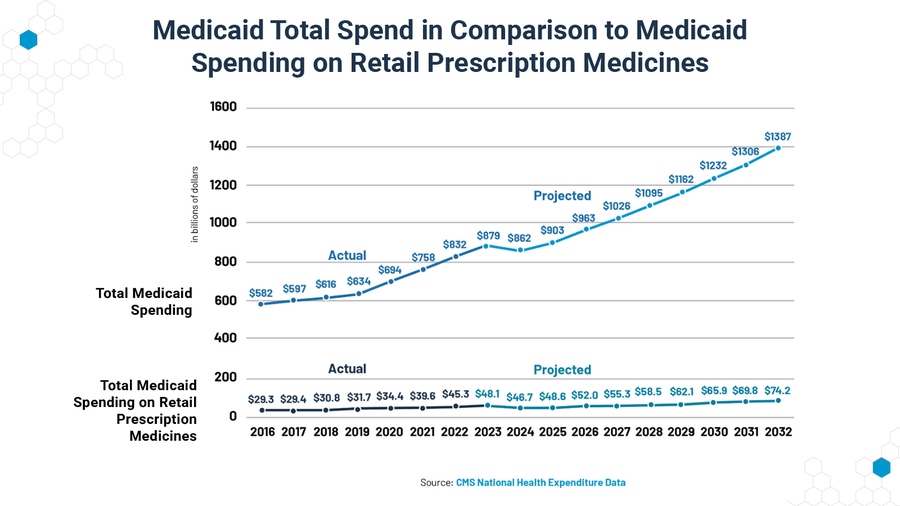
Today, all state Medicaid programs offer prescription drug coverage, while spending on prescription drugs remains a small share of total Medicaid spending. In 2023, retail prescription drugs made up just 5.9% of all Medicaid spending. This is largely due to the $54 billion in rebates manufacturers provided — a 54% increase from 2017. This program is a win-win. It helps states manage their health care costs, while providing patients on Medicaid access to affordable prescription drugs.
As we close out Medicaid Awareness Month, the biopharmaceutical industry renews its commitment to ensuring that our most vulnerable patient populations have access to affordable, innovative medicines through Medicaid.
Learn more about Medicaid in your state at phrma.org/Medicaid.
Matthew Norawong
Matthew is a senior manager on PhRMA’s Public Affairs team focusing on Medicare, Medicaid, importation and more. Prior to coming to PhRMA, he previously worked as a health policy analyst for National Journal’s Network Science Initiative, primarily supporting companies in the life sciences industry. Matthew completed his undergraduate studies in political science at the University of Washington and subsequently earned a Master of Public Health from the George Washington University. A native of the Pacific Northwest, Matthew currently resides in Washington, DC. Outside of the office, Matthew is an avid runner and enjoys playing bass guitar with his indie rock band.
Matthew Norawong