
Value assessments are an important tool in moving toward better, more affordable health care. When it comes to assessing the value of medicines, we need approaches that reflect what matters to patients, support doctor-patient decision making and are based on rigorous science. Some of the key elements that reflect patient preferences include:
- Family spillover: The positive impact of a treatment on a patient’s family and caregivers
- Hope: A chance for a cure or a major improvement
- Indirect patient costs: Non-medical costs due to illness (e.g. additional childcare)
- Unmet need: Treating a disease with few other options
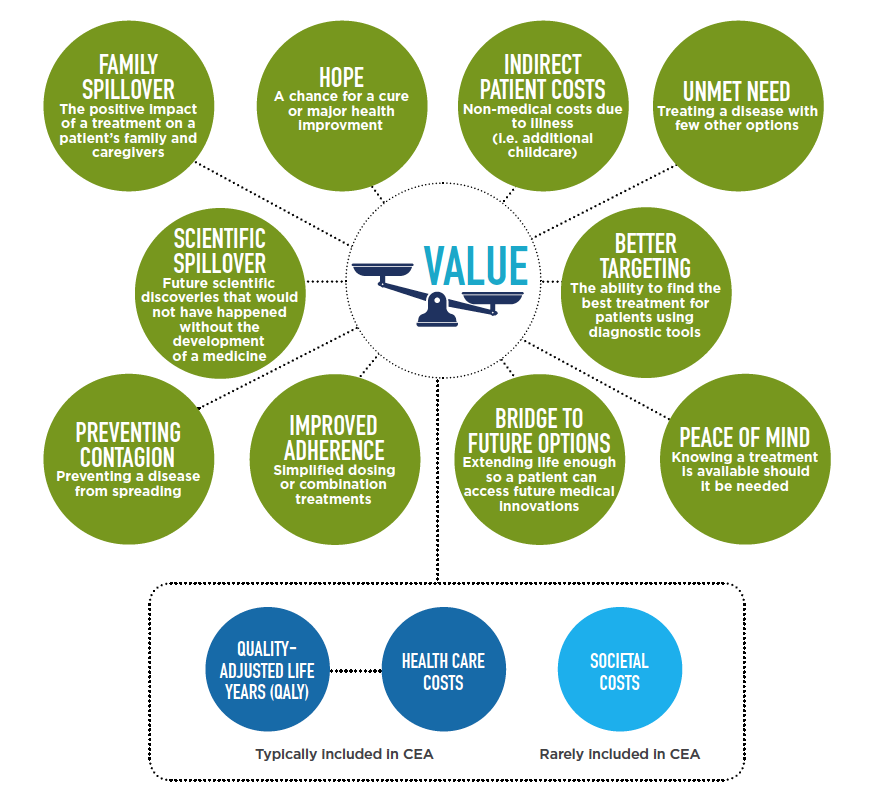
Unfortunately, conventional value assessments, also known as health technology assessments (HTAs), typically only account for health care costs, and controversial metrics like the quality-adjusted-life-year (QALY). These assessments, which includes assessments conducted by the Institute for Clinical and Economic Review (ICER) as well as many foreign countries that impose price controls on medicines, take a limited perspective on value, failing to account for outcomes and costs that matter to patients as well as important differences among them.
Just last month, ICER launched an initiative to determine how they can apply traditional methods of value assessment to potentially curative therapies. These life-saving and life-changing medicines often address significant unmet medical needs, and lead to significant future cost savings. ICER is proposing to work with HTA agencies from two foreign countries that set artificially low medicine prices and severely restrict patient access to innovative medicines, compared to American patients.
We have serious concerns with this initiative. The scope of ICER’s initiative and what therapies it will apply to is unclear. The end goal is to set a single value-based price for each medicine. Any single value-based price that favors QALYs over other elements of value that matter to patients will inevitably harm patient access and chill innovation. Conventional, QALY-based methods are also ill-suited for the assessment of orphan and rare diseases, which many curative therapies aim to treat.
We also strongly recommend that ICER find a way to meaningfully account for the full range of outcomes and costs that matter to patients when they assess not only curative therapies, but all therapies. Methods for value assessment need to keep up with the rapid evolution of 21st century medicine. And in the 21st century, the outcomes that matter to patients should matter to everyone.
Learn more at PhRMA.org/value-collaborative.Katie Koziara
Katie Koziara is Senior Director of public affairs at PhRMA focusing on the organization’s executive visibility work and media relations strategy. She previously ran the social media strategy for a D.C.-based non-profit working on federal management and leadership issues. Katie earned her B.A. in Public Policy from the University of Michigan’s Ford School and is currently earning her M.A. in Fiction Writing from Johns Hopkins University.
Katie Koziara
You won’t fix what you don’t value: Two reasons why traditional cost-effective analyses can perpetuate health inequities
PhRMA presents research at ISPOR 2022
Study finds nearly half of payers believe innovative contracts can lead to lower patient out-of-pocket costs
Growth in innovative, value-based contracts holds promise for the health system and for patients
Innovative contracts drive access for patients and value for the system
ICYMI: Patients saved nearly $800,000 out of pocket through innovative contracting arrangements
Low-value health care costs $345B each year and provides little benefit
Addressing barriers that inhibit value-based contracts
Guest post: Value-based agreements can improve outcomes and even save patients money at the pharmacy counter
New data show how ICER’s value framework could prevent or delay access to treatments for Medicaid patients across the country
5 Ways to improve ICER’s value assessment framework
Assessing value top of mind at ISPOR 2019
New analysis shows 820,000 prescriptions would be in jeopardy if ICER’s value framework is used in Medicaid
Event tomorrow: Leaders convene to discuss solutions to advance value-driven health care
New whitepaper identifies reasons why ICER’s cost-effectiveness analyses are not useful for payers
Guest post: Developing new payment models to ensure patients have access to high-investment therapies
Number of value-based contracts continues to rise
ICER’s budget impact threshold: Sounding a false alarm on affordability and access
PhRMA submission to HHS on blueprint to lower drug prices and reduce out-of-pocket costs
How ICER’s assessment of a new class of migraine treatments fails patients
Aspen Spotlight Health: Discussing the forefront of innovation
New analysis shows negative impact of ICER’s value framework on patient access in Medicare Part B
ICYMI: Recent survey adds to growing body of research on barriers to innovative payment approaches
Reality check: Value-based contracts are good for patients
Video: Barriers to results-based contracts
Improving care quality by engaging patients in shared decision making
ICYMI: Research shows promise of innovative payment arrangements in reducing costs, improving access
Clarity around anti-kickback statute needed to promote innovative payment arrangements
Video: What is a results-based contract?
Johnson & Johnson, Pfizer, Walgreens and other CEOs discuss value in the future of health care
PhRMA CEO in Forbes - How to negotiate better deals for prescription medicines
ICYMI: Innovative payment models helping provide patient access to new medicines
RA medicines often demonstrate far greater benefits to patients than initially understood
Stakeholders Agree: Modernize the legal framework to support move to value-driven health care
How do multiple sclerosis patients define value?
PhRMA CEO talks White House meeting, innovation & jobs with POLITICO’s Pulse Check
VIDEO: PhRMA CEO discusses #GOBOLDLY campaign and White House meeting with CNNMoney’s Maggie Lake
The Value Collaborative: Advancing private market solutions to achieve better health, lower costs
Value assessments should include all the outcomes that matter to patients and families
The Value Collaborative
Value assessments should include all the outcomes that matter to patients and families
Value assessments should include all the outcomes that matter to patients and families