The United States biopharmaceutical industry continues to innovate and discover critical solutions for our toughest health challenges such as the COVID-19 pandemic. America’s global leadership has not been by chance, but rather the result of a well-planned effort to facilitate innovation by incentivizing and protecting inventors and supporting collaboration between and among the public and private sectors.
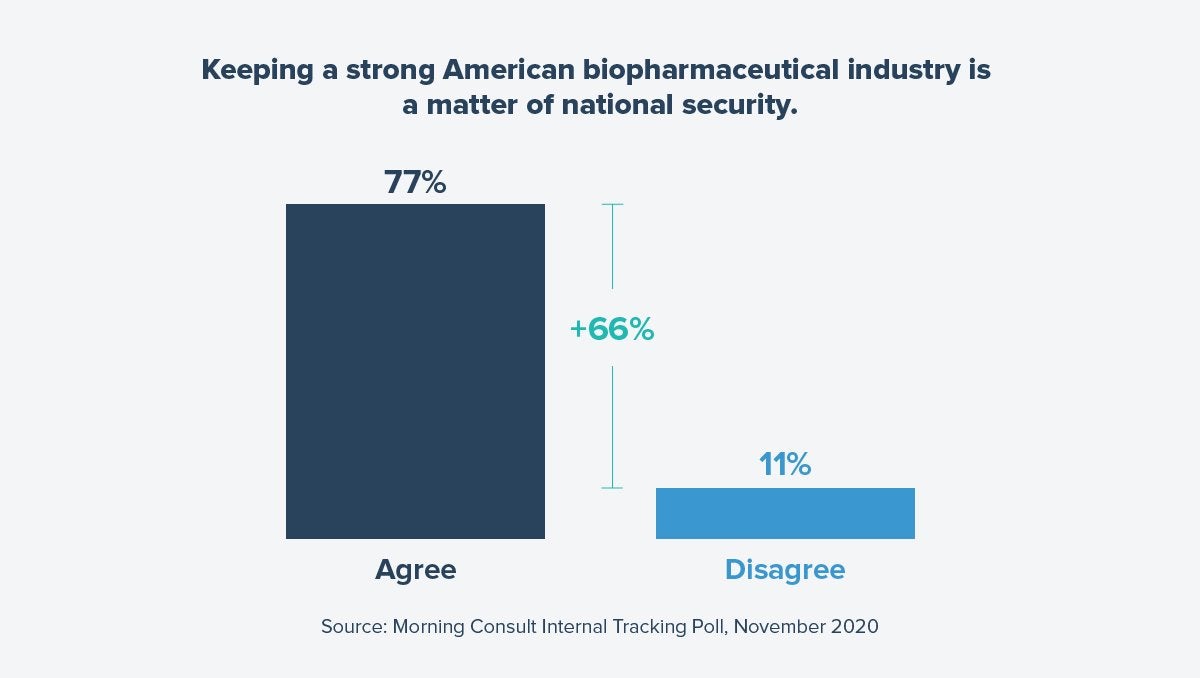
Americans appreciate industry’s role in advancing innovation. In fact, 62 percent of Americans viewed the industry positively in February – a number 30 points higher than in January 2020. Further, 77% agree that keeping a strong American biopharmaceutical industry is a matter of national security to protect us against the next pandemic.
But how did we get here? Consider current public sentiment in the U.S. and how it ties back to policies and investments put in place – in some cases – more than 40 years ago.
87% of Americans agree the coronavirus pandemic has shown how important it is for drug companies to make significant investments in research and development, according to a Public Opinion Strategies internal poll late last year.
- This biopharmaceutical industry leadership is, in part, tied to the Bayh-Dole Act of 1980, as well as other legal and regulatory frameworks. Bayh-Dole specifically allows federally funded researchers to patent inventions and license those patents to companies who then invest in further research and development – leveraging capabilities in an effort to commercialize a product for patients. Such protections and policy frameworks have led to an innovation ecosystem that generations more new medicines than any other country in the world – for example 53 novel drug approvals in 2020 including the first approved treatment for COVID-19.
- Importantly, this innovation “engine” has an exponential ability to help spur future breakthroughs. Consider the COVID-19 vaccines using mRNA and viral vector technology; they mark a new beginning for vaccines and combatting viruses and other illnesses, such as cancers, and open an entirely new world of insights and discoveries.
The Harris Poll noted fear about the vaccine rollout being too slow dropped from 47% in January to 36% in March. Among the likely contributing factors is the biopharmaceutical’s ability to leverage advanced manufacturing capabilities that have accelerated production and distribution.
- A strong innovation ecosystem enables collaboration on everything from discovery of new medicines to distribution of those medicines across the country and world. Thus, the country is well poised to continue to innovate and drive needed solutions, such as more efficient vaccine delivery. In addition, investments in advanced biopharmaceutical manufacturing and infrastructure facilitate innovation delivery from the lab to the patient. Long recognizing that biopharmaceutical manufacturing provides the critical link between the discovery of a medicine and its availability to patients, the U.S. biopharmaceutical industry has heavily invested in manufacturing capabilities to pave the way for this innovation; the industry’s capital investments in facilities increased by 17% from 2010 to 2016. The resulting capabilities differentiates the country among most other markets worldwide, providing not only resources to meet patient needs but skilled jobs and a strong economic driver.
The U.S. system of developing medicine is unique – it relies on a mix of private sector, public sector and research institutions working together. While not perfect, a dedicated set of actions to invest in innovation has helped the U.S. biopharmaceutical industry become a true strategic asset domestically – one that drives innovation with the ability to effectively address major crises, as with COVID-19. Data shows that Americans want a strong biopharmaceutical industry – supporting policies to facilitate a strong innovation ecosystem will further U.S. leadership and lead to a positive impact on patients worldwide.
Mark Keida
Mark Keida, Ph.D. is Vice President in Public Affairs. He leads PhRMA’s message and polling team, supporting advocacy communications, paid media campaigns and earned media. Mark specializes in using data to guide narrative, campaign strategy and tactics.
Mark Keida
Survey confirms too many insured Americans face barriers to reliable health care
Americans believe U.S. pharma leadership needs to be protected
50-state poll says Americans are concerned that hospital markups hurt patients
Health care practitioners sound the alarm on middlemen-imposed barriers to patient care, need for policy change
New PES survey: Out-of-pocket costs lead key health care priorities ahead of the November election
Americans speak out on health insurance barriers and need for policy change, according to the latest Patient Experience Survey
Where voters stand ahead of the election
Key voter insights two months from Election Day
Voters across all 50 states want state policymakers to focus on health insurance and PBM practices
New 50-state poll Americans want to hold health insurers and PBMs accountable for high out-of-pocket costs and other practices
ICYMI: What patients care about this election year
Key election year voter insights
ICYMI: Voter priorities this election season
Voter insights: Four things to know
New poll: Americans agree that expanding the TRIPS waiver will harm U.S. global manufacturing and innovation leadership
One year to Election Day: Four voter priorities to watch
New poll shows strong bipartisan support for PBM reform
Navigating the Patient Experience Survey: Protecting Lifelines to Access and Innovation
Three things to know from the latest Patient Experience Survey
4 Things to know about PhRMA’s new 50-state poll
Americans want state policymakers to lower out-of-pocket costs
Key Trends: Patient experience data reveal how insurers and middlemen impose barriers in health care
In their own words: Insured Americans support policy reforms that address access and affordability concerns
In their own words: Financial barriers exacerbate access challenges for insured Americans
In their own words: Insured Americans struggle to navigate complex coverage
Mental Illness Awareness Week – A time for reflection
Navigating the patient experience: Burdens and barriers standing between patients and their care
New survey: Voters seriously concerned about fine print in reconciliation bill
Survey Says: Prescription drug prices are not fueling inflation concerns for Americans
Polling continues to show voters reject so-called Medicare “negotiation” once they learn about consequences for patients
3 things voters are concerned about when it comes to their health care coverage
Patients support state action requiring PBMs and insurers to share savings and cap costs for medicines
New poll shows voters sounding the alarm on health insurance companies and PBMs
Study finds insurance barriers disproportionately burden patients with chronic illness
5 public opinion polling trends to watch
The patient experience: Uncovering the barriers to care for insured Americans
The patient experience: Insurance barriers continue to impede access to health care, especially among the country’s underserved
New poll of all 50 states and 435 Congressional Districts shows perils of so-called Medicare “negotiation”
Navigating the patient experience in the time of COVID-19
Insurance design barriers can impact patient adherence and can lead to poor health outcomes
ICYMI: PhRMA CEO speaks at STAT Summit about government price setting
Three things to know about so-called Medicare negotiation polling
The patient experience: Insurance design hurdles lead to access issues for too many Americans
The patient experience: Out-of-pocket costs are driving patients affordability and access challenges
New poll shows Americans reject Medicare negotiation once they learn more about the policy
What is Kaiser Family Foundation up to?
New report shows 3 in 10 Americans that have insurance still face a financial barrier to care
Recent polling misrepresents public support for Medicare “negotiation”
Myth vs. fact: Polling and Medicare “negotiation”
Data shows voters strongly support protecting access to their medicines
Data shows COVID-19 vaccines are creating a pathway to a strong U.S. recovery
New polling shows Americans are sounding the alarm on the TRIPS IP waiver
Four solutions Americans support to make health care more affordable
Data shows that Americans are relying on vaccines to get us through the pandemic
Top five issues voters want addressed in the administration’s first 100 days
Growing trend: Increased vaccine confidence
The latest misleading “poll” on drug pricing
Election insights: Common ground areas to address Americans’ health care concerns
Election insights: Voter priorities in the states
Insights from the election: Meeting voters where they are on health care
Deep dive: The issues that drove the 2020 vote
Voters want to address the real drivers of health care costs for patients and the system
Three things you should know about recent health care polling
Data shows that keeping a strong biopharmaceutical industry is important to Americans
Polling
Data shows that keeping a strong biopharmaceutical industry is important to Americans
Data shows that keeping a strong biopharmaceutical industry is important to Americans