Long patent examination delays cripple innovation, hinder economies, impede job creation and frustrate the launch of new products. Increased patent review times cost the global economy $10 billion annually, and are particularly harmful for small start-up firms. Every year of delay reduces the start-up’s employment growth by 21% and sales growth by 28% over the five years following the approval of the patent application. No country should accept the delayed launch of innovative technology or life-saving treatments because its patent office is plagued by long examination timelines and backlogs.
As the Office of the U.S. Trade Representative has highlighted in its Special 301 reports patent backlogs are a concern for the U.S. government with key trading partners, including Argentina, Brazil and Thailand. Indeed, the U.S. government flagged concerns with Brazil’s patent backlog as early as 1999.
Brazil, the largest economy in Latin America, has prioritized reducing the patent backlog, including through implementing the National Institute of Industrial Property’s “Plan to Tackle Patent Backlog,” hiring new examiners and leveraging work sharing programs. Moreover, the decision to eliminate the Brazilian Health Regulatory Agency’s role with respect to the examination of pharmaceutical patent applications should help reduce the patent backlog.
However, an updated analysis from Osha Bergman Watanabe & Burton LLP of the patent examination timelines for biopharmaceutical patents indicates that Brazil continues to suffer from long biopharmaceutical patent backlogs. As the data shows, the average patent examination timeline for biopharmaceutical patents granted from January 2020 through November 2025 is 9.15 years. Making matters worse, the Brazilian Supreme Court’s 2021 decision eliminating the sole paragraph of Article 40 of the Patent Law, which ensured a minimum patent term of 10 years from the date of patent grant in Brazil, leaves patent applicants across all technology sectors without a recognized mechanism to be compensated for unreasonable patent office examination delays.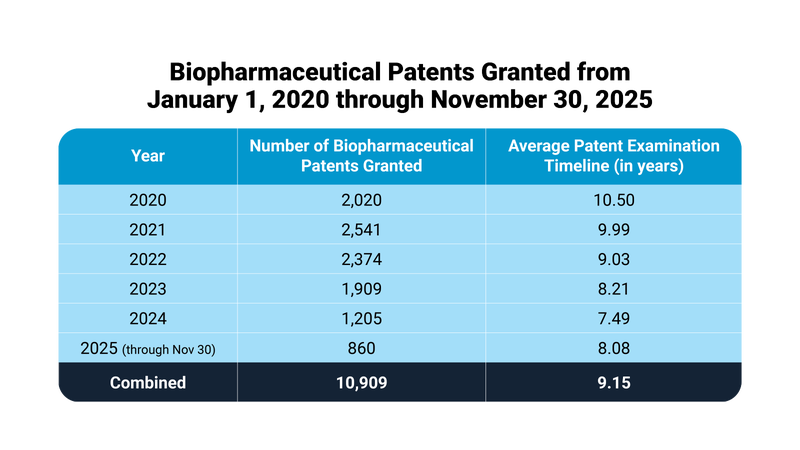
A number of countries, recognizing the deleterious impact of patent office delays on the value of patents and their ability to facilitate access to medicines, have implemented mechanisms to compensate for unreasonable delays during the examination of patent applications (specifically, Patent Term Adjustment [PTA]). Indeed, the United States has ensured that PTA provisions are in its recent trade agreements, including the United States-Mexico-Canada Agreement.
The need for durable and comprehensive reform in Brazil is even more acute given that, based on a PhRMA analysis, Brazilian patients have access to significantly fewer new medicines when compared to OECD countries, and experience much longer than average wait times for medicines that are launched in the market.
Simply put, the time is now for Brazil to establish a PTA mechanism, consistent with international best practices, to ensure that innovators are not harmed by undue delays in the patent examination process and to facilitate access to innovative medicines.
Anjam Aziz
Anjam Aziz serves as senior director at PhRMA, where he specializes in international intellectual property advocacy. He holds a B.S. in Biology from George Mason University and a J.D. from The Catholic University of America, Columbus School of Law.
Anjam Aziz
Bayh-Dole: The fuel for America’s innovation engine
Setting the record straight: 3 facts about drug patents
New PBM principles don't change the fundamental challenge: Access to lower-cost medicines
MFN could disrupt the affordable medicines patients depend on
2 Scientists looking at vile in lab
Intellectual Property
Patents
Updated Analysis Underscores the Need for Brazil to Address Patent Backlogs
2 Scientists looking at vile in lab