Part D
What is Medicare Part D?
For nearly two decades, Medicare Part D has provided seniors and people with disabilities affordable and comprehensive coverage for prescription medicines. Patients can pick up these medicines at retail pharmacies or order them through mail order or specialty pharmacies. Part D helps tens of millions of patients manage chronic and life-threatening conditions, including diabetes, mental illness, cancer and heart disease. In 2023, 51.5 million seniors and people with disabilities were enrolled in Part D.
Part D is a voluntary prescription drug benefit run by Medicare-approved private insurance plans. Since Part D was created, enrollees have experienced improved health outcomes, including an 8% decrease in hospital admissions, a 2.2% reduction in risk of mortality and an 18.3% decrease in non-emergency Emergency Department visits for seniors. Because of these benefits, more than 90% of enrollees reported they are satisfied with their Part D coverage and the program.
To ensure seniors and people with disabilities continue to have access to treatments for serious and debilitating diseases, all Part D plans are required to cover “all or substantially all” medicines in six therapeutic classes and categories. These six protected classes include anticonvulsants, antidepressants, antineoplastics, antipsychotics, antiretrovirals and immunosuppressants.
Medicare Part D
Related Resources
Out-of-pocket trends in Medicare Part D show rising costs for seniors
A new study based on IQVIA data shows alarming trends in rising out-of-pocket costs for brand medicines among Medicare Part D beneficiaries with serious and complex conditions like cancer, HIV and multiple sclerosis. The analysis, which looked at spending trends among non-low-income subsidy (non-LIS) Part D beneficiaries from 2015 to 2019 across all brand medicines and several therapeutic areas, reaffirms the need for targeted solutions to strengthen the program. Here are three findings you should know.
1. Coinsurance based on list price accounts for 80% of Medicare Part D beneficiaries’ out-of-pocket spending on brand medicines. Health plans and middlemen known as pharmacy benefit managers (PBMs) negotiate significant discounts and rebates with manufacturers that lower the cost of medicines. Coinsurance and deductibles, however, are typically based on a brand medicine’s full, undiscounted list price. The study found 92% of Part D beneficiaries’ out-of-pocket spending is based on the list price rather than the discounted price their insurer gets. That’s not how insurance is supposed to work.

2. Average out-of-pocket spending is higher, and has grown faster, for seniors with coinsurance and deductibles. Part D beneficiaries with coinsurance and deductibles taking brand medicines for certain chronic conditions are subject to significantly higher out-of-pocket costs, on average, than those with fixed copays, and these costs are growing each year. By 2019, beneficiaries taking brand oncology medicines with coinsurance and deductibles paid 8.9 times more out of pocket, on average, than beneficiaries with only copays.

3. As plans increasingly use coinsurance, beneficiaries’ must pay a larger share of their total annual cost at the start of each year. The Part D benefit structure subjects certain Part D beneficiaries to high up-front costs at the beginning of the year. This creates serious affordability challenges. If spending were equally spread throughout the year, patients would pay 8.3% of their total annual out-of-pocket costs in the month of January. Instead, in 2019, Part D beneficiaries taking brand autoimmune medicines were responsible for nearly twice as much (19%) of their total out-of-pocket costs in January (up from 12% in 2015). Similarly, beneficiaries taking brand multiple sclerosis medicine were responsible for 28% of their total out-of-pocket costs in January (up from 19% in 2015).

These trends are further proof that health plans continue to shift medicine costs to patients with severe chronic illnesses. In order to ensure high out-of-pocket costs don’t get in the way of needed care, we need commonsense solutions that provide direct relief to patients:
- Ensuring rebates and discounts are passed on to patients at the pharmacy counter
- Capping what seniors have to pay out-of-pocket each year for prescription medicines
- Lowering coinsurance earlier in the benefit
- Spreading out-of-pocket costs throughout the year
These are precisely the kind of patient-centered, holistic changes included in “Building a Better Health Care System,” our agenda for a stronger, more resilient, affordable and equitable health care system for all. America’s biopharmaceutical research industry is ready to do its part to help ensure all patients can afford the medicines they need. To learn more, visit phrma.org/cost.
Katie Koziara
Out-of-pocket trends in Medicare Part D show rising costs for seniors
The ABCs (and Ds) of Medicare
For nearly 60 years, Medicare has helped pay for medical care for Americans over the age of 65, as well as younger Americans with certain medical needs. Medicare has many different programs, all named with different letters of the alphabet, so it can often feel confusing. With Medicare increasingly in the news, clarity around how it works and what types of health care it covers is important. We’re here to break it down and share the basics about the different parts of Medicare:
- Part A covers hospital, hospice and home health care. It also allows patients to access skilled nursing facilities. Part A was part of the original Medicare program created in 1965.
- Part B covers a wide range of health care services and coverage for physician office visits, hospital outpatient care and medical equipment. It also covers medicines that are usually administered by a physician, like many injections and infusions. Many of the medicines covered by Part B are for serious and complex conditions, such as cancer, rheumatoid arthritis and mental illness, among others. Like Part A, Part B was created as part of the original Medicare program.
- Part C, also known as Medicare Advantage, is a managed care option in Medicare. Medicare Advantage plans are Medicare-approved private health insurance plans for individuals enrolled in Part A and Part B. Most plans cover prescription medicines and may also offer supplemental coverage in terms of additional benefits or lower cost sharing and out-of-pocket costs.
- Part D provides coverage for prescription medicines patients pick up at retail pharmacies or ordered through mail order or specialty pharmacies. Part D, which was enacted in 2003 and went into effect in 2006, is run by Medicare-approved private plans. In its first 15 years, Part D contributed to decreased mortality rates for seniors, reduced hospitalizations and improved adherence to medicines for seniors and others enrolled in the program.
While Medicare’s coverage of medicines has worked well for seniors and people with disabilities, we know there are ways it could work better. That’s why we put forth a number of solutions that could lower out-of-pocket costs for Medicare beneficiaries. In Part D, for example, policymakers could cap annual out-of-pocket costs, lower cost sharing and make out-of-pocket costs more predictable. They could also make sure savings from rebates and discounts pharmaceutical manufacturers negotiate with Part D health insurance plans are shared with seniors and patients with disabilities at the pharmacy counter. In Part B, policymakers could take steps to ensure Medicare and Medicare beneficiaries benefit more from the lower prices negotiated by large commercial purchasers in the private insurance market.
There are ways to achieve savings for the government and beneficiaries while protecting access to medicines and provider reimbursement. Read more about our commonsense, patient-centered reforms here.
Gabby Migliara
The ABCs (and Ds) of Medicare
Chart Pack: Medicines in Medicare Part D
Medicare is the government program that insures many of the nation’s retirees and Americans with disabilities. Coverage for prescription medicines filled at a pharmacy first became available in 2006 under the Medicare Part D program. Private health plans administer the program and compete for beneficiary enrollment. These plans also negotiate with manufacturers, without government interference, to secure to secure savings on medicines. This market-based approach has been successful since the program’s beginning, but some in Washington now are considering fundamental change.
Part D
Report
Recent Changes to Part D
The Inflation Reduction Act (IRA) made the most substantial changes to Part D since the program was created. The law took important steps to improve the Part D program, and lower out-of-pocket costs for beneficiaries in Part D. These include setting an annual cap on what seniors pay for their medicines and allowing seniors to spread out their out-of-pocket costs throughout the year to make the costs more predictable starting in 2025. The law also requires Part D plans to limit cost-sharing for covered insulins to $35 and to offer zero cost sharing for certain Part D vaccines.
However, the IRA also includes price setting provisions that undermine this important program and may reduce access to medicines for seniors and people with disabilities. For instance:
- Part D insurance plans are required to cover medicines that are selected for price setting, but the IRA does not prohibit plans from imposing utilization management to restrict access.
- Insurers can move Part D medicines to more expensive, non-preferred and specialty formulary tiers that have higher out-of-pocket costs.
- Part D plans may stop covering some medicines altogether because they are only required to cover a minimum of two medicines in most therapeutic classes.
Recent Changes
Related Resources
IRA changes to Part D risk access to medicines
Few federal health care programs have been more successful than Medicare Part D, which provides prescription drug coverage to seniors and Americans with disabilities enrolled in Medicare. While some provisions of the Inflation Reduction Act (IRA) are likely to strengthen Part D and address some of the affordability challenges patients face, the law’s price setting provisions threaten access to medicines.
What works in Part D:
- More than 50 million individuals have comprehensive drug coverage due to Part D. Since its inception, seniors enrolled in a Part D plan have experienced an 8% decrease in hospital admissions, a 2.2% reduction in risk of mortality and an 18.3% drop in non-emergency emergency department visits.
- Part D beneficiaries have historically had a variety of plans to choose from, ranging from 24 to 32 options in each state in recent years. Beneficiaries can use the Medicare Plan Finder to compare different plans and determine which fits best based on coverage of specific prescriptions and out-of-pocket costs.
What isn’t working in Part D:
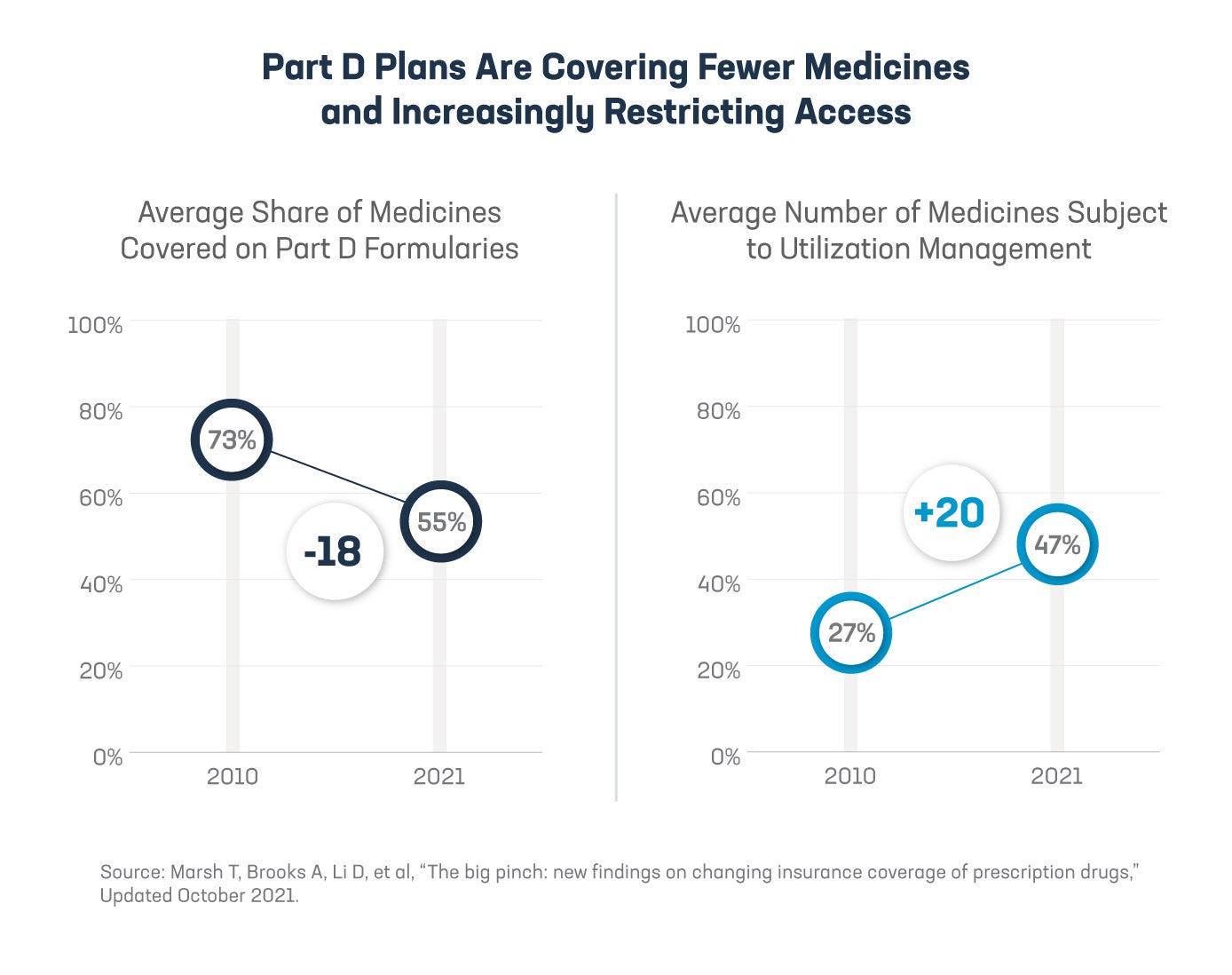
- Part D coverage has been eroding in recent years. Part D plans are covering fewer medicines and increasingly forcing patients to jump through more hoops to get access. In 2021, roughly half of all Part D medicines were subject to some form of utilization management, such as step therapy or prior authorization. Further, more than 9 in 10 oral oncology specialty medicines were subject to prior authorization in 2020.
- Seniors are paying more in out-of-pocket costs. The insurers and PBMs that administer Part D plans negotiate significant rebates and discounts. According to MedPAC, manufacturer rebates lowered total gross Part D expenditures by 23% in 2021. Despite this, 92% of seniors’ out-of-pocket spending on brand medicines is based on the undiscounted list price. And 9 out of 10 seniors taking a brand medicine are exposed to the full price through deductibles and coinsurance – even when their insurer and their PBM are paying far less.
How the IRA makes it worse:
- Yes, the IRA took important steps to lower out-of-pocket costs in Part D. These include setting a $2,000 annual cap on what seniors pay for their medicines and allowing seniors to spread their out-of-pocket costs throughout the year to make them more predictable starting in 2025 – two policies PhRMA has long supported.
- But the law failed to rein in the insurers and PBMs administering Part D plans who are leaving patients with higher costs and less access to medicines. Without addressing this abuse, insurers and PBMs will continue to prioritize profits over robust coverage options for seniors, including making seniors pay more for their medicines than they do.
- Making matters worse, seniors may not benefit from the IRA’s price setting provisions and could actually see their access to medicines restricted, as noted in a recent Health Affairs piece. Part D insurance plans are required to cover medicines that are selected for price setting, but they can still impose utilization management to restrict access. Insurers can also move medicines – including those that are price set by the government – to more expensive, non-preferred and specialty formulary tiers that have higher out-of-pocket costs. And Part D plans may stop covering some medicines altogether since they are only required to cover a minimum of two medicines in most therapeutic classes, which could be the price-set medicine and one other.
As CMS begins to implement the IRA’s price setting provisions and the other changes made to Part D in the law, seniors are likely to face more barriers to their medicines – both those impacted by government price setting and treatment alternatives. It’s important for policymakers to closely monitor and work to mitigate this and other unintended consequences. At the same time, Congress needs to fix the problems left unaddressed in the law, including insurer and PBM practices that are driving up seniors’ costs.
Learn more at PhRMA.org/IRA.
Nicole Longo
IRA changes to Part D risk access to medicines
PhRMA Comments on Medicare Prescription Payment Plan Draft Part Two Guidance
In a recent comment letter, PhRMA encouraged CMS to develop key education and outreach tools for beneficiaries on the Medicare Prescription Payment Plan program, to keep beneficiary protections at the forefront of operational calculations and effectuation decision-making, and not to delay decisions related to infrastructure and effectuation details. Our comments were intended to ensure the program meets its goal of improving affordability for Medicare beneficiaries.
PhRMA Comments on Medicare Prescription Payment Plan Draft Part Two Guidance image
Medicare
Comment
Areas for Improving Part D
While the IRA made important updates to the Part D benefit, the law failed to rein in the insurers and PBMs administering Part D plans who are leaving patients with higher costs and less access to medicines.
Insurers and PBMs that administer Part D plans negotiate significant rebates and discounts, which lowered total gross Part D expenditures by 23% in 2021, according to MedPAC. Despite this, 92% of seniors’ out-of-pocket spending on brand medicines is based on the undiscounted list price. And 9 out of 10 seniors taking a brand medicine are exposed to the full price through deductibles and coinsurance – even when their insurer and their PBM are paying far less. As a result, many seniors end up paying more for their medicines than their insurance plan.
If insurers don’t pay full price for medicines, seniors shouldn’t either. Sharing the savings with seniors at the pharmacy would deliver immediate relief to millions of Medicare beneficiaries. Congress should require Part D insurers to share the same price they pay for medicines with seniors and base seniors’ cost-sharing requirement on the net price insurers pay.
Areas for Improving
Related Resources
Many seniors are paying more for Part D medicines than their insurer
For seniors who rely on Medicare Part D, the out-of-pocket costs for medicines can sometimes be a barrier. Insurers and pharmacy benefit managers (PBMs) continue to shift more and more costs to patients. And a new analysis from the Medicare Payment Advisory Commission (MedPAC) shows why this is a problem that must be addressed.
MedPAC’s analysis shows that rebates and other payments from manufacturers and pharmacies lowered Part D spending by 33% in 2020. And while insurers and PBMs who sponsor Part D plans are saving money, Part D beneficiaries are paying more. That’s because seniors’ cost sharing isn’t based on the discounted net price Part D plans pay. Looking at the six largest plan sponsors in Part D, which include companies like UnitedHealth, Humana and CVS Health, MedPAC found:
- For five of the six plan sponsors, seniors’ median out-of-pocket costs for a representative asthma/COPD medicine exceeded 50% of the plans’ net cost. For example, if the plan paid $100 for a medicine (after factoring in rebates and discounts), seniors paid more than $50 out of pocket for that same medicine.
- For two of the plan sponsors, seniors’ median out-of-pocket costs for a representative asthma/COPD medicine exceeded 100% of the plans’ net cost. For example, assuming again that these plan sponsors paid $100 for a medicine (after factoring in rebates and discounts), the median out-of-pocket costs for seniors ranged from $121 to $132. And that’s just the median cost sharing. Many seniors paid more.

The Part D benefit is structured so that under the standard benefit design, beneficiaries who don’t participate in the low-income subsidy program are expected to pay an average of 25% of their medicine costs between the deductible and catastrophic phase. But this requirement is currently assessed before taking into account steadily increasing rebates and payments Part D plans receive from manufacturers. MedPAC’s analysis shows the effective rate of patient cost sharing is significantly higher than Congress intended, making the Part D benefit less valuable for many patients.
We can’t overlook that the Inflation Reduction Act did include changes that will make a difference for some seniors at the pharmacy, like capping the annual amount seniors pay out of pocket and making out-of-pocket costs more predictable month to month — policies the biopharmaceutical industry has long advocated. But the law didn’t do nearly enough to stop insurer and PBM abuses and instead prioritized government price setting that will do more harm than good.
The MedPAC analysis demonstrates why policymakers need to stop insurer and PBM abuses. To make changes that meaningfully lower patient out-of-pocket costs, policymakers should ensure that seniors’ cost sharing is based off the net price Part D plans pay, not the list price.
Nicole Longo
Many seniors are paying more for Part D medicines than their insurer
Seniors Face Growing Barriers to Medicines in Medicare Part D
Medicare Part D is intended to provide beneficiaries coverage and ensure access to the treatments their doctors prescribe. But, year after year, America’s seniors are increasingly encountering insurance barriers. Even though the Inflation Reduction Act guarantees selected medicines are included on Part D formularies, this does not ensure timely patient access.
Part D,Medicare
Resource
Share the Savings: If Insurers Don’t Pay Full Price for Medicines, Seniors Shouldn’t Either
Many Medicare beneficiaries struggle to afford the medicines they need, even as insurers and pharmacy benefit managers (PBMs) in the Part D program receive significant rebates from drug manufacturers that lower the prices they pay for medicines.
"Share the Savings: If Insurers Don’t Pay Full Price for Medicines, Seniors Shouldn’t Either" image
Insurance Coverage
Fact Sheet
Three charts show how the Medicare Part D program could be improved to work better for seniors and people with disabilities
In yesterday’s post, we learned how Medicare Part D works for seniors and people with disabilities. Unfortunately, Part D beneficiaries are increasingly facing higher out-of-pocket costs for the medicines they need. This includes high coinsurance amounts typically based on list price, a lack of an out-of-pocket cap and an uneven distribution of out-of-pocket costs over the course of the year.
Here are three facts about the Medicare Part D program you may not know:
1. Part D plans are covering fewer medicines and increasingly restricting access. Over the years, Part D plans have restricted access to medicines through tighter formularies, limiting the number of medicines covered for beneficiaries. Additionally, insurers and pharmacy benefit managers (PBMs) use what’s known as utilization management as a strategy to reduce their spending on covered medicines, which has a negative impact on patient access. These insurance tactics often prevent or delay patients from accessing the medicines that their physician prescribes and that they need. They include prior authorization, meaning a patient has to get approval from their health plan before they can access the medicine their doctor prescribed, and fail first (also known as step therapy), meaning a patient has to try and fail on a health plan’s preferred medicine before they can get the medicine their doctor prescribed.
2. Unfortunately, people enrolled in Part D typically do not benefit directly from the rebates and discounts health plans and PBMs negotiate with manufacturers. Most health plans do not share rebates with patients at the pharmacy counter. Instead, some patients pay cost sharing based on the medicine’s full list price, sometimes exceeding the net price paid by the Part D plan for the medicine. For instance, in 2017, non-low-income subsidy Part D patients using insulin paid 149% of the net plan costs in the deductible phase. Assuming rebates continue to grow, patients are expected to pay more than double net plan costs by 2026.

3. Part D plans have shifted costs to seniors through increased use of coinsurance. A new study, which looked at spending trends among non-low-income subsidy Part D beneficiaries from 2015 to 2019 across all brand medicines and several therapeutic areas, found coinsurance based on list price accounts for 80% of Medicare Part D beneficiaries’ out-of-pocket spending on brand medicines. And as plans increasingly use coinsurance, beneficiaries’ must pay a larger share of their total annual out-of-pocket costs at the start of each year, which creates serious affordability challenges. High cost sharing also exacerbates patient’s abandonment of their prescriptions. A new found 61% of patients did not fill their new prescriptions when they had to pay more than $250 out of pocket, while only about 7% of patients abandoned their prescriptions when out-of-pocket costs were less than $10.

PhRMA supports ways to modernize how Medicare covers and pays for medicines. Medicare Part D could work better and be made fairer by improving affordability and predictability for beneficiaries who face high out-of-pocket costs for their medicines. Improvements to Part D must be done the right way, with targeted and measured reforms. This can include capping Medicare beneficiary out-of-pocket costs in Part D, lowering cost sharing and spreading those costs over the calendar year, and making sure the savings negotiated with health plans are passed directly to patients.
Learn more about the Medicare Part D program.
Gabby Migliara
Part D 101: Three charts show how the Medicare Part D program could be improved to work better for seniors and people with disabilities